


Introduction to Zero Trust Principles
In the past, organizations believed that anything inside their internal network was safe. However, that idea is no longer valid. Today, applications spread across data centers, private clouds, public clouds and edge locations. There is no clear “inside” or “outside” anymore.
As a result, a new approach Zero Trust has become popular. It’s not just one tool, but a new way of thinking about security with a principal “never trust, always verify”. Every user, device, or application is considered untrusted until it is verified. Access depends on identity, situation and security rules.
In hybrid environments, applications constantly communicate across different platforms. Most traffic now happens within the network (east-west traffic) and traditional security at the network edge is insufficient. Zero Trust solves this by applying security checks close to the application locations, ensuring every communication is verified, approved and continuously monitored.
Why Segmentation is Critical
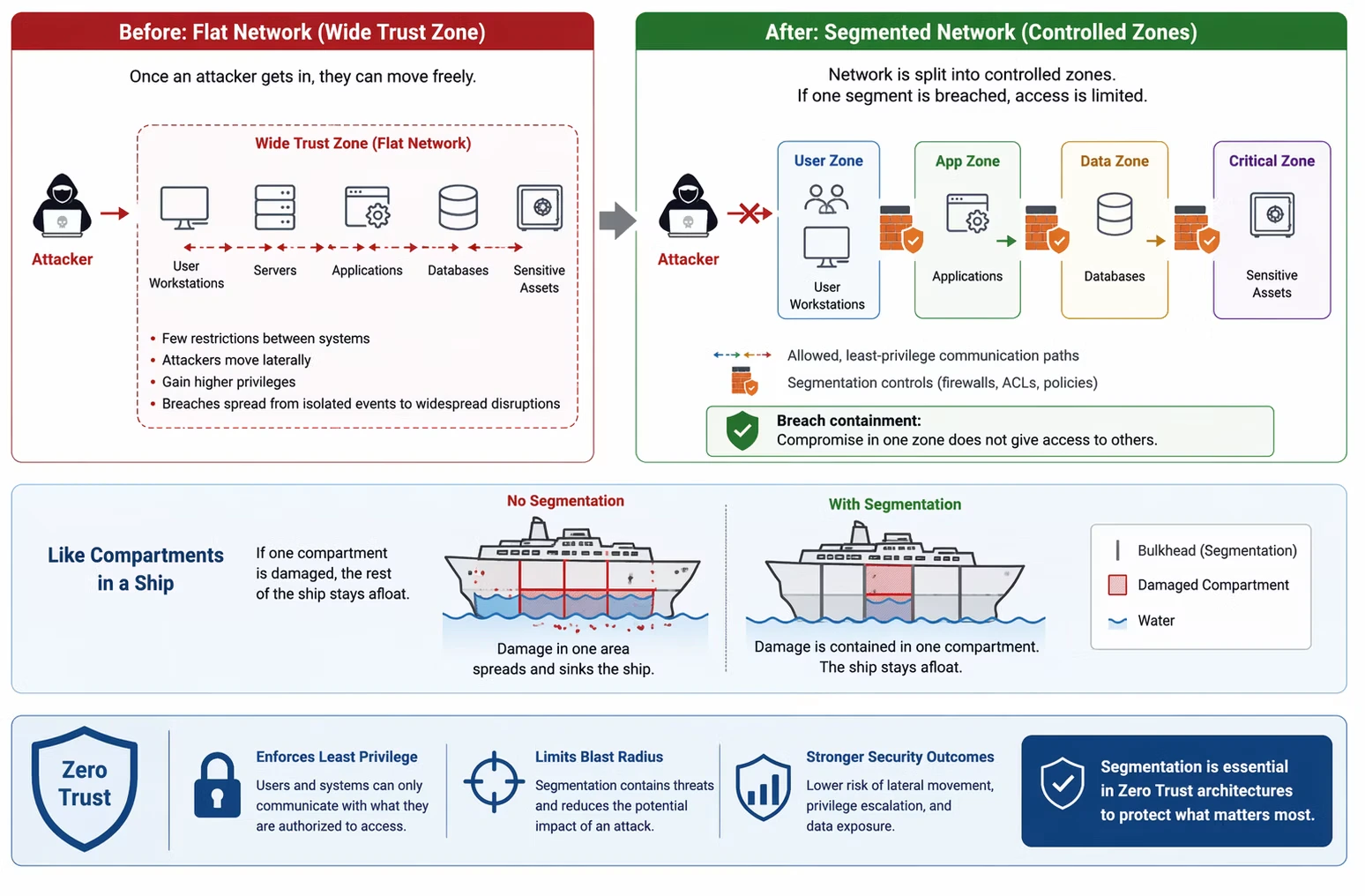
Segmentation is not a new concept, but its significance has increased due to modern cyber threats. Previously, networks had wide trust zones, allowing attackers to move freely once they gained access. This “flat network” issue is a key reason why breaches escalate from isolated events to widespread disruptions. Attackers don’t stop after the first breach; they spread laterally, gain higher privileges and aim for valuable assets.
Segmentation addresses this risk by dividing the network into controlled zones. If one segment is breached, access to nearby systems is limited.
In Zero Trust architecture, segmentation is crucial. It enforces communication based on least-privilege basis significantly reducing the potential impact of an attack.
Below diagram illustrates the high-level comparison of zero trust micro segmentation with a ship analogy. With bulkheads (segmentation), damage is contained to one compartment, keeping the ship afloat. The diagram contrasts with a flat network, where an attacker moves freely, with a segmented network (User Zone → App Zone → Data Zone → Critical Zone) separated by firewall/ACL controls.
Microsegmentation Fundamentals
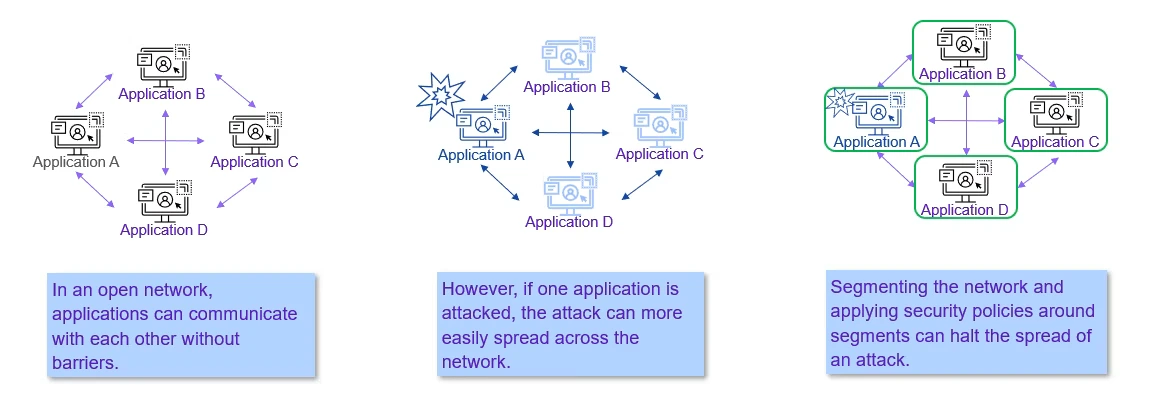
Microsegmentation takes traditional segmentation a step further to more granular level. Instead of dividing networks into large zones, it applies security controls down to individual workloads, applications, or processes limiting attackers’ ability to move laterally inside the network.
This approach is software-driven and policy-based. Microsegmentation creates a logical isolation using granular rules that govern communication.
Below are some characteristics:
- Workload-level control: Policies are enforced for each VM, container, or application
- Least privilege access: Allow only the required level of access for a user or system to function.
- Dynamic enforcement: Policies move with workloads across cloud and on-prem environments
- Distributed enforcement points: Multi-layer controls exists at the VM, Hypervisors, hosts, firewall or SDN layers
Microsegmentation aligns naturally with Zero Trust by eliminating NO or ZERO trust inside the network.
Visibility and Dependency Mapping
A major challenge while adopting micro segmentation is visibility. Many application owners lack awareness of application dependencies and traffic flows, delaying rule enforcement.
Proper dependency mapping is necessary before implementing segmentation. This involves:
- Discover workloads and services across multiple environments like Dev, Test, Prod
- Mapping east-west and north-south traffic flows
- Identifying application tiers (Web, App, DB) and communication patterns
- Understanding legitimate and irregular interactions
Without this visibility, segmentation can increase risk by granting excessive permissions or affecting application functionality.
Policy Modeling Strategies
Policy modeling means converting security requirements into rules that can be applied and enforced in real systems. In microsegmentation, this process must balance between accuracy and ease of operation.
Here are some common strategies:
- Application-centric policies – Define rules based on application tiers (web, app, DB)
- Identity-based policies – Use labels, tags, or identities to group workloads dynamically
- Centralized policy for Core Services – Keep single policy for core services like AD, DNS, NTP, etc. to be used by all workloads
- Allow-list (positive security) model – Start with a “deny all” approach and explicitly allow only necessary communication
- Unified policy framework – Keep a unified policy framework across all environments to avoid inconsistencies
A well-designed policy model simplifies management while ensuring effective security controls. Automation and AI help create and improve security rules based on actual traffic behavior.
Deployment Stages and Rollout Methods
Microsegmentation should be implemented in phased approach.
- Discovery Phase
- Inventory workloads and applications
- Create a Source of Truth for workloads
- Visibility Mode
- Use tool to capture the application traffic flows
- Identify dependencies and refine mappings
- Policy Design
- Create segmentation policies aligned to business and application requirements separating core and application-based rules
- Pilot Phase
- Identify application for pilot workloads and perform all test use cases
- Test and Simulation
- Validate policies in monitor mode
- Ensure there is no unintended application disruption
- Gradual Enforcement
- Apply policies in controlled segments or environments, starting with lower environment
- Identify and carefully plan for critical applications or high-risk zones
- Scale-Out Deployment
- Extend segmentation across all applications and environments

This phased approach minimizes operational risk and builds confidence among stakeholders.
- Discovery Phase
Continuous Compliance and Monitoring
Segmentation is not a one-time task. Hybrid environments are dynamic with workloads scaling and applications evolving. The threat landscape also changes continuously.
Continuous monitoring helps in:
- Aligning policies with actual application behavior
- Detecting unauthorized communication attempts early
- Meeting audit and Compliance requirements
- Identification and Correction of Policy drift
Modern implementations integrate with SIEM, SOAR and threat intelligence platforms to enable:
- Real-time alerting
- Detecting behavioral anomalies
- Automating remediation actions
Continuous validation is essential to maintain Zero Trust policies.
Hybrid Cloud and On-Prem Use Cases
Microsegmentation is particularly valuable in hybrid architecture, where uniform security controls are challenging.
Common use cases include:
- Secure cloud migration - Ensure consistent policies as workloads move across environments
- Multi-tier application - Isolate Web, App and DB layers of a multi-tier application
- Regulated workloads - Enforce strict segmentation for financial, healthcare, or government data
- Container and Kubernetes security - Apply controls at pod or namespace level
- Legacy system isolation - Protect unsupported systems by limiting their communication scope
- Isolating impacted workloads - Fully isolate workloads affected by vulnerabilities or attacks until they are fixed
Microsegmentation ensures consistent security across different environments.
Security Benefits and Blast Radius Reduction
The ultimate objective of Zero Trust microsegmentation is not just prevention but to stop the lateral movement of threat. Microsegmentation aims to reduce the blast radius - the extent to which an attacker can move and cause damage.
Key benefits:
- Preventing lateral movement - Attackers are confined to the segment where the attack occurred
- Fine-grained access control - Only necessary communication is allowed
- Faster breach containment - Negotiated workloads can be isolated immediately
- Improved resilience - Business operations continue even during incidents
- Enhanced compliance posture - Demonstrates strong control over data flows and access leading to better compliance score
By limiting how attackers can move within the network, organizations shift from purely defensive strategies to more resilient security approaches.
Conclusion
Zero Trust microsegmentation is the new method organizations adopt to secure their networks. This approach avoids relying on implicit trust and perimeter defenses. Instead, it emphasizes verifying first and trusting later. It enforces detailed, context-aware controls directly at the workload level, limiting lateral movements and strengthening security posture.
For hybrid cloud environments, where complexity and scale continue to grow, microsegmentation offers a practical and effective mechanism to enforce Zero Trust principles, contain threats and maintain operational resilience.
It is no longer optional; it is increasingly becoming a standard requirement for modern security architectures.


