


In my previous blog, “Why legacy backups are insufficient against cyber threats,” I shared the strategy on modernizing backup technology for cyber resiliency. Another important strategy is to build an isolated recovery environment to run business-critical applications while the forensics are still running on a production system.
There are eight things that may help build an IRE:
Isolation and segregation:
A robust security strategy for an isolated environment typically involves several key components:
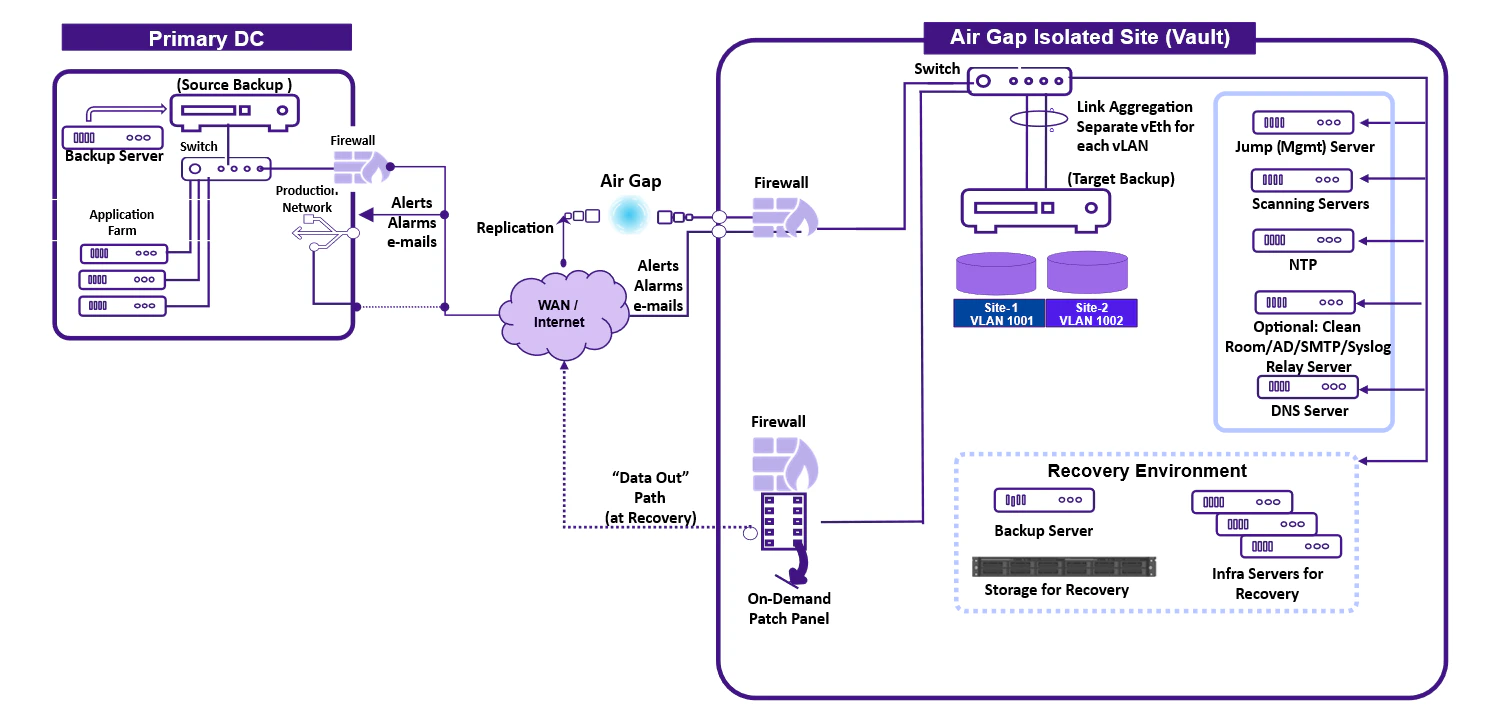
- Physical airgap or one-way replication: To ensure isolation, a physical airgap is recommended between environments. This means there are no direct network connections, reducing the risk of unauthorized data transfer or cyber threats. Alternatively, you can synchronize data using one-way replication through OEM-provided solutions like data diodes or through firewall rules that allow information to flow in only one direction—often from production to the isolated environment.
- Separate core infrastructure services: Essential infrastructure elements to host networking, firewalls, virtual machines, storage systems, monitoring tools, backups, Active Directory and Citrix resources are provided independently for the isolated environment. This separation ensures that operational dependencies do not overlap with other business-critical systems and helps contain potential threats within defined boundaries.
- No routable connection from production to the IRE: Zero Trust Security should be enforced by ensuring that there are no routable network paths from the production systems to the IRE. This prevents lateral movement and direct access, limiting exposure to malware or attackers who might compromise production assets.
- Used exclusively for IRE workloads: All resources within this environment are dedicated solely to IRE tasks. These workloads are deliberately segregated from regular business functions, maintaining focus on recovery and resilience activities without interference from unrelated processes.
- Identity and access
- CyberArk/PAM break-glass scenario: During a cyber event, it is possible that you may lose your regular sign-in processes and password access. Clients are advised to have a break-glass procedure set up within privileged access management (PAM) solutions like CyberArk. The process should be strictly monitored and logged.
- MFA, Entra ID: Procedures to recover AD (at domain or forest level) must be maintained and tested regularly. There are solutions available that can automate and fast-track Forest recovery from days to a few hours.
- Just-in-time access with TOTP: Just-in-time (JIT) access and MFA strategy should also be thought through while designing IRE.
- Secure administration flows: One complicated task is defining the security flows so the network traffic can be isolated to prevent the widespread impact of a cyber event. Some of the recommended best practices include yellow–green VLAN deployment, no direct RDP/SSH, restricted iLO and restricted Citrix VDI access.
Immutable storage: Immutability is the most important element of building an IRE, with many possible scenarios, including the following:
- Immutability is achieved in Vault Storage and Data from Vault to be restored in IRE (Recommended). In the architecture below, vault and IRE are segregated.
- Anomaly and threat detection
Implement malware scanning, threat and anomaly detection
There are two important problems it solves for organizations:
Faster recovery
The backup is scanned and marked as 'good backup', which can help the organization to choose the right snapshot to recover from. Otherwise, restoring from multiple points in time and scanning for malware could elongate the restoration timeline.
Prevention from reinfection
As I am only restoring from the ‘good backup’, it reduces the chances of reinfection due to restoring the infected copy.
YARA rules-based threat hunt
It can proactively search for indicators of compromise (IOCs) across systems and backups, rather than waiting for alerts from traditional tools. It can help with the following:
- Early detection of advanced threats
- Forensic analysis and incident response
- Customizable and scalable: Organizations can craft rules tailored to specific threats or compliance needs and can also Integrate with SIEM, EDR and automation pipelines for continuous monitoring.
Right-sizing
Right-sizing IRE is an important aspect of designing IRE; otherwise, it may not justify its costs over keeping the application shut down for a longer time. There are a few guiding principles while right-sizing IRE:
- Identify MVB and performance requirements
- Determine how long the IRE will run
- Analyze “cloud vs. on-prem,” “shared vs. dedicated”
- Be ready to accept that bnt everything is required to run in IRE
- Recovery templates and regular drills
Use IaC and other automation tools for automated and orchestrated recovery.
Everything works well manually with just one or two recoveries to do. In the event of a cyber incident, a recovery scenario might involve restoring and bringing online 200-400 servers. Tasks like prechecks, server boot up sequencing, application start up and post-checks can be fully automated.
Regular tabletop and full-scale recovery drills
All the processes, runbooks and procedures must be stored securely and included in the vault for safe retrieval.
- Failback
Define failback from IRE to Prod scenarios
This is the most complex step in recovering from the cyber event. Once it’s been validated that all production infrastructure is secure, the connection from IRE to Prod should be established for the failback procedure. This can be host-to-host migration or storage-to-storage migration.
Conclusion - In the end, building an isolated recovery environment is about being ready for the day when production systems simply cannot be trusted. It is not just a backup conversation anymore—it is about having a clean, controlled place where critical services can keep running while the bigger recovery effort is still in progress. The real challenge is getting the balance right: strong isolation, trusted access, clean recovery points and enough capacity to support what the business truly needs. And like anything in cyber resilience, it only works if it is tested, practiced and kept practical. When done well, an IRE can take a very bad day and make it a lot more manageable.


