


 Listen to article

The emerging agentic web
Agentic AI is rapidly moving us toward a web where AI agents can act on behalf of people and organizations and collaborate across platforms and organizational boundaries. The potential is significant: agents could coordinate complex work, enable new forms of digital commerce and make services more accessible to businesses and individuals. But realizing that opportunity requires more than increasingly capable agents. Agents must also be able to find and interact with one another across an open ecosystem while supporting the trust, safety and alignment with human values necessary for that ecosystem to scale.
From discovery to trusted transactions
NandaIndex represents an important step toward the discovery infrastructure needed for this agentic web. Through an open resolution protocol and shared service, NandaIndex is designed to help systems locate information about agents across otherwise separate environments. This connects directly with our earlier research on the Agentic Transaction Lifecycle, where NANDA Index is identified within the Discovery phase. As agent ecosystems grow, the ability to discover and locate agents across organizational and technology boundaries becomes increasingly important.
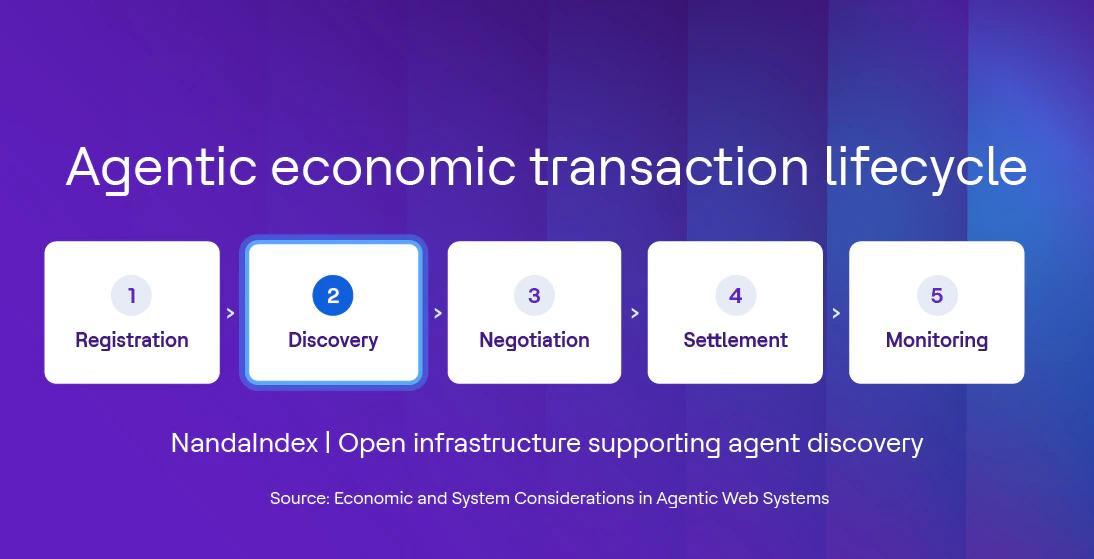
AI safety goes beyond the agent
As autonomous agents increasingly interact, AI safety cannot focus only on the behavior of an individual model or agent. We also need to understand the system-level dynamics that emerge as agents interact, coordinate and transact. Our joint research, Economic and Systemic Considerations in Agentic Web Systems, examines these emerging dynamics and won the Best AI Research Paper Award at The AI Awards 2026 in London. The opportunity is not simply to guard against undesirable coordination, but to enable responsible collaboration among agents toward goals aligned with human values. As these ecosystems mature, they will also require broader safety infrastructure for monitoring systemic risks, learning from incidents and failures and supporting accountability across the ecosystem. NandaIndex does not solve these broader safety challenges itself, but discovery infrastructure can provide an important foundation for the interconnected agent ecosystems in which they will need to be addressed.
Building the foundations for a safer agentic web
This work builds on the broader collaboration between HCLTech and the MIT Media Lab, including early HCLTech contributions to an MIT-HCLTech hackathon, and other projects that help bring cutting-edge AI research into the value we deliver for our clients and other stakeholders. As Vijay Guntur, CTO of HCLTech, notes:
“At HCLTech, we see Agentic AI becoming integral to how enterprises operate, collaborate, and serve customers. As organizations deploy agents across different clouds, platforms, and business ecosystems, open discovery and interoperability will be essential. NandaIndex offers a promising approach to connecting these agents across organizational boundaries while preserving enterprise control, security, and governance.”
As the agentic web evolves, the opportunity is not simply to enable more autonomous agents, but to help build an ecosystem in which interoperability, innovation and AI safety advance together.


