


The challenge with traditional document processing
Organizations across industries share a common bottleneck: accurately, quickly and at scale converting unstructured documents and document packages into actionable, system-ready data.
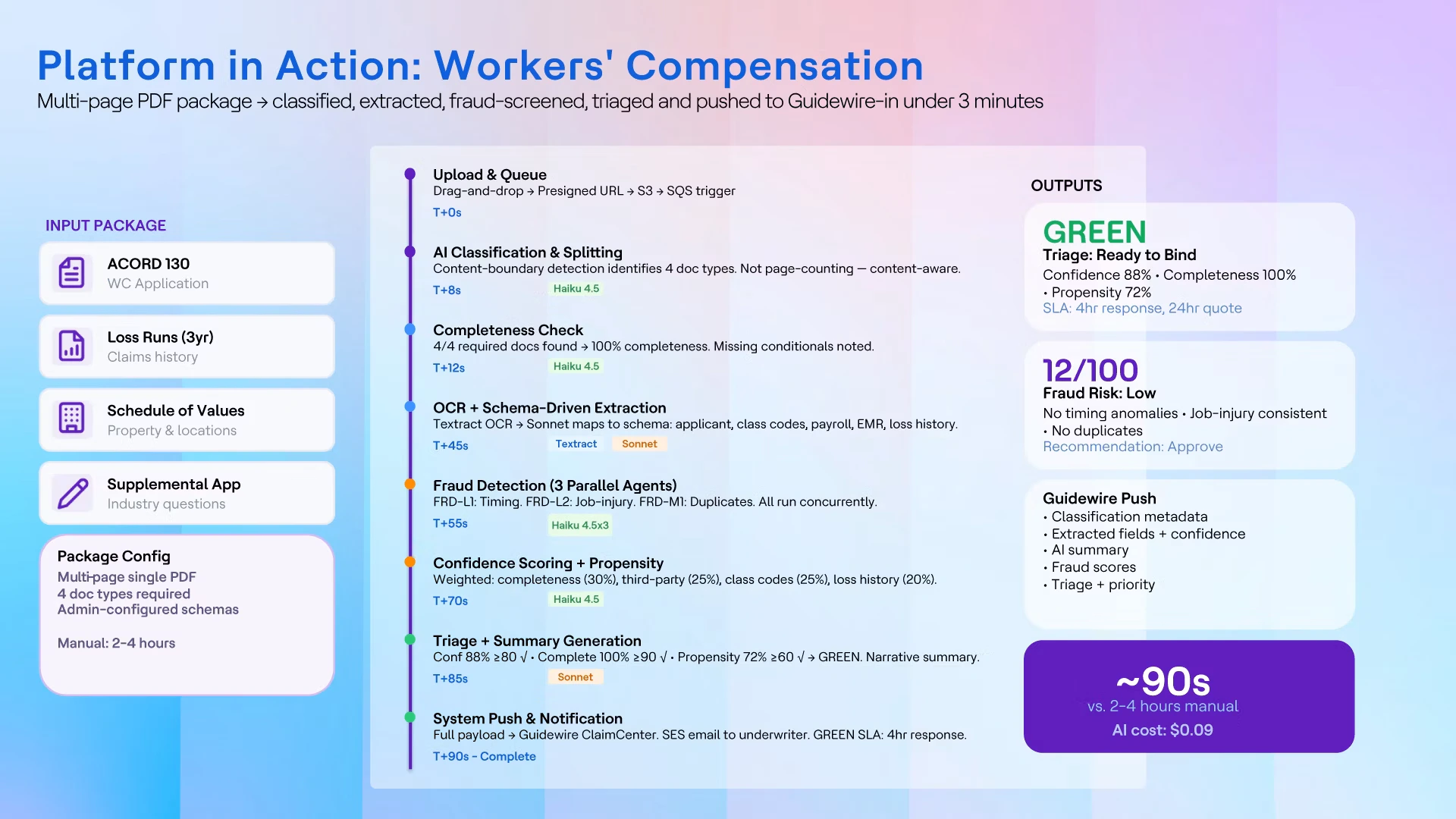
Consider a typical Workers’ Compensation submission in insurance. A single package arrives as a multi-page PDF containing distinct document types, such as an ACORD 130 form, three years of loss runs, a schedule of values and a supplemental application. Processing this manually is expensive, error-prone and slow. But the alternative hasn't been much better.
Traditional IDP solutions are built on brittle foundations
Most rely on developer-maintained templates that have hardcoded extraction rules for each document type. When form layouts change, templates break. When new document types appear, engineering intervenes to build a new pipeline. The result is an infrastructure that scales poorly, adapts slowly and creates a perpetual dependency on technical resources to keep pace with business needs.
AI-enhanced solutions haven't fully solved this either
Multiple Products offer ML models on top of the same rigid templates, such as improving accuracy within known forms, but still require developer involvement for anything outside predefined boundaries. More critically, they process documents in isolation, miss the contextual relationships between documents within a package, fail to validate data holistically and rarely close the loop to downstream systems like Guidewire, underwriting, etc.
The gap is structural, not incremental
What enterprises need is a strong, scalable foundation that offers:
- A classification that works without prior training on every document variant
- Splitting ability to contextually split the merged document that contains multiple forms/information sets
- Extraction that is dynamic, context-aware and layout-agnostic
- Validation that operates at the package level, not just the document level.
- Integration that connects natively to systems of record without custom connectors
This is precisely what AI-IDP is built to deliver—a generalized, modular approach to intelligent document processing. AI-IDP doesn't improve the traditional IDP model; it inverts it.
Rather than asking "what are the rules for this document type?" it asks "What does AI see in this document and what data matters to your business?"
This shift from rule-driven rigidity to intelligence-driven flexibility is the foundation of everything AI-IDP does.
The platform is built on two core principles:
Schema as configuration, not code:
An administrator uploads a sample document. Any document, from any industry. AI analyzes it, identifies every extractable field and surfaces them for review. The administrator selects which fields matter to their use case.
That selection becomes a reusable extraction schema, stored and ready to deploy.
No code. No templates. No developer required.
A new document type is onboarded in the afternoon, not as part of a sprint cycle. A new line of business goes live without an engineering ticket. When layouts change, the schema adapts, not breaks.
Configuration replaces customization. Business users own the setup. Engineering focus shifts to value rather than maintenance.
Modules as capabilities, not constraints:
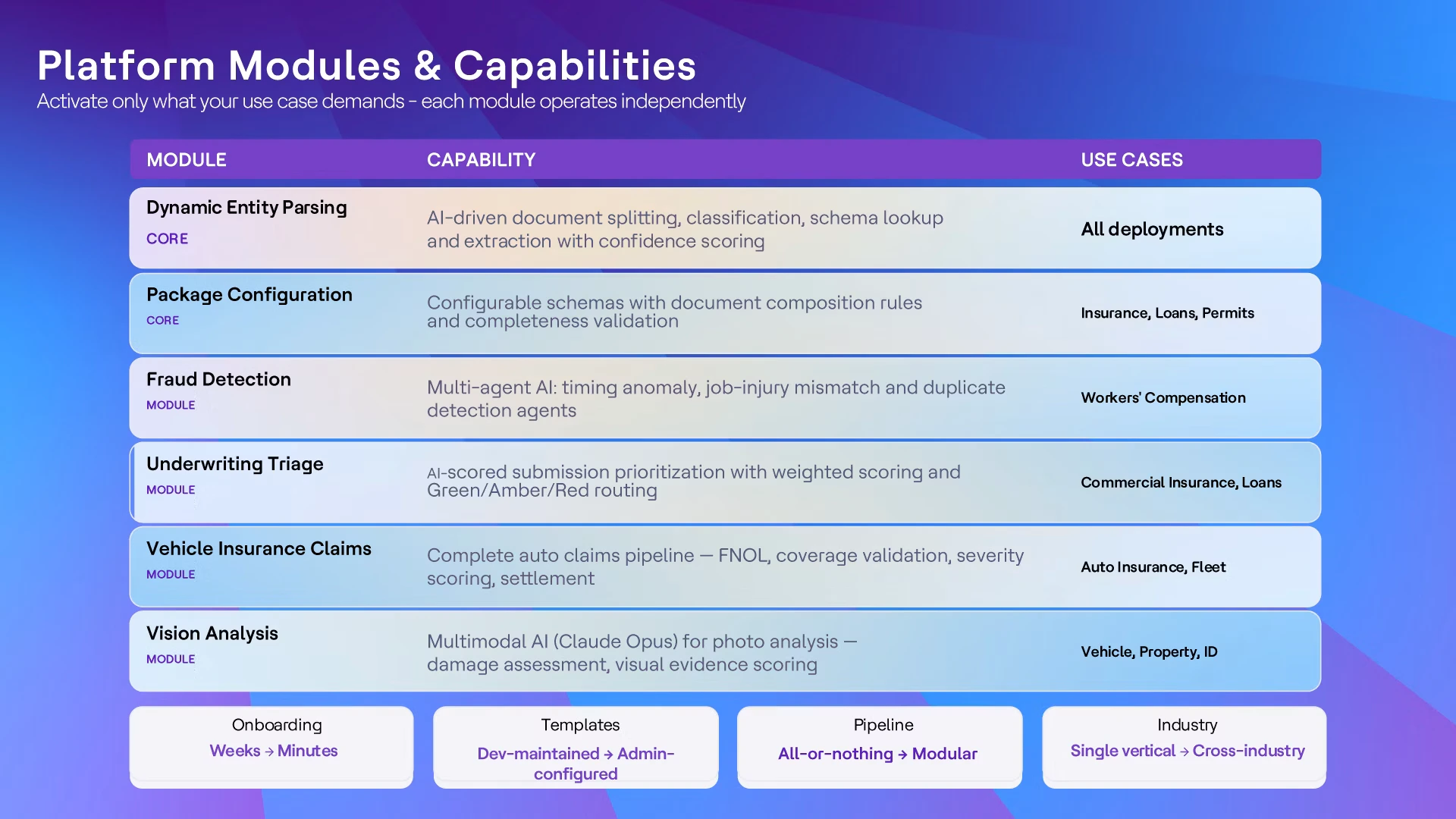
Every downstream processing capability in AI-IDP, fraud detection, underwriting triage, claims automation, compliance checks and system integration is offered as an independent, pluggable module. Organizations activate only what their use case demands.
Running a healthcare workflow? Vehicle damage assessment stays off. Need native Guidewire integration? Turn it on in minutes. Expanding into a new line of business? Add the relevant modules without touching existing pipelines.
Each module operates independently while drawing from the same extracted data foundation, thus ensuring consistency across the platform without creating interdependencies that slow you down.
You don't inherit a platform bloated with features you'll never use. You build exactly the capability stack your business needs.
AI-IDP feature map:
| Feature | Traditional IDP | AI-IDP Generalized Platform |
| Document type onboarding | Weeks to onboard a new document type | Minutes: upload a sample, select fields, ready for processing |
| Template bounding | Developer-maintained templates | Admin-configured, no code required |
| Modularity | Fixed pipeline-all or nothing | Modular pipeline-activate only what you need |
| Data variation | Breaks when forms change | AI re-adapts to layout variations |
| System Integrations | Custom integrations per use case | Pre-built modules snap in via configuration |
| Industrial adoption | Locked to specific industries | Works across insurance, healthcare, banking, legal, government |
Solution architecture on AWS
AI-IDP is built entirely on AWS serverless services, enabling automatic scaling from tens of documents per day to thousands without major architecture changes.
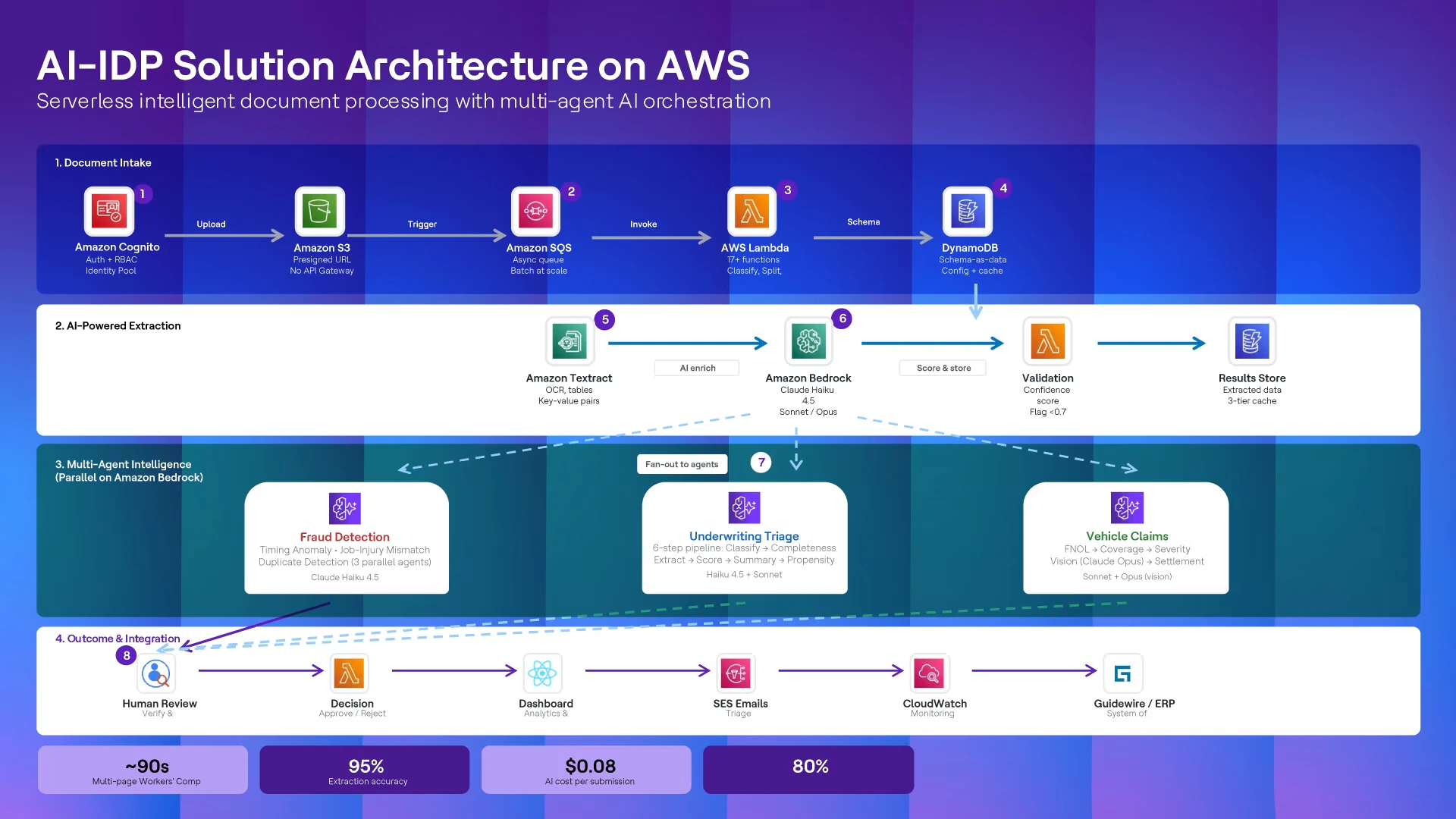
Processing flow:
- Document intake: Upload via drag-and-drop or email ingestion to Amazon S3 with presigned URLs for secure transfer. Supports single files and multi-document packages
- Async orchestration: Amazon SQS decouples upload from processing, enabling batch operations without throttling. Users can upload multiple documents and continue working while the queue processes at scale
- Classification and splitting: AI agents analyze multi-page PDFs, reason about content transitions and form boundaries and split them into individual documents. This is intelligent boundary detection, not rule-based page counting
- Schema lookup: The system fetches the configured extraction schema for each classified document type from DynamoDB. Only fields that administrators selected during configuration are targeted
- Extraction Agent: Amazon Textract/Extraction agent performs OCR, key-value and table extraction. Entities are structured, confidence-scored and stored. Low-confidence fields are automatically flagged for human review
- Agentic processing: Amazon Bedrock powers multi-agent orchestration. Based on the package and use case in context, the respective agents are invoked, for example:
- Fraud detection, three specialized agents operate independently: a timing anomaly agent analyzes date patterns suggesting premeditation, a job-injury mismatch agent cross-references occupation codes against reported injuries and a duplicate detection agent scans claimant history across carriers
- Underwriting triage, a scoring algorithm weighs data completeness, third-party match quality, class code alignment and loss history to route submissions into priority queues
- Human-in-the-loop: Users review extracted values with bounding-box highlights on the source document. All human edits are reviewed and persisted. The AI assistant answers the real-time questions about the extracted data
- Integration: Extracted data, scores and summaries flow into the frontend dashboard and push to connected systems of record with full metadata, classification and AI-generated summaries
Platform in action: Workers’ compensation use case
To illustrate the platform in action, consider a real-world implementation for a workers’ compensation intake workflow.
Conclusion
AI-IDP represents a shift from rigid, template-driven document processing to a generalized platform where administrators configure extraction schemas and processing capabilities are activated as modules. The same serverless infrastructure on AWS handles insurance submissions, healthcare records, loan applications and government permits, differentiated only by configuration.
Organizations looking to modernize document processing across multiple lines of business or industries can leverage this approach to reduce operational costs, accelerate processing times and eliminate the engineering bottleneck that traditional IDP solutions create.
AWS services used:
Built on AWS: Lambda, Amazon Textract, Amazon Bedrock (Claude 3), DynamoDB, S3, SQS, Cognito. Integrated with Guidewire ClaimCenter.

