Executive summary
The AI-Native Contact Center is HCLTech's enterprise-ready agentic customer engagement platform built on Amazon Connect. Instead of giving enterprises another telephony system bolted onto a CRM, it gives them an AI-native operating model for customer interaction: self-service that actually resolves issues, routing that places every contact with the right agent the first time and real-time agent assist that turns every conversation into a guided, accountable interaction.
The platform is designed to combine omnichannel conversational AI, supervisor-led agentic routing and resolution, enterprise system integration across any CRM or ITSM backend and enterprise-grade analytics, security and observability. The result is a solution built not just to handle volume, but to help organizations resolve customer needs in a way that is fast, consistent and traceable.
Introduction
Contact centers are not short on channels. They are short on resolutions. Most enterprises can already field calls, chats and emails across multiple systems. The harder problem is turning that volume into fast, accurate, consistent outcomes without losing context as a customer moves between self-service, channels and agents, or as a case moves between CRM, ticketing and knowledge systems.
That is where the AI-Native Contact Center stands out. HCLTech has designed it as a cloud native agentic application on Amazon Connect that keeps the customer experience unified while combining conversational discipline with AI-led reasoning, creating a structured intelligence layer that moves interactions from contact to resolution. A practical operating model for self-service, routing and agent assistance that fits the real enterprise world of multiple CRMs, multiple ticketing systems and multiple languages.
The need
What happens when a new call connects in a traditional contact center? Customers are routed, but resolution slows down as agents search across disconnected systems, switch screens to find case history, wait on knowledge lookups and hand off context-free transfers across queues. What should be a straight line from contact to resolution becomes fragmented and slow.
The AI-Native Contact Center is built to bridge the gap between contact and resolution. Instead of stopping at call routing, it gives enterprises a cloud native platform that can interpret intent, coordinate self-service and live-agent paths and apply agentic reasoning with enterprise-specific context. This makes customer engagement operationally usable, governed and aligned to how large organizations run their CRM and service operations.
Solution architecture
The platform transforms traditional call-center routing into an AI-native customer engagement operating model on AWS. The solution combines omnichannel self-service with real-time orchestration and Bedrock-powered reasoning to separate routine resolution from complex, judgment-driven interactions.
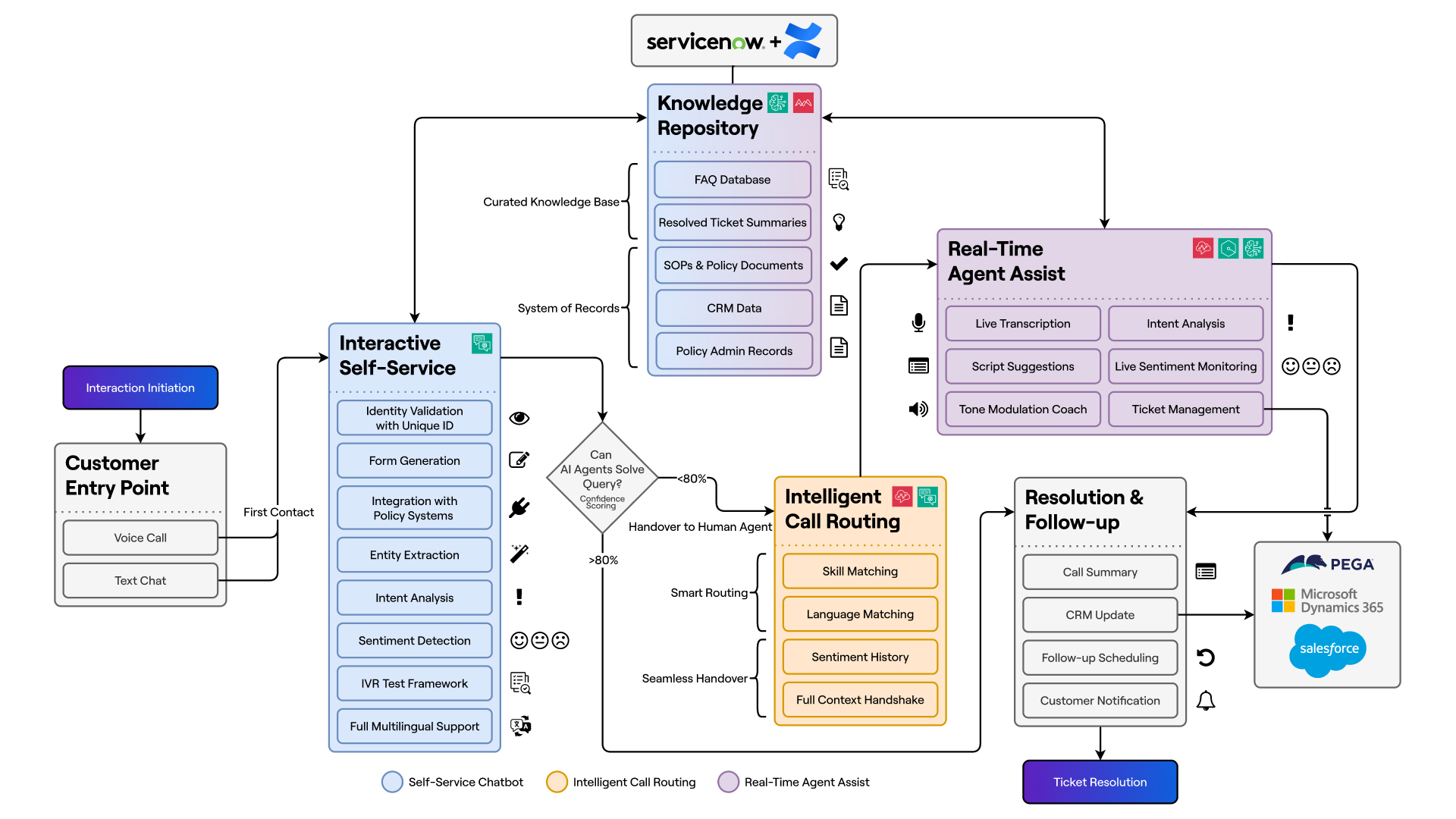
The user flow above shows the journey a single interaction takes through the platform: self-service first, a clear AI-resolvability checkpoint, then a fall-through to best-fit routing and real-time agent assist only when the interaction genuinely needs a human in the loop. This is the operating model behind the platform's three core pillars:
Conversational self-service, AI-native by design: the platform resolves routine queries end-to-end through Lex-driven structured intents, Amazon Connect AI agents for open-ended resolution and native speech-to-speech via Amazon Nova Sonic. Native in-flow integration with third-party speech providers (ElevenLabs for expressive multilingual text-to-speech and Deepgram for speech-to-text) extends language and voice coverage without leaving Connect's orchestration, analytics, or compliance boundary.
Best-fit routing and decoupled agent assistance: the platform separates the customer-facing interaction from the heavy lifting of context assembly. Customers are routed by skill, language, sentiment and conversation summary, while Amazon Connect Contact Lens and Bedrock-powered agent assist work in the background to surface knowledge, suggest next-best actions and prepare post-call summaries in real time.
Governed integration and traceability: customer profiles, case history and interaction records are exchanged with enterprise systems through a normalized integration layer, giving the solution a consistent contract regardless of which CRM or ITSM platform sits behind it. Supporting services such as AWS Secrets Manager, Amazon CloudWatch and AWS IAM/KMS reinforce the security, observability and encryption model expected in enterprise environments.
The AI intelligence layer
At the core of the platform's agentic architecture is its AI intelligence layer, built on Amazon Bedrock, Amazon Q in Connect and Amazon Connect Contact Lens:
- Specialized agent coordination with Amazon Connect AI agents: The platform does not depend on a single scripted bot flow to handle every interaction. Connect AI agents work alongside Lex-driven deterministic flows, escalating seamlessly to human agents when judgment, exception handling, or policy interpretation is required, creating a more modular and explainable resolution model for enterprise customer service
- Enterprise-grounded reasoning with Amazon Bedrock and Knowledge Bases: By connecting Bedrock-powered agent assist to enterprise knowledge bases and synchronizing prior case history and policy documentation through the integration layer, the platform can reason with internal product knowledge, prior resolutions and organization-specific service patterns. This makes the system materially more credible than generic AI outputs disconnected from the enterprise context
- Resolution support that is closer to real operations: The AI layer is designed not only to transcribe and summarize but also to help agents navigate identity verification, policy validation, case lookup and resolution guidance. That makes the platform more than a transcription assistant. It becomes a structured intelligence layer for every customer-facing interaction
Technical implementation
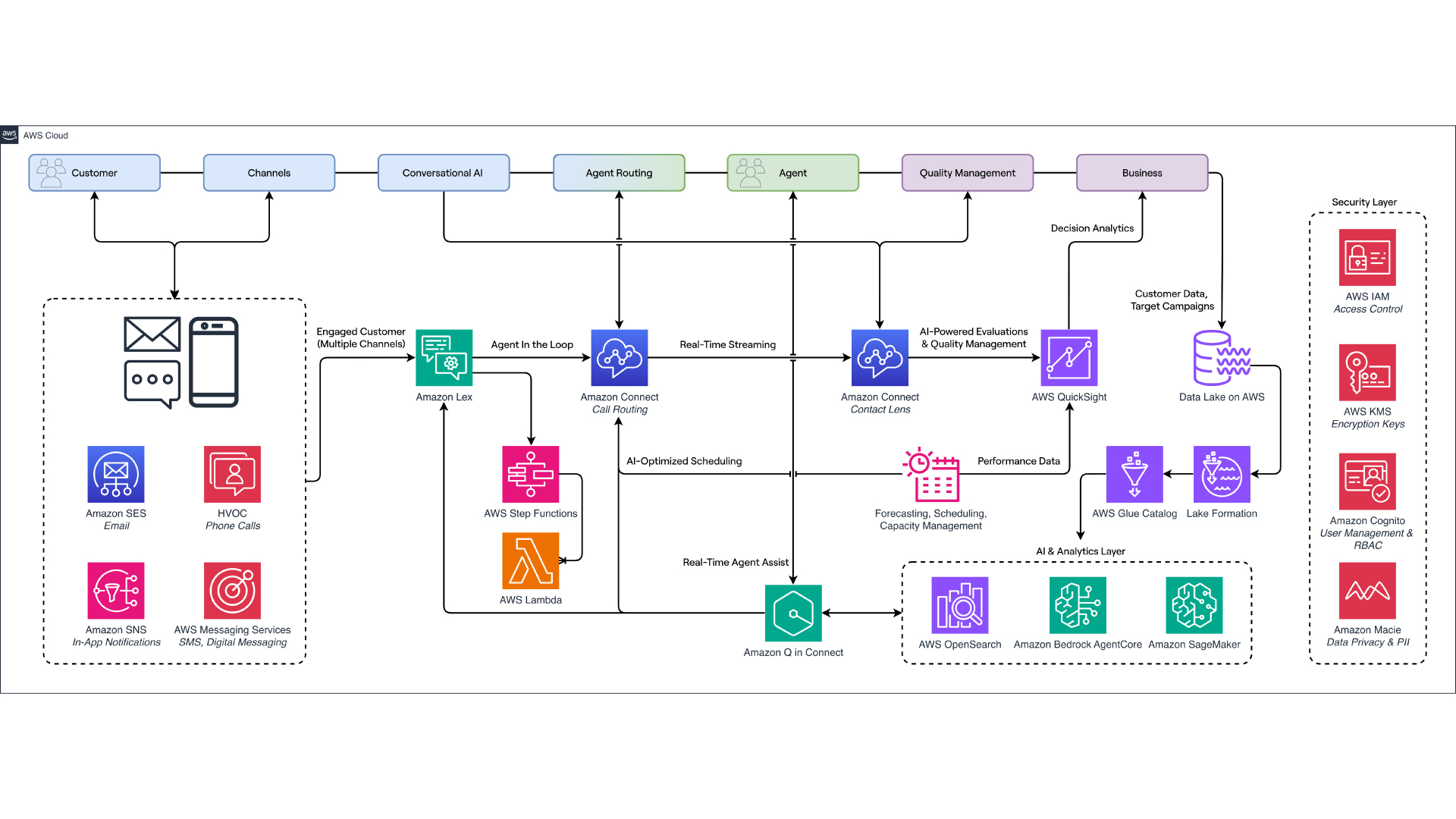
- Customers initiate contact through voice, chat, email, SMS, or in-app messaging, all routed through Amazon Connect
- Amazon Lex handles intent detection and identity verification at first contact, escalating to a Connect AI agent for open-ended or complex queries
- Amazon Connect's call routing engine directs the contact based on skill, language and real-time queue conditions, continuously informed by AI-optimized scheduling and capacity forecasting running in the background
- Amazon Q provides real-time agent assist during the live interaction, surfacing knowledge and suggested actions, while also feeding AI-optimized scheduling signals back into routing
- Amazon Connect Contact Lens analyzes the interaction in real time and post-call for sentiment, transcription quality and compliance, producing AI-powered evaluations for quality management
- The AI and Analytics Layer, Amazon SageMaker, Amazon Bedrock and AWS OpenSearch, support intent detection, generative summarization and knowledge retrieval that both Amazon Q and Contact Lens draw on
- Interaction outcomes, customer data and campaign context flow into the Data Lake on AWS, which feeds AWS QuickSight for decision analytics back to the business
- Forecasting, scheduling and capacity management outputs close the loop, continuously tuning how future contacts get routed
Technical architecture and AWS services
AWS services used in the solution:
- Amazon Connect: Core omnichannel contact center platform managing voice, chat and digital channel routing, queues and the agent workspace
- Amazon Lex: Handles structured conversational AI intents for predictable, high-volume self-service paths
- Amazon Connect AI agents (Amazon Q in Connect): Provides open-ended, agentic self-service and real-time agent assist, escalating to human agents when needed
- Amazon Nova Sonic: Native speech-to-speech model for low-latency, natural-sounding voice AI across supported locales
- ElevenLabs/Deepgram (native third-party speech integration): Optional in-flow text-to-speech and speech-to-text providers for extended language coverage and expressive voice, configured via Connect flows and AWS Secrets Manager
- Amazon Connect Contact Lens: Real-time and post-call transcription, sentiment analysis and agent performance evaluation
- Amazon Bedrock: Powers generative AI capabilities for case summaries, agent recommendations and knowledge retrieval
- AWS Lambda: Connects Amazon Connect flows to the enterprise integration layer for customer lookup, case retrieval and policy validation
- Integration Layer (API Gateway/enterprise integration bus): Normalizes calls into CRM/ITSM systems (Salesforce, Dynamics 365, ServiceNow, Zendesk, Freshdesk, etc.) behind a common contract, decoupling Connect flow logic from any single backend
- Data Lake on AWS (Amazon S3/RedShift): Stores and manages customer data, interaction history and analytics datasets
- Amazon SageMaker: Powers custom machine learning models for intent detection and sentiment analysis beyond Bedrock-native capabilities
- AWS QuickSight: Delivers dashboards and decision analytics from the data lake for business stakeholders
- AWS Secrets Manager, Amazon CloudWatch, AWS IAM/KMS: Provide secrets handling, monitoring, access control and encryption
Value for users:
- Faster resolution cycles: The combination of self-service, best-fit routing and real-time agent assist helps teams move more quickly from contact to resolution, reducing average hold time and increasing first-contact resolution
- Backend-agnostic integration: Because the integration layer normalizes CRM/ITSM connectivity behind a common contract, the platform is easier to position for organizations running multiple systems, replacing a backend, or operating in regulated, data-residency-sensitive environments
- Multilingual voice without custom engineering: Native Nova Sonic and native ElevenLabs/Deepgram integration mean expanding language or voice coverage is a configuration change in the flow designer, not a Lambda/WebSocket build
- Reduced SME dependency: Self-service resolves common requests directly, freeing agents and subject matter experts for complex, judgment-driven interactions
- Contextual, consistent responses: Every interaction, regardless of channel or backend system, draws on the same unified customer and case context
- Enhanced customer experience: Proactive guidance, real-time sentiment-aware assistance and consistent resolution quality across voice and digital channels
Call to action: Stop routing, start resolving!
Assess in days: A rapid current-state review of channel volume, routing logic and integration touchpoints produces a high-fidelity modernization roadmap.
Pilot fast: A proof-of-concept on a single queue or use case validates the self-service, routing and agent-assist model before full rollout.
"From contact to resolution: Listen, reason, resolve."
- Listen (engage): Capture customer intent across voice and digital channels through a unified, cloud native Amazon Connect deployment
- Reason (assist): Use Amazon Bedrock and Connect AI agents to coordinate self-service, routing and real-time agent guidance grounded in enterprise-specific context
- Resolve (act): Move from contact to closed case through a traceable, integration-agnostic workflow designed for real operational follow-through
Ready to turn contact volume into resolution velocity? Enterprises and AWS partners can engage HCLTech to schedule an AI-Native Contact Center briefing or demo and explore how an agentic, Amazon Connect-powered platform can accelerate customer experience outcomes.