


If 2024 was the year enterprises explored what GenAI could generate, 2026 is the year they are evaluating what AI can complete. Nowhere is this shift more visible than in the contact center. As the primary interface between businesses and customers, contact centers are becoming the first large-scale environment where AI is moving beyond answering questions to executing tasks, resolving requests and delivering measurable outcomes.
The shift from Generative AI to Agentic AI is more than a technology evolution. It represents a fundamental change in how customer operations are designed, executed and measured.
“GenAI answers questions. Agentic AI completes outcomes.”
The shift in one sentence:
GenAI is an excellent language engine. It can Draft, Summarize, Translate and Converse with supernatural fluency. But it stopped where the work began. A human still had to read the suggestion, decide whether to act on it, open the CRM, type the update, send the email and close the ticket. Agentic AI changes that equation. It plans, acts, observes the result and re-plans—closing the loop without waiting for a human to push the button. Where GenAI was a co-pilot whispering suggestions, Agentic AI is a colleague that takes the work off your desk.
Architecture:
The diagram below compares the two concepts. On the left, GenAI follows a linear prompt-to-response flow that always hands control back to a human. On the right, Agentic AI introduces an orchestrator that coordinates specialized agents—intent, knowledge, action and compliance—each connected to enterprise systems, governed by policy and looped through memory and observation until the outcome is delivered.
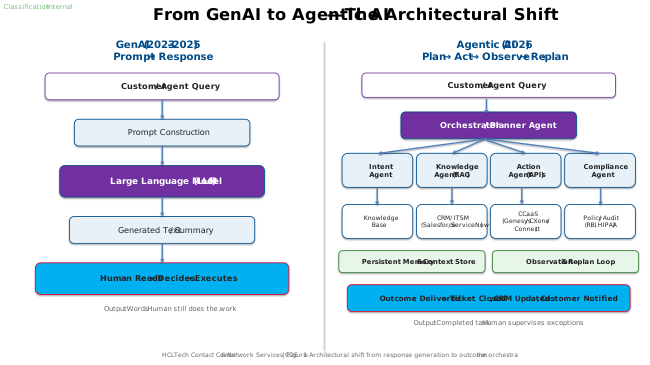
GenAI (left) vs. Agentic AI (right)-The architectural shift from response generation to outcome orchestration.
What actually changed:
Underneath the buzzwords, six concrete things are different. This isn't a cosmetic upgrade—it's the difference between hiring a writer and hiring an operator.
| Dimension | GenAI (2023–2025) | Agentic AI (2026) |
| Primary Output | Text, summaries, drafts | Actions, decisions, completed tasks |
| Human Role | Reviews and executes | Supervises and approves |
| Memory | Single session | Persistent, cross-system context |
| Tools | Standalone LLM | LLM + tools + APIs + other agents |
| Success Metric | Quality of response | Task completion rate (TCR) |
| Architecture | Prompt → Response | Plan → Act → Observe → Re-plan |
Why the Contact Center is ground zero:
Every contact center interaction is already a workflow—a request, a lookup, a decision, a system update, a follow-through. That makes it the perfect proving ground for agentic AI. Four use-case patterns are emerging fastest:
- Autonomous Voice & Chat Resolution: Agents that listen, infer intent, retrieve the right knowledge article, call the right API, update the CRM, raise the ITSM ticket and confirm closure, all in a single conversation. Tier-1 contacts that used to take 8–12 minutes are now resolved in 2–4.
- Smart Outbound & Proactive Service: Agentic dialers that don't just place calls but qualify, validate consent, comply with TCPA/RBI/DNC rules in real time and hand off only the warmest leads to humans—lifting connect-to-conversion by 30–50%.
- Agent Assist 2.0: The leap from “here's what to say” to “here's what I just did—please confirm.” Refunds processed, appointments rescheduled, escalations routed, all in the background while the human focuses on empathy.
- Quality Intelligence, Not Just Quality Assurance: Agents that don't just score 5% of calls but analyze 100% of them, identify systemic failure patterns and propose process or knowledge-base fixes that prevent the next failure.
Early enterprise deployments are reporting:
- 20-45% reduction in average handle time (AHT)
- 35-70% reduction in QA labor cost
- 2-3x faster first-contact resolution on tier-1 use cases
- 15-25% improvement in CSAT for AI-handled journeys
The inconvenient truth:
Gartner predicts that 40% of Agentic AI projects will be cancelled by the end of 2027.
The reasons are remarkably consistent across cancelled programs: hype-driven scoping, weak data foundations, unclear ROI hypotheses and absent governance frameworks.
The technology isn't the problem—the operating model is.
The winners in 2026 won't be the organizations with the most sophisticated models. They'll be the ones who treat Agentic AI as an operating-model change—investing as much in data quality, governance and human-in-the-loop design as they do in the AI itself.
The 5-pillar blueprint for success:
Across our COE engagements with banking, manufacturing, life sciences and animal-health clients, the deployments that move from pilot to production share five disciplines:
- Start with a Bounded Outcome. Don't deploy “an AI agent.” Deploy “the agent that resolves missed deliveries” or “the agent that processes refund requests under $500.” A narrow, measurable outcome is the difference between a demo and a deployment.
- Fix the Data First. 63% of enterprises don't trust their own data for AI. Before you plug in an LLM, clean your knowledge base, atomize long policy documents into retrievable chunks and cluster real-world scenarios so the agent knows what good looks like.
- Design Human-in-the-Loop by Default. The best Agentic deployments don't try to replace humans—they redraw the line. AI routes and resolves the routine; humans own empathy, exceptions and edge cases. Make the handoff explicit, measurable and distinguished.
- Orchestrate, Don't Monolith. A single mega-agent doing everything is breakable. The state of the art is a planner agent coordinating specialized agents—one for intent, one for knowledge retrieval, one for taking actions, one for compliance. Think microservices, not monoliths.
- Govern Like You Mean It. Audit trails. Refusal patterns. Bias testing. Human override. Data residency. These are not optional in regulated industries—they are the licence to operate. In banking (RBI), healthcare (HIPAA) and cross-border deployments (China data laws), governance is the moat.
What HCLTech is seeing in the field:
Across our Contact Center COE engagements in 2025-26, three patterns are emerging consistently and they are reshaping how we advise clients on technology roadmaps, vendor selection and operating models.
- Budget Reallocation: Spend is increasingly shifting definitely to outcome-based AI services. Business is asking vendors to price on resolved interactions, not on capacity consumed.
- Platform Convergence: The lines between CCaaS, CRM and ITSM are blurring. An agent that closes a contact-center ticket may also update Salesforce, raise a ServiceNow change.
- Security & Compliance: In regulated markets, clients are no longer impressed by demos. They want to see the audit log, the bias report, the data residency proof and the human-override mechanism. Partners who can prove governance win.
Two snapshots from the frontline:
Banking-cards dispute resolution
A large bank deployed an Agentic AI assistant to triage cards-dispute calls. The agent verifies the customer, classifies the dispute reason, checks the merchant network, retrieves the relevant RBI-aligned policy and either auto-approves provisional credit (under threshold) or routes to a senior agent with a pre-drafted decision memo. Result: AHT down 38%, first-call resolution up 42% and full audit trail per RBI master direction on customer protection.
Animal health-veterinary distributor support
A global animal-health company introduced Agentic AI to handle order-status, product-availability and back-order conversion calls from veterinary clinics. The agent integrates SAP order data, inventory APIs and the CRM to confirm ETA, propose substitutes and place the back-order—all within the same call. Distributor NPS rose 18 points in the first quarter.
The bottom line:
GenAI made the contact center smarter. Agentic AI is making it autonomous, accountable and outcome driven. The organizations that succeed with Agentic AI will not be defined by the number of models they deploy, but by their ability to combine automation, governance and human expertise into a scalable operating model.
The future of contact centers is not human-less. It is human-led and AI-augmented, where autonomous agents handle routine work while people focus on judgment, empathy and complex decision-making.
The question is no longer “What can AI say to my customer?”
It's “What can AI do for my customer—and prove it did it well?”
For more information, write to us at contact.fluidcc@hcltech.com.
