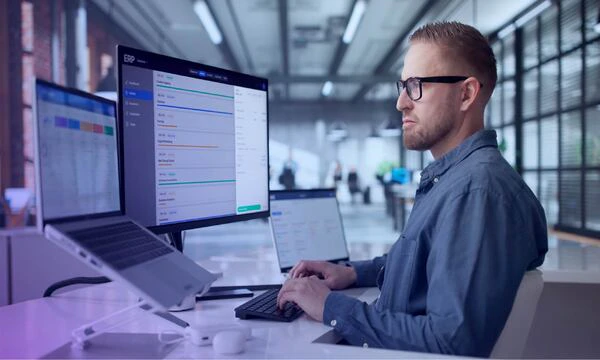
The future of work is the evolving model through which people, technology, skills and organizational practices create value. An AI-first workforce is one in which employees routinely use AI for decisions, knowledge work and workflow execution while people retain accountability. For leaders asking what is the future of work, the answer is not simply more automation, but it is reshaping jobs, operating models and the digital workplace. Workforce transformation therefore depends on building an AI workforce that can use AI safely, question its outputs and redesign work around better business and employee outcomes.
Artificial intelligence in the workplace is moving from isolated experimentation to an embedded capability. The priority is to connect adoption with workforce enablement and measurable value.
What does an AI-first workplace look like?
An AI-first workplace is a digital environment designed so AI is available within the tools, data and workflows employees already use. It applies AI where speed and scale add value, while human judgment governs intent, quality and exceptions.
Core characteristics include:
- Embedded AI productivity tools: Approved enterprise AI assistants and copilots support drafting, summarization, search, analysis and meeting follow-up.
- Contextual decision support: AI retrieves enterprise knowledge, identifies patterns and presents options without removing human accountability.
- Intelligent workflows: Automation connects collaboration, service management and business systems instead of creating another standalone tool.
- Secure foundations: Identity, permissions, data quality, knowledge management and monitoring are built in from the start.
Generative AI in the workplace becomes useful when it reduces friction in real work. A service assistant, for example, can summarize a case and recommend an action while an employee handles exceptions.
How AI is changing workforce expectations
AI is changing what organizations expect from employees and what employees expect in return. Workers increasingly need to use AI for work, evaluate its output and own outcomes rather than complete a fixed sequence of tasks. They also expect trusted tools, relevant learning and clarity about how roles may change.
This shift raises the value of judgment, adaptability and process knowledge. PwC found that highly AI-exposed entry-level roles are seven times more likely to require traditionally senior capabilities such as leadership and strategic thinking.
The employment proposition must evolve accordingly. Employees need opportunities to build skills, participate in redesign and understand how productivity gains will affect workload, performance and career mobility.
Emerging skills for the AI era
An effective AI workforce requires technical fluency and distinctly human capability. The goal is to establish the right skill depth for each role.
Priority capabilities include:
- AI and data literacy, including appropriate prompting and tool selection
- Critical evaluation, source verification and domain judgment
- Workflow mapping, experimentation and process redesign
- Privacy, cybersecurity, intellectual property and responsible use
- Creativity, empathy, communication and stakeholder management
- Curiosity, learning agility and comfort with ambiguity
The world economic forum estimates that 39% of workers’ existing skills will be transformed or become outdated between 2025 and 2030, with AI and big data among the fastest-growing skills.
Enterprises need a tiered skills architecture: baseline literacy for all employees, advanced workflow and oversight skills for managers and process owners and specialist capabilities for builders, risk teams and platform operators.
Human-AI collaboration in the enterprise
Human-AI collaboration is the operating model at the center of an AI-first workforce. AI can search, compare, summarize, draft, predict and execute routine actions. People set goals, interpret context, resolve trade-offs and approve high-impact decisions.
The model should allocate work by strength. In HR, an assistant may surface policy guidance while a professional handles sensitive circumstances. In IT support, an agent may resolve a standard request but escalate uncertain cases.
Enterprises should define autonomy for each workflow: recommend an action, act after approval or act independently within explicit limits. Handoffs, quality thresholds, escalation routes and decision rights must be documented.
Change management for AI adoption
AI adoption is not primarily a communications exercise. It is a continuous program of work redesign, learning and behavioral change. Employees are more likely to adopt workplace AI when they understand the problem, see how it improves work and can experiment safely.
A practical change approach should:
- Explain why change is needed and what will and will not change
- Involve employees in selecting use cases and redesigning workflows
- Provide role-based learning in the flow of work
- Equip managers to model good practice and set quality standards
- Create peer communities for sharing patterns and lessons
- Use pilots, feedback and experience data to improve solutions
Responsible AI and workforce governance
Responsible AI turns broad principles into controls employees can apply in everyday work. Governance should cover approved tools, permitted data, model risk levels, human review, audit trails, bias testing, accessibility, intellectual property and incident response.
Every AI-enabled workflow needs a business owner, technical owner and named human accountable for outcomes.
The term AI employee is sometimes used for autonomous agents, but it can obscure accountability. An agent is a software actor with an identity, permissions and lifecycle; it is not a legal or ethical decision-maker. Enterprises should govern agents as managed digital entities and keep responsibility with human and organizational owners. Microsoft emphasizes identities, permissions, monitoring and lifecycle controls for agents at scale.
Governance should also address surveillance, deskilling, workload intensification and unequal AI access. Worker feedback, transparent policies and accessible reporting channels help maintain trust.
Measuring workforce transformation success
Measurement of success should connect adoption to business performance, employee experience, capability growth and risk.
A balanced scorecard can include:
- Business outcomes: Cycle time, throughput, service quality, revenue impact and error reduction
- Employee outcomes: Effort, cognitive load, satisfaction and time for higher-value work
- Capability: Proficiency, reuse of approved patterns and skills coverage
- Quality and risk: Corrections, overrides, unsupported outputs and security events
- Operating model: Workflows redesigned, handoffs documented and improvements scaled
Organizations should establish a baseline, compare pilots with similar workflows and combine operational data with employee feedback. Measurement should occur at workflow or team level wherever possible, not become individual surveillance.
Preparing for the next generation of work
The next generation of work will combine AI assistants, specialized agents, multimodal interfaces, adaptive learning and dynamic deployment of skills. Roles will continue to change as routine tasks are automated and employees take greater responsibility for intent, orchestration and judgment.
Preparation begins with six actions: map work at task and decision level; prioritize high-value, manageable-risk workflows; strengthen data, identity and knowledge foundations; build role-based skills; establish governance before scale; and expand only when evidence shows better outcomes.
The digital workplace is the delivery layer for this transformation. Integrated collaboration, knowledge, workflow automation, employee support and experience analytics make AI accessible and governable across roles and locations.
The future of work is not predetermined by technology. It will be shaped by how organizations redesign work, distribute opportunity and protect human agency. Enterprises that treat AI workforce preparation as an operating-model change not a software rollout will be better positioned to improve productivity, adaptability and meaningful work.