


Market Impact of VMware Licensing Changes
VMware's licensing changes have impacted how organizations budget, buy and manage their private cloud environments. For many customers, these changes have led to higher total cost of ownership and a focus on restructuring their platforms.
Consequently, many companies are reevaluating their reliance on VMware and exploring alternative infrastructure strategies and hypervisor solutions. This has prompted a faster review of options like Nutanix, Hyper-V and open-source virtualization platforms. New opportunities have emerged for competing vendors, system integrators and cloud providers to offer migration, consulting and transformation services as part of a strategy for moving away from VMware.
Why Enterprises Are Reassessing Private Cloud Stacks
Companies are reviewing their private cloud platforms due to rising licensing costs and tighter vendor control over infrastructure decisions. They want to modernize application delivery, improve cyber resilience, enable AI-ready infrastructure and match their infrastructure spending with measurable business results.
Key Drivers Behind the Reassessment
Uncertain costs: Stricter licensing terms have increased cost uncertainty for many companies.
Modernization needs and evolving technology demands: Enterprise needs are growing, requiring platforms that support container workloads, automated processes driven by APIs, self-service provisioning, policy-based governance, integrated security and unified management.
Resilience and compliance: Companies are increasingly influenced by factors such as cyber recovery, business continuity, data sovereignty, regulatory requirements and zero trust architectures.
Private AI: As organizations move from proof of concept to production AI, they are evaluating private cloud stacks that support enterprise AI, regulated datasets, proprietary inference models and GPU-based high-performance infrastructure.
HCLTech Assessment Framework for VMware
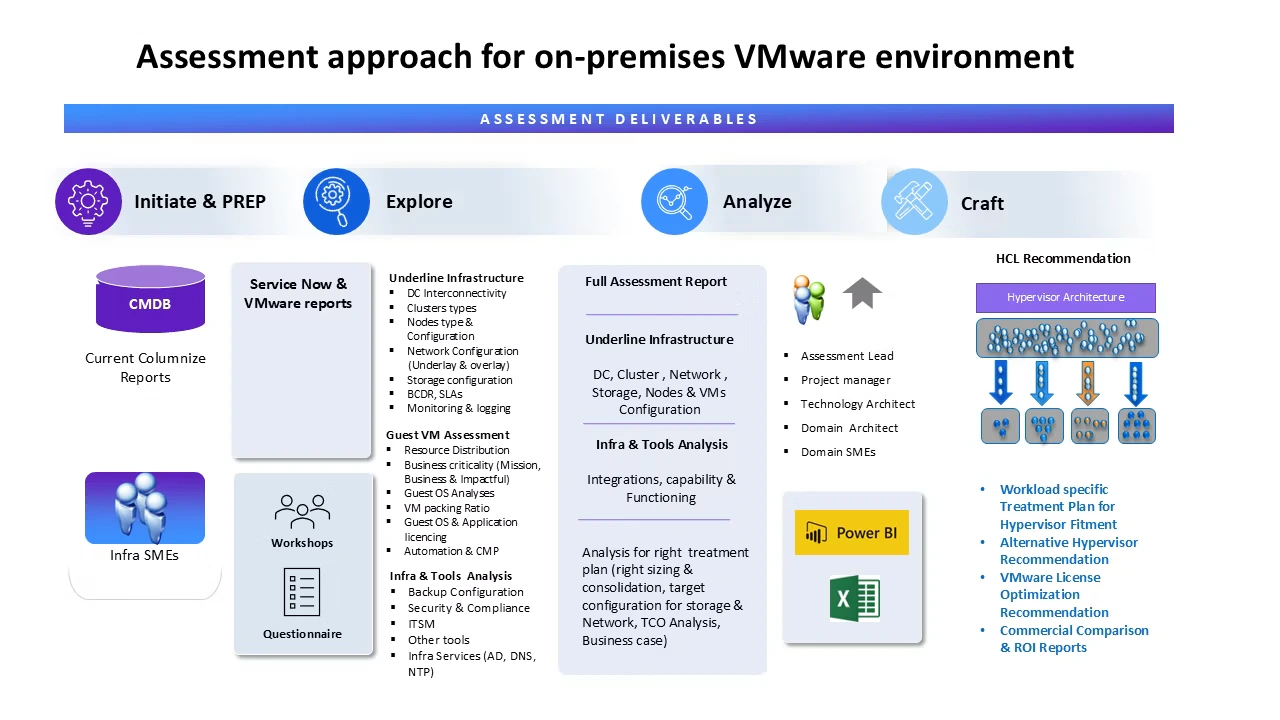
The HCLTech framework offers a systematic approach for assessing VMware alternatives within a client's VMware environment. It consists of four phases: Discover, Explore, Analyze and Craft, to ensure a consistent and organized assessment.
- Discovery and Explore: In the discovery phase, HCLTech gathers data using native tools and conducts multiple workshops with the HCLTech steady-state team. The rest of the data collection and validation occurs through workshops with infrastructure experts using questionnaires.
- Analyze: HCLTech analyzes the collected data using a predefined template during this phase. This includes evaluating the functionalities of the vSphere environment, storage, network and tools. They also check compatibility, dependencies, integration and risk mapping against the target hypervisors.
- Craft: The Craft phase covers compatibility for the guest operating system in relation to the target hypervisor, recommends alternative hypervisors, delivers commercial comparisons and provides ROI reports, including a high-level implementation plan.
Alternative Platform Maturity against VMware
HCLTech has created a maturity index to evaluate alternative strategies, benchmarking VMware against leading platforms across eight key capability areas, including Hyper-V, Nutanix, Azure Local, AWS Outposts, OpenShift Virtualization, Oracle Linux Virtualization and Citrix Hypervisor. The index uses a simple high-medium-low rating system based on an assessment of over 70 enterprise virtualization features.
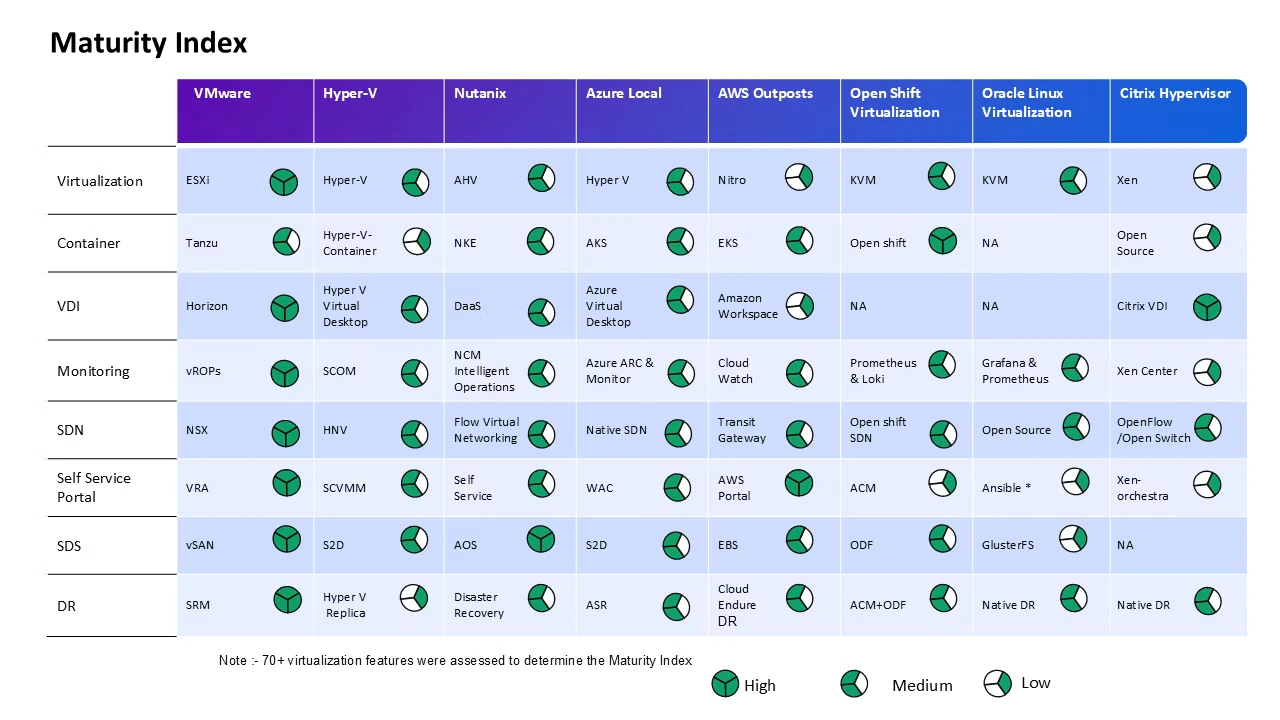
- No single alternative platform currently matches VMware's comprehensive maturity across all layers.
- Nutanix is the closest integrated alternative, especially for hyper-converged infrastructure, storage (AOS) and automation.
- Cloud-integrated platforms like Azure Local and AWS Outposts offer strong capabilities but rely heavily on their respective cloud ecosystems.
- OpenShift Virtualization stacks perform well in container-native settings but do not yet match the completeness of traditional enterprise infrastructure.
- Citrix is a solid option for virtual desktop infrastructure (VDI) and is often used alongside other platforms rather than as a full replacement.
Migration Planning and Workload Rationalization
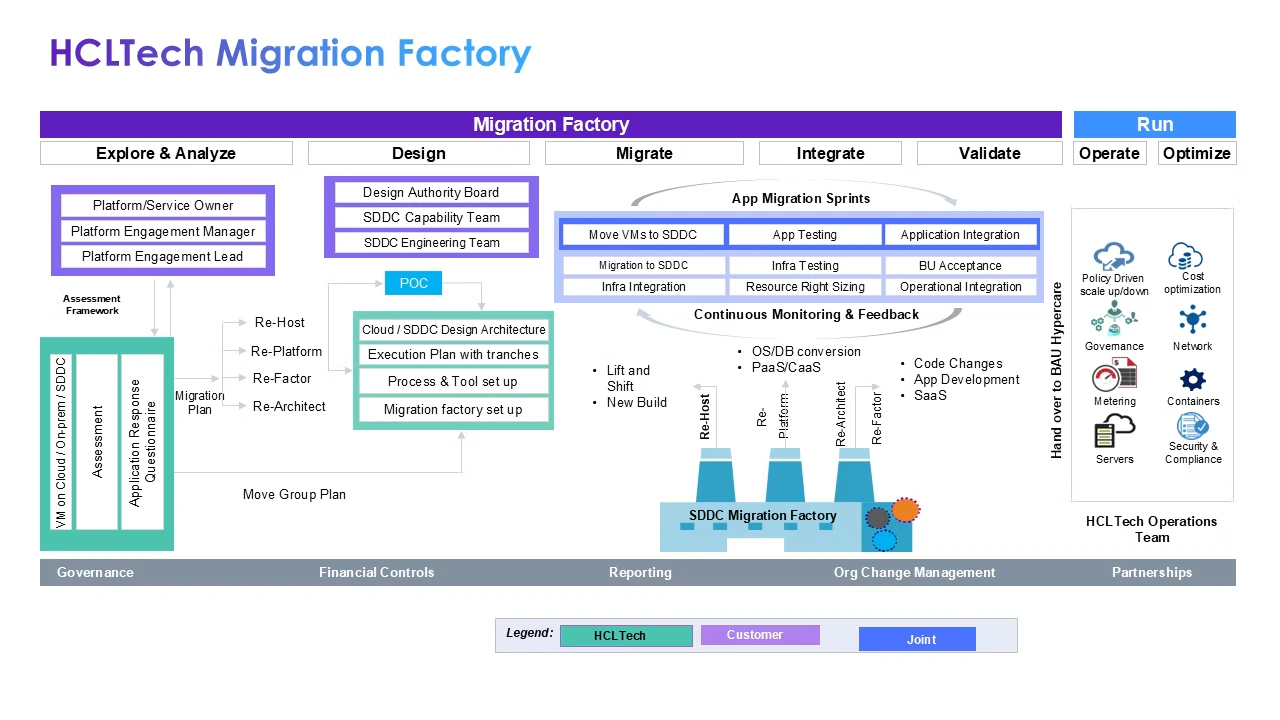
HCLTech will use its EXACT Framework to plan and execute the migration program. This framework provides a structured delivery approach covering assessment, design, build and migration, with governance, validation and handover throughout each phase.
HCLTech proposes a Migration Factory delivery model to implement the transformation in an organized, scalable and low-risk way. This approach employs the 4R framework—Rehost, Replatform, Rearchitect and Refactor—to match each workload with the most suitable migration path.
The Migration Factory follows a wave-based execution model, grouping workloads by criticality, complexity and dependency. Each wave progresses through a defined lifecycle of discovery, validation, migration, testing and stabilization, supported by automation and proprietary HCLTech accelerators.
Risk-Managed Transition Strategies
Risk Categories and Mitigation
Tracks | Risk Description | Business Impact | Mitigation Strategy |
| Maturity of Alternate platforms | Lots of effort and time involved in designing and building the target platform(s), considering compatibility and reusability while complying with customer security standards | Delay in migration projects |
|
| Upgrade of OS and Application | Cases where the conversion of VMs is not successful due to guest OS and application supportability, or compatibility may require refactoring guest OS and applications on fresh servers | Delay in migration projects Additional app team efforts |
|
| Dual Hypervisor Environment | During migration, two hypervisors may run simultaneously, resulting in operational complexity | Environmental complexity Additional Ops team effort |
|
| App Performance | Moving some applications to new target hypervisor may lead to unacceptable performance metrics | Delay in migration projects Additional App team efforts |
|
| Support from COTS vendor for migration | For COTS products to devise the migration strategy, vendor support is occasionally essential during migration planning to ensure a smooth migration path | Delay in migration projects |
|
| Unsupported Feature | Certain features (RDM, etc.) are unsupported on the target hypervisor even when a particular application leverages them | Delay in migration projects |
|

