


Overview
Zero Trust programs often stall at the same point: identity policies may be modern, but network access still relies on legacy VPNs, fragmented controls and broad network-level trust. The next step is to bring identity and network access decisions together—evaluating who is connecting, from what device, to which resource and under what risk conditions before access is granted.
Microsoft Global Secure Access (GSA) is a unified Security Service Edge (SSE) solution built on Microsoft Entra that secures access across all traffic types through three dedicated forwarding profiles such as Microsoft 365, Internet and Private Access with enabling granular, policy driven control. Microsoft Entra Internet Access delivers Secure Web Gateway (SWG) capabilities to protect internet, SaaS and Microsoft 365 traffic, while Microsoft Entra Private Access applies Zero Trust Network Access (ZTNA) to private applications. GSA verifies every access request based on user identity, device health, location and risk signals before granting least-privilege access and granting connectivity only to authorized applications, GSA enforces secure, least privilege access based on identity, device posture and contextual risk.
HCLTech SSE-GSA offering helps organizations transition from traditional network based security to an identity driven Zero Trust model, shifting protection from the network edge to an identity centric security framework. It enables clients to modernize remote access, strengthen security, simplify operations and deliver consistent user experience across cloud and private environments.
Current Challenges
Enterprises adopting a borderless operating model face a consistent set of pain points that legacy security architectures were never designed to solve.
- Flat network trust and lateral movement: Traditional VPNs often grant broad Layer-3 network access after authentication, creating excessive privileges and increasing the risk of lateral movement if credentials are compromised. Publicly exposed VPN gateways can also expand the organization’s attack surface.
- Perimeter trust assumptions no longer hold: The castle-and-moat model implicitly trusts anything inside, an assumption invalidated once data and identities live outside the network boundary.
- Appliance sprawl and cost: Perimeter security appliances and point tools (VPN Gateway, Proxies) are expensive to license, scale and maintain and struggle to deliver consistent policy across users, devices, apps and data.
- Fragmented policy and Visibility: Network and identity managed as separate domains produce inconsistent controls and gaps across SaaS, private apps, generative-AI services and internet destinations undermining unified governance and compliance reporting.
- Degraded user experience: Manual VPN sessions and traffic hair pinning through central data centers add latency and erode productivity for a distributed workforce.
- Migration complexity: Moving away from an established VPN requires careful planning, including application dependency mapping, port and address documentation, private name resolution, Conditional Access design and rollback procedures, which stalls many transformation programs.
HCLTech Solution:
HCLTech delivers a structured, outcome driven GSA adoption journey that derisks the shift from perimeter based security to identity first Zero Trust. Our approach leverages the full Microsoft SSE stack while wrapping it in proven delivery of accelerators and managed services.
Architecture Diagram
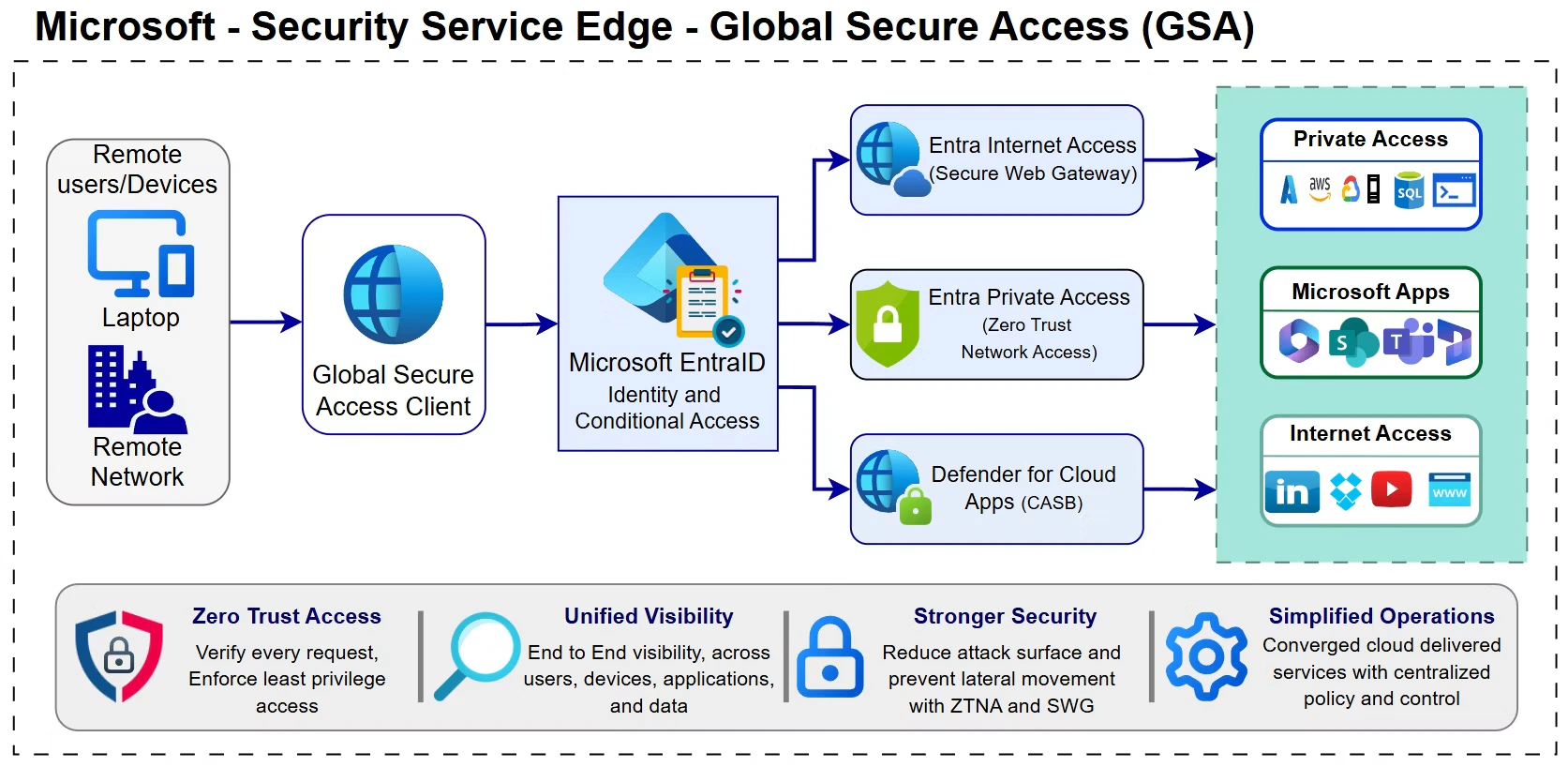
Assess and Design
We inventory every access path—on-premises applications, SaaS, internet egress and AI workloads—to identify policy gaps, then produce a target state SSE reference architecture (traffic forwarding profiles, remote network topology, private app segmentation and Conditional Access model) mapped to data sensitivity, user personas and device trust. The output doubles as an executive roadmap with phased milestones and measurable risk reduction targets.
Modernize Remote Access with Entra Private Access
We replace VPN network access with identity centric ZTNA per-application publishing via Private Access connectors, so users reach only the specific applications they are entitled to no inbound ports, no exposed subnets. Quick Access and per-app enterprise applications, combined with private DNS, deliver a phased VPN to ZTNA cutover that leadership can track against decommissioning KPIs.
Secure Web and SaaS Traffic with Entra Internet Access
We deploy the identity based Secure Web Gateway to filter web content, enforce tenant restrictions (preventing data leakage to personal accounts), apply TLS Inspection (preview) and block malicious traffic all integrated with Microsoft Defender for Cloud Apps and Shadow IT governance across the SaaS estate.
Unify Policy through Conditional Access
We bring identity and network access policies together through Microsoft Entra Conditional Access, enabling more consistent access decisions that evaluates identity, device compliance, session risk and network context enforcing least privilege uniformly across private apps, SaaS and the open internet and eliminating policy drift between stacks.
Deploy Safely and Operate at Scale
Following Microsoft best practices, HCLTech starts with broad Quick Access for discovery and pilot deployments, then transitions to granular per-application access, we stage policies in report only mode, exclude break glass accounts, access licensing (Entra ID P1/P2 or the Entra Suite) and support coexistence and migration from Zscaler, Palo Alto, Netskope and Cisco during transition. Our managed services then handle monitoring, tuning and optimization, with GSA traffic logs streamed into Microsoft Sentinel for continuous visibility and SOC correlation.
Benefits
Adopting Global Secure Access through HCLTech helps organizations translate Global Secure Access capabilities into measurable security and operational outcomes:
- Stronger security posture: Explicit verification of every request under Zero Trust principles reduces both breach likelihood and blast radius, directly improving the enterprise risk profile.
- Minimized attack surface and lateral movement: Per-application access renders internal resources invisible unless explicitly authorized, so the compromised credential cannot pivot across the network.
- VPN elimination and cost savings: Replacing legacy VPN solution and perimeter proxies removes hardware refresh cycles and shifts enforcement to software defined, identity based policy.
- Seamless - Low Latency Experience: Traffic is routed through Microsoft’s global backbone, spanning more than 70 regions and 190+ edge locations is providing fast, always on access from anywhere, improving workforce productivity and adoption.
- Unified governance and audit readiness: Single Conditional Access model governs private apps, this approach enables consistent security policies across private applications, SaaS and internet traffic simplifies compliance evidence and closes control gaps.
- Future - ready Zero Trust foundation: Identity centric platform natively woven into Entra ID, GSA positions the enterprise for evolving needs including securing AI apps and agents protecting the investment over time.
Conclusions:
The perimeter is no longer a place: it is an identity With Microsoft Global Secure Access and HCLTech’s proven delivery expertise, organizations can accelerate their Zero Trust journey, enterprises can retire risky VPNs, unify their access policy and build a resilient Zero Trust foundation for the borderless workplace.
“Connect with the HCLTech Cloud Security CoE for MS-SSE-GSA readiness assessment”

