
As enterprises accelerate digital transformation, sustainability is no longer a parallel initiative. It is becoming a core design principle of modern IT. Organizations are increasingly adopting cloud technologies not only to drive agility and scale, but also to reduce the environmental footprint of their digital operations.
Hyperscale cloud providers such as AWS, Microsoft Azure and Google Cloud have made significant investments in energy-efficient infrastructure, renewable energy procurement and carbon transparency. These efforts have positioned cloud platforms as powerful enablers of sustainable IT. However, translating cloud capabilities into measurable ESG outcomes requires more than migration alone. It demands an integrated hybrid cloud strategy, continuous optimization and ecosystem collaboration.
This is where HCLTech plays a critical role - helping enterprises move from cloud efficiency to cloud-enabled sustainability.
Cloud providers: Laying the Sustainability foundation
Public cloud platforms offer structural advantages that make them inherently more sustainable than traditional on-prem environments.
Infrastructure efficiency at hyperscale
Cloud providers design and operate global infrastructure optimized for maximum utilization. By consolidating workloads across millions of customers, hyperscalers significantly reduce idle capacity. Advanced cooling technologies, AI-driven energy management and industry-leading Power Usage Effectiveness (PUE) metrics further lower the energy intensity of compute.
Renewable energy at scale
Leading cloud providers are among the world’s largest corporate buyers of renewable energy. Through long-term Power Purchase Agreements (PPAs), Renewable Energy Certificates (RECs) and direct investments in solar and wind projects, they are actively accelerating grid decarbonization. These investments create sustainability benefits that extend well beyond individual data centers.
Embedded sustainability transparency
Cloud native tools such as the AWS Customer Carbon Footprint Tool, Microsoft Sustainability Manager and Google Cloud Carbon Footprint provide customers with unprecedented visibility into emissions associated with their cloud usage. This transparency is a critical enabler for informed decision-making and credible ESG reporting.
Together, these capabilities make cloud adoption a strong first step toward more sustainable IT operations.
Sustainability in the cloud: A Shared responsibility model
Much like security and resilience, sustainability in the cloud operates under a shared responsibility model.
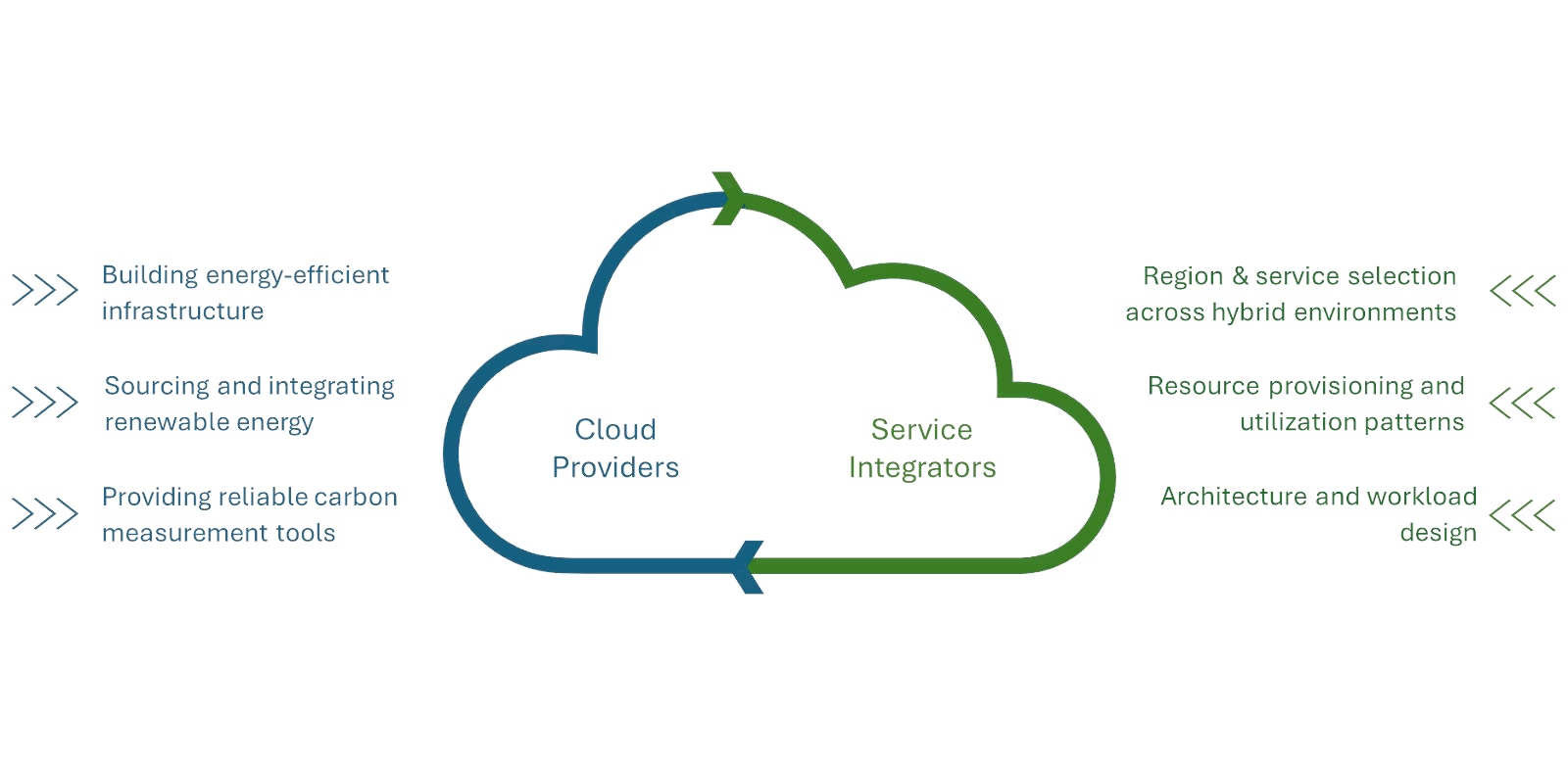
When these responsibilities are aligned, organizations can unlock the full sustainability potential of cloud platforms.
The Hybrid Cloud reality: Where complexity meets opportunity
Most enterprises operate in hybrid and multicloud environments, combining on-prem infrastructure with multiple public cloud platforms. While cloud providers offer strong sustainability foundations, achieving consistent, enterprise-wide ESG outcomes across this landscape requires orchestration beyond any single platform.
HCLTech addresses this challenge by enabling sustainability across the entire hybrid cloud value chain.
How HCLTech enables Sustainable Hybrid Cloud outcomes
HCLTech brings together deep cloud engineering expertise, sustainability domain knowledge and industry-scale delivery capabilities to help enterprises operationalize sustainability in the cloud.
Unified carbon visibility and ESG reporting
HCLTech helps enterprises integrate native cloud sustainability tools with third-party ESG and carbon management platforms to deliver a single, consistent view of emissions across public cloud, private cloud and on-prem environments. This enables:
- End-to-end visibility across Scope 2 and relevant Scope 3 emissions
- Alignment with global frameworks such as the GHG Protocol and CSRD
- Audit-ready, regulator-aligned sustainability reporting
Sustainable cloud architecture and optimization
Beyond cloud migration, HCLTech focuses on continuous optimization through:
- Right-sizing and modernization of cloud workloads
- Carbon-aware region and service selection
- Converged FinOps and GreenOps practices to balance cost, performance and environmental impact
- Identification and elimination of overprovisioned and underutilized resources
These practices help enterprises achieve measurable reductions in both cloud spend and carbon footprint.
Governance-driven sustainability by design
HCLTech embeds sustainability into cloud operating models by:
- Designing sustainability guardrails within cloud landing zones
- Integrating ESG considerations into DevOps and platform engineering pipelines
- Establishing policies for responsible consumption, lifecycle management and procurement
This ensures sustainability is not an afterthought, but a built-in capability across the hybrid cloud estate.
From Cloud adoption to measurable ESG impact
While hyperscale cloud providers deliver the infrastructure and energy foundations for sustainability, achieving net-zero and broader ESG objectives requires deliberate, data-driven action.
HCLTech supports enterprises across the sustainability maturity curve by enabling:
- Accurate emissions baselining across hybrid cloud environments
- Continuous measurement using cloud native and third-party tools
- Optimization-led reductions through architectural and operational improvements
- Governance models aligned with evolving regulatory requirements
- Advanced decarbonization levers, including renewable energy strategies and high-quality offsets, where appropriate
This approach transforms cloud adoption from a technology initiative into a measurable ESG enabler.
The Path forward: Cloud innovation, enabled by HCLTech
Hyperscale cloud providers are making bold investments in greener infrastructure, renewable energy and transparency, creating a strong foundation for sustainable IT. However, sustainability is not achieved through infrastructure alone. It requires intentional design, continuous optimization and enterprise-wide governance.
HCLTech partners with organizations to bridge this gap, helping them harness cloud innovation to build responsible, resilient and sustainable hybrid cloud environments. By combining cloud provider capabilities with HCLTech’s sustainability-led engineering and governance expertise, enterprises can move beyond efficiency gains to deliver real, measurable ESG outcomes.
In this journey, the cloud is not the destination - it is the catalyst. HCLTech helps turn that catalyst into lasting sustainability impact.