


The convergence of 5G, decentralized edge computing and programmable network slicing has reshaped the operational landscape for Communications Service Providers (CSPs). What was once a straightforward strategic goal of managing surging traffic volumes while reducing operational costs and maintaining stringent Quality of Service (QoS) has evolved into a complex challenge that demands automation beyond traditional scripting.
While GenAI has proven valuable in synthesizing massive datasets, generating insights and enabling predictive analysis, the “What If” layer still stops short of execution. The real bottleneck lies in translating intelligence into autonomous action. This is where Agentic AI comes into play. Unlike conventional AI systems that assist with decision-making, Agentic AI agents are designed to perceive, plan, act and learn independently. These distributed, goal-driven entities represent a paradigm shift from intelligent support to self-driving network operations.
For CSPs, this means reimagining NetOps not as a reactive function but as a proactive, self-evolving system. Agentic AI can eliminate the latency and inefficiencies inherent in traditional incident resolution workflows by autonomously identifying issues, initiating corrective actions and continuously optimizing performance.
This is not just another AI narrative; it is a technical blueprint for operational transformation. By embedding Agentic AI into the core of network operations, CSPs can unlock a new era of agility, resilience and cost-efficiency.
Architectural foundation: The six-pillar Agentic NetOps framework
To reliably achieve self-sustaining NetOps, a layered architecture is required to facilitate autonomous, context-aware decision-making and secure action. This six-layer consultant-level framework ensures the scalability and governance of the agent ecosystem:
Data and telemetry ingestion:
A critical entry point for high-volume, real-time data is required for agent perception
- Data sources: Raw network data from
- Routers
- Switches and firewalls
- Call Data Records (CDRs)
- Customer call drops
- Logs and events from ServiceNow and Bugzilla
- Mechanism: Source system connectors and file uploads
- Data sources: Raw network data from
Data store and knowledge base:
Provides contextual memory and high-fidelity reference for agent reasoning
- Storage models: OpenSearch, NoSQL, vector databases, file store, knowledge graph (e.g., Kuzu)
- Content: Stores coding guidelines, test plans and scripts, tickets, bugs, KB articles, requirements, user stories and source code (SVN)
Foundation and reasoning models:
The core cognitive engine for semantic understanding and planning
- LLMs: OpenAI, Gemini, Llama 3, Claude, Phi-3
Agent abstraction and tooling (usage modes)
The execution layer is comprised of specialized AI entities equipped with defined capabilities
- Agent types: Network copilot, topology builder, RAG builder, repository configurator, model config, multi-agent orchestration
- Interfaces: Utilizes API wrappers and tools like GitHub Copilot to interact with external systems
Governance and orchestration:
The meta-control plane ensures agent actions are compliant, auditable and aligned with high-level business intent
- Policy enforcement: Governance, risk, compliance, security, FinOps
- Traceability: Telemetry and audit/logging for Explainable AI (XAI)
Consumption and deployment:
Defines the integration points for both human supervisors and network infrastructure
- Deployment modes: Standalone, embedded in systems, APIs (headless), edge deployments, multi-agent orchestration
NetOps incident management: The 9-step autonomous flow
The deployment of a NetOps Agent transforms reactive incident management into a proactive, closed-loop system, directly addressing the business goal of MTTR reduction. Below is the standard enterprise incident lifecycle:
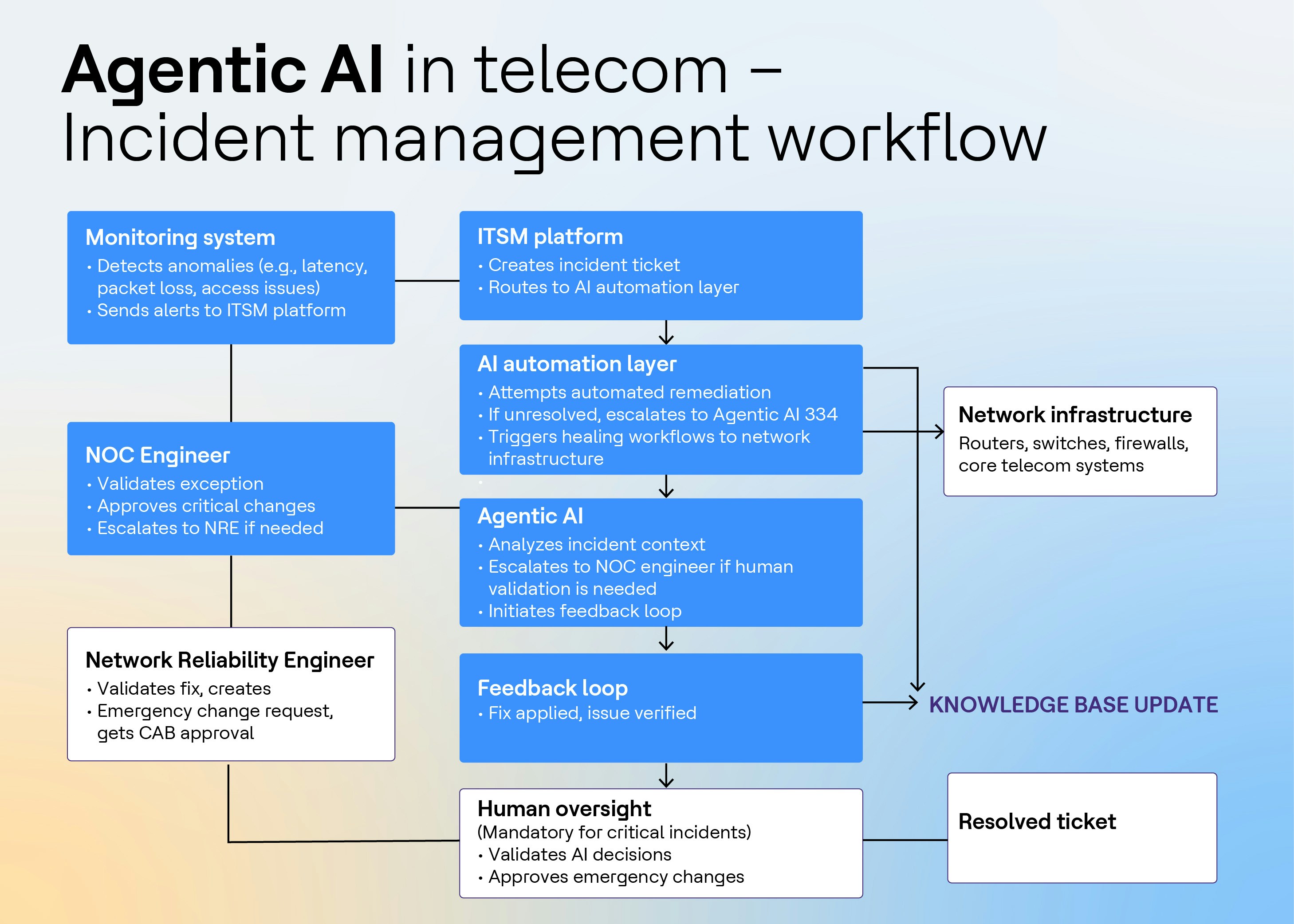
| Step | Agentic NetOps incident flow | Rationale and agent function |
|---|---|---|
| 1 | Detection and triaging | Network infrastructure data from routers, switches, firewalls and other network elements feeds into a dashboarding tool (e.g., Splunk). Data from network elements is continuously monitored at the dashboarding layer. |
| 2 | Ticket creation | An issue detected at the dashboarding tool registers the network issue, triggering the creation of a ticket in an ITSM tool (e.g., ServiceNow). Standardizes the incident record, moving the issue into a managed workflow. |
| 3 | Automation trigger | Once the ticket is created, an automatic resolution attempt is triggered via an automation runbook. This is a first-level attempt to fix known issues, utilizing a tool like iAutomate or a generic automation tool to resolve the issue. |
| 4 | Agent assignment | If the initial automation runbook fails to remediate the fault, the ticket is assigned to a specialized NetOps Agent. Hands over ownership of the resolution goal to the autonomous AI entity. |
| 5 | Diagnosis and root cause | The agent first queries the Known Error Database (KED) for historical solutions. It retrieves topological data, path information, configuration and QoS statistics from a central source of truth to diagnose the issue's main reason. Utilizes RAG and contextual memory to move beyond symptom correlation, checking the quality of service and diagnosing the root cause before recommending a solution. |
| 6 | Remediation plan | The agent plans the resolution, including the recommended fix (e.g., a configuration change or traffic re-route) and the code required to execute it. It then updates the ITSM ticket with the fix. Executes complex planning using LLM capabilities and external tooling access, ensuring the ticket is updated with the resolution method and the fix. |
| 7 | Knowledge base update | The successful remediation and its details are immediately stored back into the KED or knowledge base. Accelerates the collective intelligence of all agents, improving future agent performance and preventing future recurrence of the same fault. |
| 8 | Verification and QoS assurance | The NetOps agent or a specialized SLA assurance agent verifies the fault resolution and checks service quality restoration. This new, effective resolution is added to the agent’s knowledge to automatically resolve this issue for new application creation. Ensures the fix is effective, applies the fix as a class-to-QoS update for new applications and formally updates the knowledge base. |
| 9 | Human closure | The Network Engineer checks that the application exists, validates the suggested fix and formally closes the ticket in the ITSM tool. Maintains the final human-in-the-loop audit and sign-off, often including steps like checking if the application exists, validating the fix and creating a Change Advisory Board approval. |
Levating human oversight: From troubleshooting to strategic supervision
As Agentic AI systems take on the heavy lifting of incident resolution and operational execution, the role of human oversight evolves. Engineers and network operators shift from reactive troubleshooting to strategic supervision and validate agent decisions, refine system guardrails and ensure alignment with broader business and compliance objectives. This transition elevates human contribution to a high-value governance layer, where expertise is applied not to fix issues but to shape and steer autonomous behavior.
The next frontier
The potential of Agentic AI extends beyond incident response. It lays the foundation for level 4/5 autonomous networks, where operations are not only intelligent but fully self-directed. To realize this vision, technical leaders must focus on building collaborative agent ecosystems that address key operational domains:
Network copilot
A conversational interface enabling engineers to interact with the network using natural language. Agentic AI interprets intent, validates commands and executes multi-step actions to bridge human strategy with machine precision.
Topology builder
An autonomous agent that continuously constructs and updates a real-time graph of the network’s logical and physical topology. This dynamic map becomes an essential context for cross-domain root cause analysis and proactive fault isolation.
Repository configurator
Agents audit and reconcile live network configurations against the desired state repository. By detecting drift and enforcing compliance, they ensure operational integrity and security without manual intervention.
Multi-agent orchestration
In scenarios that require trade-offs, such as balancing energy efficiency with ultra-reliable low-latency communication, specialized agents collaborate and negotiate to achieve optimal outcomes across competing priorities.
Strategic imperative: Building the Agentic AI fabric
The future of network operations is defined by intelligence that is distributed, goal-driven and adaptive. Success will depend on how effectively CSPs can architect a robust, governed Agentic AI framework that scales with complexity, learns from experience and aligns with business goals. Investing in this transformation is not just a technological upgrade; it is a strategic shift; it is a strategic move toward sustained agility, resilience and economic efficiency.
