

Driving automotive safety forward with engineering resilience
Overview
A leading global automotive supplier was preparing to launch a next-generation driver monitoring system designed to enhance in-cabin safety by detecting driver distraction and drowsiness. However, as the program neared critical deployment stages, sudden global supply chain disruptions rendered key microcontrollers obsolete — threatening the system’s core functionality. With major vehicle programs underway in North America and Europe, the client seized the opportunity to redefine the vehicle safety standards while minimizing the potential revenue impact.
The Challenge
Seamless transition of the driver monitoring system to a new microcontroller architecture without functional loss
- Address microcontroller obsolescence through urgent, effective hardware redesign
- Redesign tightly integrated hardware-software system for seamless component replacement
- Ensure uncompromised safety-critical functionality, aligned with ISO 26262, AUTOSAR and ASPICE standards
- Maintain consistent functional safety across diverse vehicle platforms
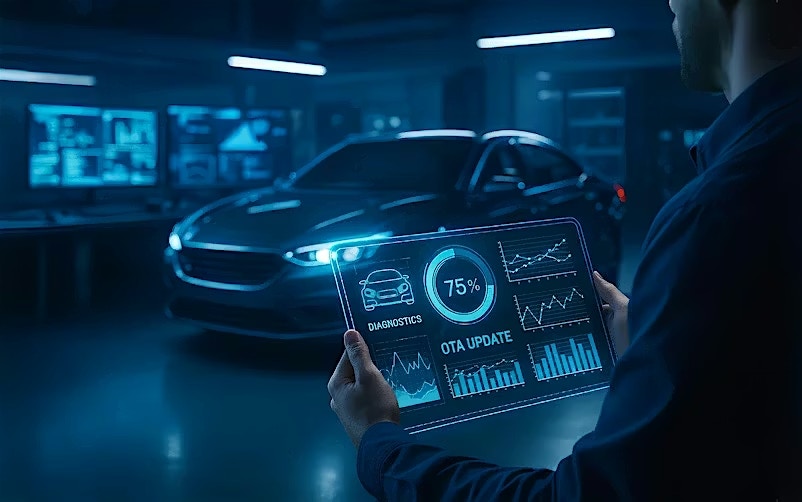
- Preserve and enhance advanced features like real-time diagnostics and OTA updates
- Support ongoing deployment and enable rapid adaptation to future requirements
The Solution
A structured engineering-led migration approach powered by multi- domain expertise
To overcome critical hardware obsolescence and ensure long-term system resilience, the client partnered with HCLTech to lead a high-velocity, structured migration. The focus extended beyond part replacement to a full transformation of the system architecture.
Key pillars of the approach included:
- Seamless hardware redesign: Leveraging VLSI and FPGA expertise, our team of experts redesigned PCBs and control systems to ensure signal integrity and enhanced processing speeds across vehicle variants.
- Software re-architecture for new silicon: Embedded software was ported and optimized with AUTOSAR-compliant modules, advanced algorithms for driver state detection and a robust, secure over-the-air update framework.
- ADAS-level verification and validation: Automated validation pipelines, including CAPL scripting and compliance checks aligned with ASIL-A/B, ISO 26262 and ASPICE, guaranteed no safety-function regressions.
- Multi-OEM program enablement: Cross-functional teams worked closely with OEMs, ensuring documentation, compliance reporting and support allowed agile adaptation even in a shifting supply chain landscape.
The Impact
Engineering resilience and speed-to-market amidst global uncertainty
- More than eight DMS programs delivered on-time, with no degradation in safety or feature sets
- Faster validation cycles, accelerating launches and reducing cost
- Mitigated supply chain risk, restoring OEM confidence and protecting revenue streams
- Architectural resilience, with enhanced OTA and diagnostics features positioned for future ADAS scaling

Verwandte Fallstudien

A leading automotive organization sought to modernize its application lifecycle management environment by introducing PTC Codebeamer as a central platform for engineering collaboration
Learn more
Transforming software asset management at scale with HCLTech and Flexera
Learn more
HCLTech developed SoC for next-gen automotive keyless entry for enabling seamless, connected vehicle access for modern automotive systems
Learn more
Vehicles are evolving into intelligent edge systems via software updates and connected services. Semiconductor strength, clear architectures, and disciplined execution will shape future mobility
Read more
A virtual‑first SiL platform enabled a global OEM to accelerate Level‑3 ADAS validation through modular workflows and TestSphere KDT, cutting test design effort by 75% and enabling sub‑day releases.
Learn more
Driving innovation and AI-powered customer experience for a global EV charging leader
Learn more