Artikel anhören
Enterprise AI has moved beyond isolated functional pilots and is now being embedded across core business processes, enterprise applications and everyday workflows. As adoption scales, organizations are beginning to see tangible gains in productivity, decision-making and customer experience.
The operational impact is increasingly visible. HCLTech’s latest research report, The Blueprint for AI Leadership, finds that 90% of organizations believe GenAI and Agentic AI are already having either a major or some impact on operational workflows and process efficiency. Similar impact is being seen in data accessibility (91%) and knowledge access and productivity enablement (90%). The majority of respondents (59%) also believe AI investment is essential to staying competitive.
Yet investment alone is not translating into equal value. AI Leaders, representing 18% of the sample, are maximizing return on investment (ROI) not simply by reducing costs but by using AI to drive growth, innovation and improved customer experience. AI Followers, who make up 60%, are also seeing returns, but continue to lag in the higher-value use cases that reshape operating models and create competitive advantage.
This divide is most visible in agentic and autonomous systems. AI Leaders are four times more likely than Followers to scale these capabilities, showing how unevenly organizations are moving from functional AI deployment to enterprise-wide transformation.
The gap reflects a broader structural and operational challenge. Many organizations are generating value from AI, but a persistent divide remains between what they expect AI to deliver and what they can realistically achieve. This is especially clear in commercial outcomes, where only 18% report AI significantly impacting revenue generation. The issue is not only technical, spanning data, architecture and enterprise applications, but also organizational, involving leadership alignment, ownership and the ability to drive change. The winners are not simply deploying more models or launching more pilots; they are using AI to redesign the enterprise itself.
Efficiency and transformation
Many organizations still measure AI ROI primarily through process speed and efficiency improvements (28%) or cost savings and productivity gains (23%). These indicators matter, but they provide only a partial view of AI’s broader impact, particularly in revenue growth, product innovation and long-term competitiveness.
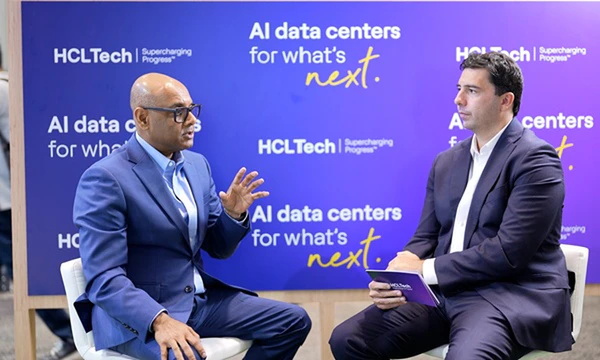
Such a narrow lens can limit the ability to unlock AI’s full value. “You can focus on efficiency-driven AI, or you can focus on transformation,” says Sadagopan Singam, EVP and Global Head, Enterprise Platforms and Edge Services, Digital Business Services, HCLTech. “Efficiency-driven AI is about process automation, whereas transformative AI is about reimagining and redesigning the processes themselves.”
The goal, he argues, is to reach orchestrated intelligence by aligning AI with business goals, embedding continuous workforce learning and balancing AI capabilities with governance and accountability. “These are the key factors separating Leaders and Followers. If all of them are in place, then you're actually creating a self-reinforcing loop that feeds more success.”
This is the crucial difference between productivity and advantage. Productivity is local: a task is completed faster, a report is generated more quickly or a support response is drafted with less effort. Advantage is systemic: decisions improve, workflows compress, exceptions are handled better and the enterprise begins operating with a different rhythm, quality and resilience. One is an efficiency gain; the other is a moat.
Larger organizations appear better positioned to progress toward this state. While they may face legacy complexity, they are also more likely to have the resources to address foundational requirements such as security and data discipline while advancing multiple AI initiatives. Firms with revenues exceeding $10 billion are almost seven times more likely to report that AI ROI significantly exceeds expectations and are more likely to be driven by clearly defined use cases.
AI initiatives, however, are often distributed across technology and infrastructure (76%), data and analytics (74%) and operations (47%). This reflects AI’s cross-functional relevance, but it also creates risk. Without clear leadership and alignment to business goals, accountability can fragment, decision-making can slow and impact can dilute.
Running the right race
Smaller organizations are not excluded from success. Those that address structural challenges and focus on enterprise-wide transformation rather than isolated use cases can still generate significant value. “It's not only about the size of the organizations,” says Singam. “It's also about where and how they want to apply AI.”
In practice, many firms operate with different definitions of success. “Organization A may call something a success while organization B may view the same outcome as a failure,” he says. “So, organizations shouldn't get too obsessed with how to win, because winning is completely subjective.”
Despite these differences, the barriers to scaling AI are widely shared. Legacy systems continue to limit organizations’ ability to scale AI effectively, while integration complexity, technical debt and vendor lock-in compound these challenges, particularly for those operating on fragmented technology foundations.
Organizational readiness adds another layer of constraint. Leaders are significantly more likely than Followers to believe they are investing sufficiently in organizational and talent readiness (67% versus 37%), highlighting a clear divide in how prepared organizations feel to support AI-driven change.
Workforce challenges are often cited, but the findings suggest they are less decisive than structural limitations and uneven readiness. This is where a full-stack reboot becomes essential. AI Leaders are not modernizing one layer of the stack; they are progressively rewiring data and semantics, process definitions, application estates, interoperability, governance models, talent design and workflow orchestration. They are asking not how AI can sit on top of the business, but what parts of the business must be rebooted so AI can become operationally intrinsic.
AI Leaders also tend to adopt more distributed ownership models, moving beyond “Highest Paid Person’s Opinion” (HiPPO) decision-making. Their ability to orchestrate AI across complex technical and organizational environments is a key differentiator. As Singam notes, while a single enterprise AI platform may be ideal, “organizations very rarely get there today, so the ability to orchestrate multiple platforms is important.”
The Agentic AI question
The shift toward Agentic AI will further test organizational readiness. According to Singam, this transition will intensify competitive divergence. “It will be winner takes all: What is the ideal human-to-agent ratio? What are the best metrics for measuring this?”
Confidence in AI’s transformative potential is high. Yet in many organizations, AI remains concentrated in areas where technical and workforce foundations are already strong, producing incremental gains rather than systemic change. These gains are often measured using metrics that fail to capture AI’s full impact on growth and competitiveness.
The agentic shift will make this measurement challenge sharper. In 2025, Gartner predicted that 40% of enterprise applications will include task-specific AI agents by the end of 2026, up from less than 5% in 2025. Gartner also predicts that by 2027, 40% of enterprises will demote or decommission autonomous AI agents due to governance gaps identified only after production incidents occur.
As Agentic AI scales, counting usage, tokens and isolated productivity gains will not be enough. The more meaningful questions will be whether workflows are becoming more reusable, decision-making is improving, cycle times are compressing without control breakdowns, institutional memory is accumulating and the enterprise is becoming easier to change rather than harder.
The organizations most likely to pull ahead share clear characteristics: sustained architectural modernization, robust data foundations, strong leadership alignment and cultures that empower employees to use, challenge and extend AI capabilities. These attributes enable organizations to move beyond efficiency gains and use-case expansion toward AI-driven relevance, where intelligence is embedded directly into enterprise applications, workflows and operating models.
Importantly, Followers are not locked into their current position. “The winner of tomorrow is going to be a Follower who's agitated about the gap,” says Singam. “With sufficient self-awareness and decisive action, organizations can still close the gap and potentially leapfrog today's Leaders.”