Artikel anhören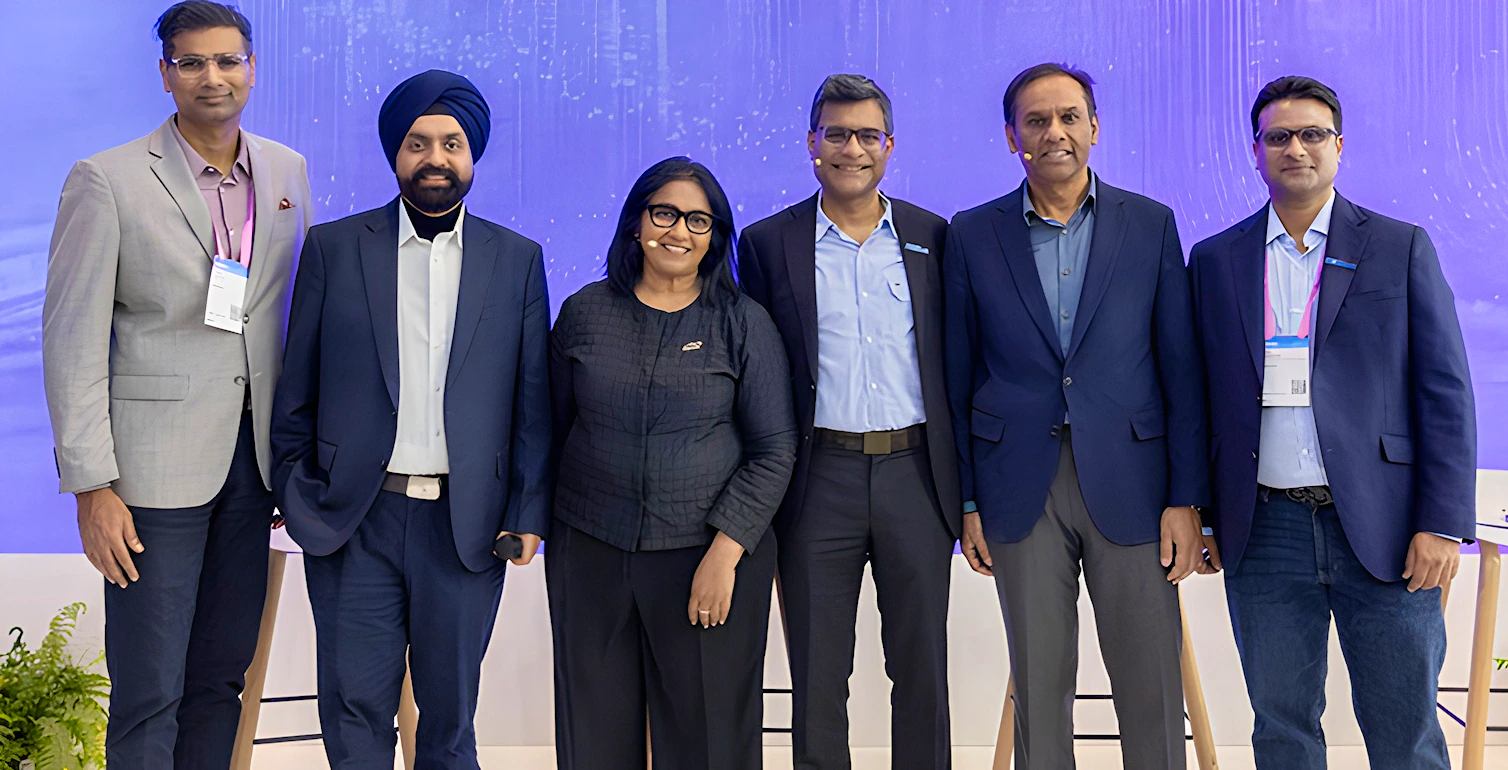
Across telecom, the narrative is shifting from if AI belongs in networks to how fast operators can operationalize it. Recent industry signals underline that momentum: a 2026 NVIDIA telecom AI survey reports that 65% of operators say AI is driving network automation and 89% plan to boost AI spending in 2026. Meanwhile, the GSMA has also announced “Open Telco AI” to accelerate telco-grade AI development, another indicator that the ecosystem is moving quickly.
But on stage at HCLTech’s booth, the panel was clear: autonomy is a journey, and the hard parts are as much organizational as they are technical.
Dr. Saikat Chaudhuri, Professor at UC Berkeley, moderated the discussion. He framed the central question: are telcos just automating, or actually moving “towards judgment, towards adaptation, towards decision making, towards optimization done by the network”?
Conservative execution, ambitious enablement
From AT&T’s perspective, autonomy requires deliberate pacing, because the downside risk is real.
Sarita Rao, Head of International Ecosystem Solutions at AT&T, said AT&T is “in the middle of it,” adding: “We’re beyond the beginning, but we’re…[not] close to the end of the possibilities.”
What matters most, she argued, is protecting the core: “You can’t be haphazard in the way you look at this. If you’re not in a very deliberate, purposeful action, you could put things at risk.”
Rather than framing the mission as efficiency versus growth, she positioned the autonomous enterprise as fundamentally about being smarter; “smarter with people’s time and smarter with the business customers trust them to run.” That includes “more intelligence on what’s happening…[and] more predictability on what could be happening at a customer location or site.”
Crucially, she described a model built around both guardrails and participation: “We have a very protected sandbox that we allow all of our employees to participate [in] to build [those] agentic capabilities,” while ensuring that governance “doesn’t feel restrictive, but it feels safe.”
Four streams to make autonomy real
“We are far from where we need to be,” said Aamir Hussain, Chief Technology and Product Officer at Liberty Latin America. In his view, telecom has talked about automation for decades, but complexity keeps rising while customers demand simplicity.
What changed in the last two years, he said, is the opportunity to rethink the model, if telcos address four practical streams:
- Processes: “We as telcos, have a lot of legacy…You automate a bad process, you will have a bad byproduct.”
- Data: “At the end of the day, we have more data than we can imagine…You [have] to put it all together and make it simple.”
- Technology: AI/ML isn’t new, but “ease of use has really made headways over the last 18 months.”
- Workforce: “Our workforce needs rescaling.” The next generation of workers will “not expect somebody to go in and open a spreadsheet and go do an SQL database query. They’ll say: ‘Where’s my agent AI interface?’”
He illustrated what has changed with a practical shift in executive workflow: instead of waiting weeks for dashboards and reports, users can now ask a personal AI agent to surface information in the format he prefers, and even non-technical leaders, like a CFO, can query the same data directly.
At the same time, he was practical about the reality of adoption. While AI tools are available to thousands of employees, active usage remains limited. The barrier is no longer access to technology, but culture. Embedding these tools into daily ways of working is still a work in progress.
Customer experience, monetization and “networks for AI”
Gurpreet Singh Kohli (GSK), EVP and Global Business Head – Telco and Enterprise Networks at HCLTech, aligned with both viewpoints: “It’s the journey [that] started decades back.” But he emphasized the customer and revenue implications now coming to the centre: “How will revenues enhance? How will customer experience move up? Customer journeys are changing.”
He also underscored how AI is transforming the journey from data to decision. Where structured data and big data once depended heavily on specialists to design and run complex queries, natural language interfaces now allow users to simply articulate what they need, with the system generating the queries automatically in the background. As models evolve further toward large reasoning capabilities, the potential to move from insight to action becomes even more powerful.
In his framing, that capability is influencing both “AI in networks and networks for AI.”
When asked for a concrete example, he pointed to edge-based deployments directly linked to measurable business outcomes. By shifting applications and data closer to the edge, organizations can create safer operating environments and reduce defects in production. In these scenarios, network availability and security move to the forefront, and, importantly, customers are willing to invest when they see a clear link between network performance and business value.
Governance and sovereignty: Autonomy can’t ignore regulation
If the panel agreed on one universal friction point, it was governance.
Hussain underscored the operational reality of regulation and data residency: as a regulated telco, “PII is extremely important to manage and [to] make sure we protect it at all costs.” He noted that operating across many jurisdictions creates sovereignty constraints: “A small place like the Cayman Islands, they don’t want their data going anywhere else.”
He described how Liberty Latin America’s approach evolved: early experimentation created sprawl and “a plethora of applications,” forcing stronger structure: “We were reminded that we have to ensure that we have the right structure, architecture, governance and framework in place.”
Rao reflected that same balance between enablement and protection, noting that AT&T remains “very restrictive on what…tools [are]…put onto their devices…because we know they’re safe,” underscoring the priority placed on controlled deployment and trusted environments.
And from the integrator perspective, Kohli broadened the responsibility frame: “With every new power comes responsibility. We can’t just go berserk with it, because we are now invading into people’s privacy.”
The network is the prerequisite, and the product
A recurring theme was that autonomy isn’t just software. Hussain argued that “network is going to be the killer product here,” because AI-enabled experiences require “a low latency, smart high-capacity network,” and “upload becomes much more important.”
Without a robust network and infrastructure foundation, even the most ambitious AI use cases remain theoretical. Innovation is only meaningful if it can be reliably delivered at scale.
What leaders said they personally need to change
The panel closed with a personal, practical challenge: what do leaders themselves need to do to stay ahead?
- Hussain: “Learn more. What I knew 18 months ago changed significantly…Just keep learning. Be open and be ready to change. If you are not going to change, you will probably become irrelevant…very quickly.”
- Rao: “Personal use is critical to understand how it works and how much do you rely on it. It’s the constant use…once you play with it, you get your own ideas of how you can apply that differently in your business.”
- Kohli: Ensure the network is “always available, always reliable and always secure,” with a focus on “how can we reduce down time to zero.”
Autonomy is an ecosystem play, executed step-by-step
Dr. Chaudhuri closed by reinforcing the gap between aspiration and reality: “we’re nowhere near having a fully automated telco.” But he also highlighted the path forward: the interplay of infrastructure, strategy, talent, governance and ecosystems, tackled incrementally rather than trying to “boil the ocean.”
The throughline from all three panellists was consistent: autonomous telecom won’t arrive through hype cycles or isolated tools. It will be built through disciplined process redesign, data foundations, guarded experimentation, workforce reskilling and network evolution toward customer outcomes that justify the investment.