


 Artikel anhören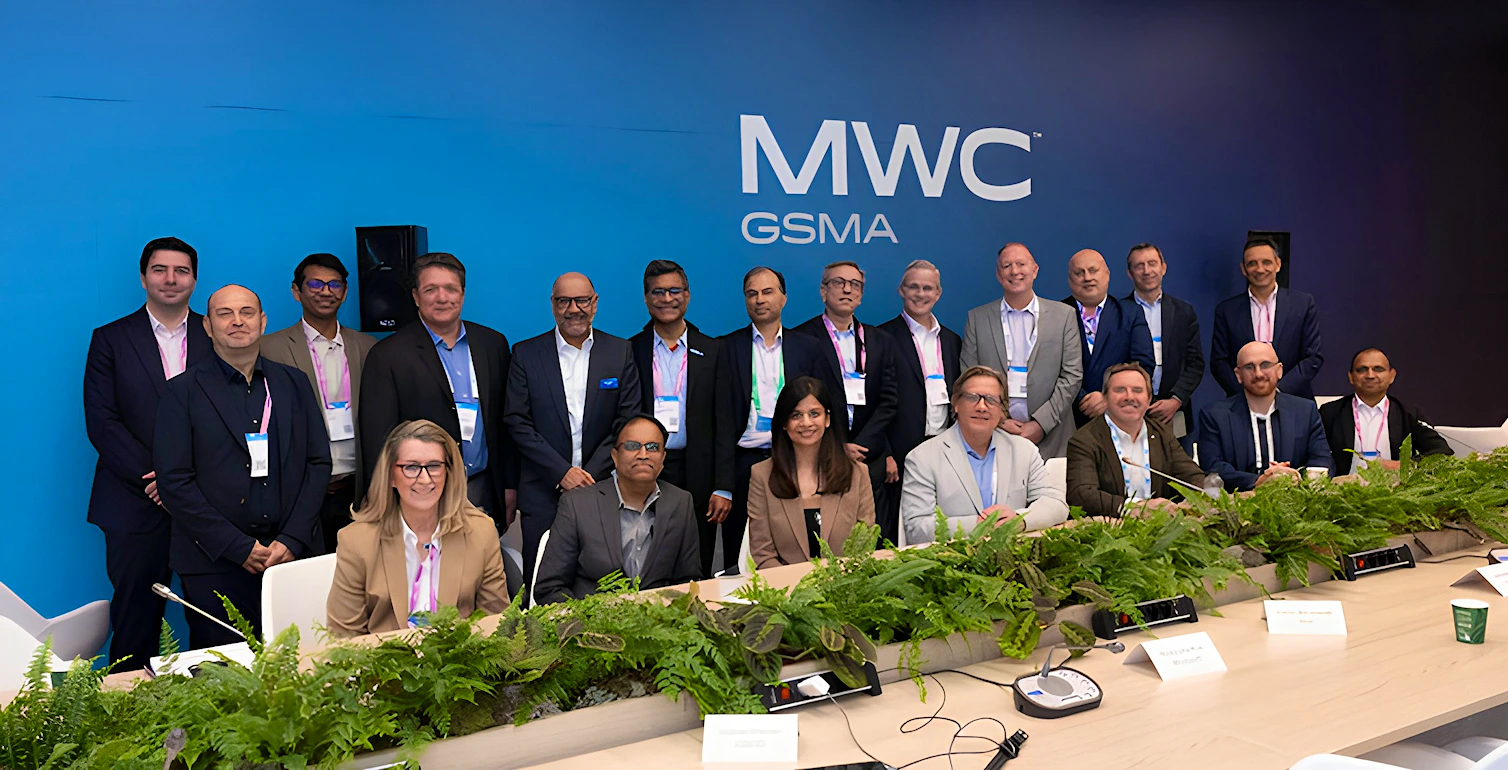
The discussion hosted by Anil Ganjoo, Chief Growth Officer and Global Head, Telecom, Media, Publishing & Entertainment and Technology, and moderated by Dr. Saikat Chaudhuri, Professor at UC Berkeley, stepped back from tactical debates about tools and architectures to focus on a broader question: what does the future organization look like in an industry being reshaped by rapid technological change?
Senior business and technology leaders from Meta, Microsoft, Cisco, Nokia, T-Mobile, Ericsson, Bain & Co, Extreme Networks, Salesforce and others explored how telecom, media and technology companies are redefining themselves as AI accelerates innovation across the sector. Traditional growth models are under pressure, competitive boundaries are blurring and technology is no longer a distinct vertical. Increasingly, it is becoming the operating model across industries.
Against that backdrop, the conversation examined where new sources of value may emerge, what barriers prevent organizations from capturing them and how companies can remain adaptable as both technology and market expectations continue to evolve.
Theme 1: Rebuilding growth around customers, data and monetization
A central thread was the idea that many TMT firms already sit on uniquely advantaged customer relationships, high-frequency engagement and rich operational data, yet have historically monetized only a fraction of that value. Leaders described a broad pivot away from the “connectivity as commodity” mindset toward a model where customer understanding, service personalization and outcome-led experiences become primary growth engines.
The opportunity is not limited to consumer monetization. Enterprise use cases, especially those tied to performance guarantees, reliability, security and experience, were repeatedly framed as areas where differentiated value can be created, provided firms can translate data into actionable services.
Theme 2: Why ecosystems are becoming the new operating model
Another consistent takeaway was that few organizations believe they can reach their next stage of monetization alone. Ecosystem operating models are becoming standard, not optional; spanning infrastructure providers, software platforms, data partners, application developers and industry-specific specialists.
Leaders emphasized that value increasingly comes from assembling capabilities across the stack and packaging them into coherent propositions, rather than trying to build every component internally. This includes partnerships between organizations that may have competed historically, reflecting a market where collaboration is becoming a practical requirement for speed, scale and differentiation.
Theme 3: Competing in a world of constrained revenue growth
The conversation acknowledged structural challenges affecting monetization across mature markets: price pressure, strong competition and regulatory dynamics that shape what can be charged for and how services can be differentiated. This led to a practical focus on where differentiation is still possible, such as:
- Experience-led services with clear performance needs, such as latency, reliability, uplink-heavy use cases and real-time responsiveness
- Segment of one hyper-personalization models grounded in real-time context rather than quarterly planning cycles
- Platforms that reduce friction for partners and enable faster proposition launch
The group also discussed the tension between innovation and regulation, noting that while regulation can constrain certain revenue models, it can also create clearer rules and trusted frameworks that enable adoption, especially where customer trust is at stake.
Theme 4: Trust as a strategic differentiator
Trust emerged as a direct commercial differentiator rather than a purely ethical or regulatory topic. Leaders noted growing sensitivity around privacy, data handling and reliability, especially as AI-enabled services become more embedded in everyday workflows.
In that context, responsible deployment is not simply risk mitigation. Instead, it supports brand strength, customer confidence and willingness to adopt new services. As AI-enabled propositions multiply and competition increases, trust can become one of the clearest mechanisms for differentiation.
Theme 5: Execution is the real barrier to innovation
While the conversation focused on the future organization, it repeatedly returned to execution reality. Legacy infrastructure and accumulated technical debt were seen as major constraints on speed-to-market and the ability to scale new models. Several leaders highlighted that the cost of change can erode the business case for innovation if modernization is not approached strategically.
The group also addressed a second execution challenge: the proliferation of pilots and fragmented experiments. As innovation becomes easier and faster, organizations risk spreading energy across dozens of small initiatives that never scale. The need is shifting from “how to start” to “how to focus,” prioritizing fewer, higher-impact bets aligned to business value.
Theme 6: Growth must align with core capabilities
Leaders debated where growth should come from and cautioned against pursuing adjacent revenue streams that do not match core capabilities. Past examples across the industry were referenced indirectly: acquisitions or diversification moves that failed because organizations could not operationalize them, sell them effectively or integrate them into an existing operating model.
A counterpoint emerged: sustainable growth is often achieved by staying close to the core, then modernizing and re-packaging that core through software-led models, platform thinking and ecosystem partnerships. The emphasis was on building a defensible “right to win,” rather than chasing the newest category.
Theme 7: Scaling AI requires organizational change
AI diffusion was framed as an organizational change challenge more than a technology challenge. Leaders described adoption constraints across three levels:
- Individuals: productivity tools, daily workflow integration, trust and skills
- Teams: collaboration, shared data context, role redesign
- Enterprises: governance, operating model, cross-functional alignment, investment discipline
Culture and mindset were repeatedly cited as bottlenecks, particularly among experienced teams that may resist new ways of working. However, the group also noted that culture is not only “people-based;” it can be scaled through processes, tooling, incentives and structured enablement.
Several approaches surfaced as mechanisms to drive adoption and innovation:
- Baseline AI literacy programs
- Hackathons and structured experimentation
- Gamification and internal tool marketplaces
- Clear measurement frameworks tied to business value
A recurring point was that transformation must be measurable. Organizations need shared metrics and a clear line of sight between initiatives and outcomes, whether revenue growth, customer experience improvement, faster time-to-market or structural cost shifts.
Theme 8: Why interoperability will shape the next phase of AI adoption
Leaders also discussed how industry-wide interoperability will shape what scales. As AI tooling matures, emerging protocols and standards were seen as early signals of how ecosystems will connect, how trust will be operationalized and how solutions will be deployed across organizational boundaries.
The implication was that the market is still early: meaningful scale will come as interoperability improves, standards consolidate and infrastructure becomes more capable of supporting increasingly complex, real-time workloads.
The leadership agenda for the next era of TMT
The roundtable converged on a clear view: the next era of TMT will be defined less by traditional category labels and more by its ability to operate like a best-in-class technology company: customer-led, ecosystem-enabled, trust-driven and execution-disciplined.
Success will depend on focusing on monetizable value anchored in the core, building differentiated services where experience and outcomes matter and scaling adoption through culture, process and metrics, not just tools. In a market where disruption is continuous and outcomes are harder to defend, agility and adaptability are becoming the most durable advantages.


