


 Artikel anhören
The global regulatory environment in life sciences has become a competitive battleground. Pharmaceutical, biotech and medtech organizations that treat regulatory affairs as a back-office function are systematically undervaluing one of their most consequential strategic levers. Three pressures are converging: regulatory velocity is accelerating, health authority updates are multiplying across hundreds of global portals and market access windows are tightening. In response, industry leaders are transforming regulatory operations into an intelligence-driven capability. The question for CXOs is not whether to modernize regulatory operations, but how quickly the organization can make the shift before the cost of inaction compounds.
The breaking point: Regulatory complexity is outpacing operating models
Global life sciences organizations face an unprecedented volume of regulatory activity. Health authority updates now flow from hundreds of health authority portals such as FDA, EMA, MHRA, WHO and dozens of regional bodies, each with its own cadence, format and regulatory expectation. The volume of updates has grown dramatically, while response timelines have compressed. The result is a structural mismatch. Regulatory teams built for a lower velocity world are now being asked to operate at a speed and scale that their current tools simply cannot support.
This structural mismatch is already surfacing across the regulatory operating model. Monitoring teams remain heavily occupied with manual aggregation and triage, work that consumes expert level capacity without generating strategic insight. Labeling updates are slowed by fragmented authoring workflows and repeated manual review cycles, while competitive intelligence is often treated as a periodic reporting activity rather than a continuous strategic capability. As a result, leadership lacks real-time visibility into competitor approvals, withdrawals, pipeline movements, regulatory milestones and market positioning, creating blind spots that can delay strategic decisions and weaken competitive response.
This is not a resourcing problem. It's a structural one. Higher headcounts don't solve fragmentation and more processes don't solve the absence of connected intelligence. The operating model itself must change.
Operating model shift: From reactive to proactive
Current state | Future state (AI-enabled) |
|---|---|
Manual monitoring of health authority portals | AI-driven autonomous intelligence |
Fragmented, siloed tools | Unified, connected regulatory platform |
Reactive regulatory actions | Proactive regulatory strategy |
Weeks-long labeling cycles | Hours-to-days label execution |
Human-intensive document comparison | Automated guideline analysis |
Limited competitive visibility | Real-time competitive intelligence |
Why point solutions are failing
The regulatory technology market has generated a proliferation of specialized tools, monitoring platforms, labeling systems, submission managers and competitive trackers, each solving a discrete problem in isolation. The cumulative effect is not efficiency; it's fragmentation. Intelligence gathered in one system does not propagate to another. A regulatory change detected in a monitoring tool requires manual re-entry into a labeling workflow. A labeling update does not automatically trigger a downstream submission check. The organization ends up owning a collection of disconnected point solutions that collectively fail to replicate the integrated intelligence that the regulatory function requires.
This fragmentation carries a compounding cost:
- Duplication of data entry increases error rates
- Version mismatches among the Summary of Product Characteristics (SmPC), Patient Information Leaflet (PIL) and package labels pose safety risks
- The absence of a shared cognitive layer means every function is working from a different and potentially stale view of the regulatory environment
- As regulatory complexity increases, the coordination overhead required to manage multiple disconnected systems scales faster than the teams managing them
The solution architecture must match the problem architecture. Regulatory operations are an end-to-end workflow, from signal detection to impact assessment, from labeling to submission and from regulatory monitoring to audit readiness. A platform that integrates these functions through a shared intelligence layer is not a luxury; it's the minimum viable capability for operating at the pace global regulation now demands.
The shift: From regulatory affairs management to strategic intelligence engine
The organizations redefining regulatory excellence share a common characteristic: they have stopped treating regulatory affairs as a cost center and started treating it as a source of strategic intelligence. This requires fundamental reorientation, from reactive regulatory affairs management to proactive strategy, from manual effort to autonomous intelligence and from disconnected tools to an integrated platform.
AI in regulatory affairs is not a future aspiration. It is a competitive advantage:
- Agentic AI systems can now autonomously crawl, classify and prioritize regulatory updates from hundreds of global health authority portals. They can detect guideline changes, assess impact against current labels and submissions and recommend revised wording without waiting for a human analyst to initiate the cycle.
- In labeling, AI can auto-generate near-final SmPC, PIL and Instructions for Use (IFU) drafts, propagate changes across all label types and markets simultaneously and maintain a complete, auditable version history.
- For competitive intelligence, AI-enabled continuous monitoring transforms fragmented market signals into a continuous strategic intelligence layer, giving leadership early visibility into competitor approvals, withdrawals, safety actions and regulatory moves so they can anticipate market shifts, strengthen positioning and make faster, more confident strategic decisions.
The shift to AI-driven regulatory intelligence does not replace the regulatory scientist. It elevates the function. Routine aggregation, comparison and drafting tasks move to autonomous agents. The human expert engages at the point of judgment, reviewing AI-generated recommendations, making strategic decisions and directing the organization's regulatory positioning. This reallocation of human capital from low-value to high-value work is where the transformational impact is realized.
What a future-ready regulatory platform looks like
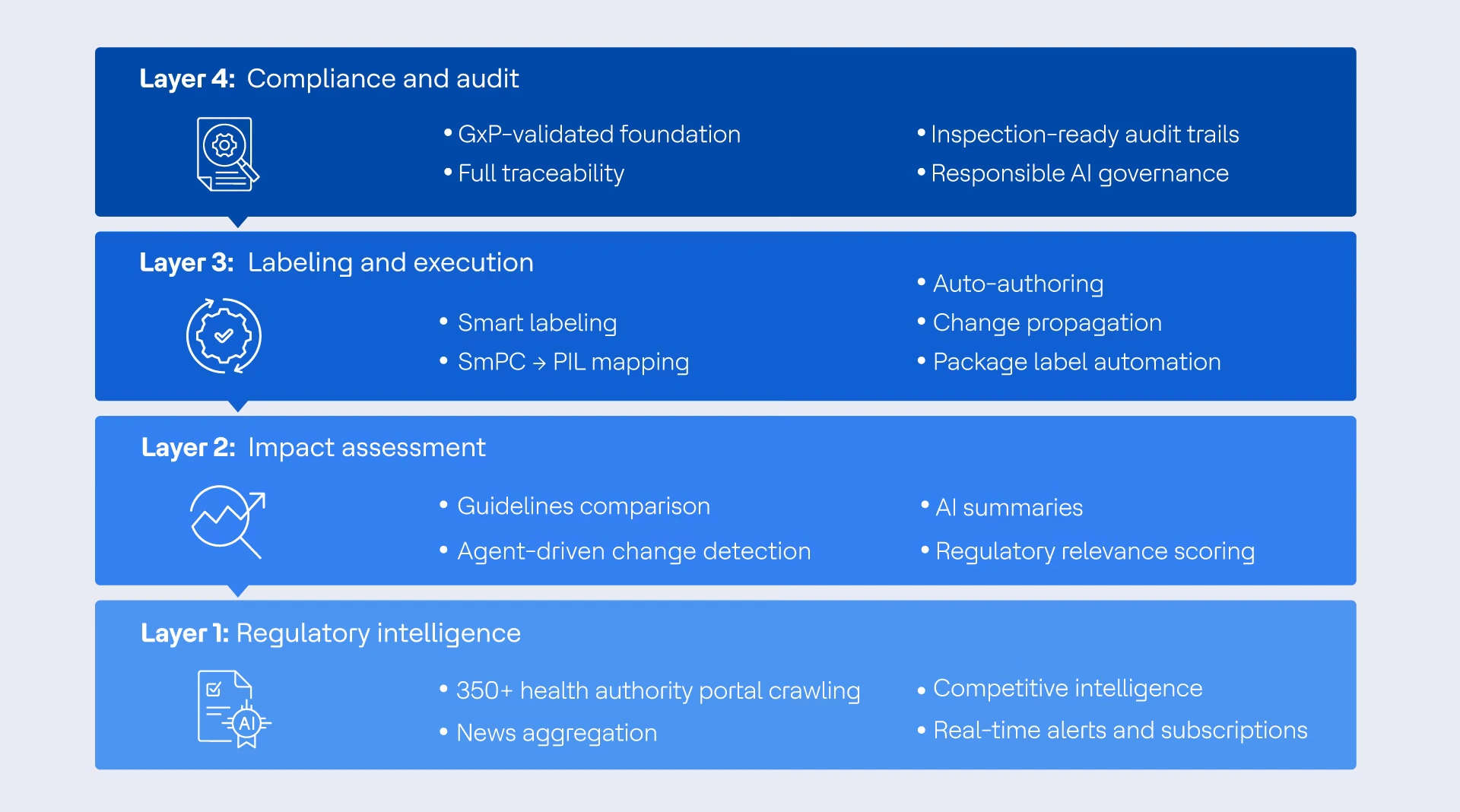
A future-ready regulatory platform is not defined by its feature list, but by its architectural integrity, specifically whether intelligence generated in one part of the platform flows seamlessly to every other part.
Five capabilities distinguish platforms capable of delivering this:
- A unified regulatory intelligence layer that continuously monitors global health authority portals, aggregates external signals, press releases, safety notices and clinical data and classifies updates by relevance, product, region and therapeutic area. This layer eliminates the manual monitoring burden and ensures that every downstream function operates from a current, accurate view of the regulatory environment.
- An integrated impact assessment capability that connects regulatory signals directly to the organization's product portfolio and submission history. When a guideline changes, the platform automatically identifies which products are affected, what label sections require revision and what the submission implications are—all in hours rather than weeks.
- An end-to-end labeling capability that covers the full lifecycle, from auto-authoring SmPCs and PILs to synchronizing changes across Company Core Data Sheets (CCDS), target labels, IFUs and package artwork. Change propagation must be intelligent, detecting not just explicit revisions, but also paraphrases, structural shifts and changes in clinical implications. Furthermore, it must maintain complete traceability for regulatory review.
- A GxP-validated compliance and audit foundation that ensures every action taken by AI agents is traceable, every recommendation is auditable and every output meets the inspection readiness standards of global health authorities. In a GxP environment, Responsible AI is not optional; it's the baseline for deployment.
- A continuous market and competitor sensing capability that tracks approvals, withdrawals, safety actions, clinical milestones and regulatory decisions. By linking these signals to the organization’s portfolio and market strategy, the platform helps leadership anticipate shifts, assess positioning and act faster on emerging risks and opportunities, embedding external intelligence directly into regulatory decision-making.
Platform capability stack
Business impact for CXOs
The business case for regulatory intelligence modernization is grounded in quantified operational improvement and strategic risk reduction. Organizations that have deployed integrated, AI-driven regulatory platforms report measurable outcomes across every dimension of the regulatory value chain.
Value realization metrics
32%-40% Reduction in manual monitoring effort | ~40% Decrease in guidelines comparison workload |
35%-40% Reduction in labeling update cycle time | 32%-40% Accelerated speed to market |
28%-38% Fewer regulatory risks and omissions | 2-3x Increase in competitive situational awareness |
Value realization metrics Real outcomes achieved from Intelligent Regulatory Platform (IRP) implementation across life sciences organizations
Beyond the operational metrics, the strategic value is equally significant:
- Faster label updates translate directly to faster market access
- Reduced regulatory risk means lower exposure to enforcement actions and recall events
- Improved competitive awareness enables more informed pricing, positioning and market entry decisions
- The shift of regulatory professionals from manual tasks to strategic work improves talent retention and elevates the function's influence in the broader organization
For CIOs and CTOs, the platform architecture question is board-level: can the organization's regulatory technology estate support the velocity, auditability and global scale that modern regulatory operations demand? For CDOs and COOs, the data and process integration question is equally strategic: is regulatory intelligence connected to the product, commercial and market access functions that depend on it? The answers to both questions determine whether the regulatory affairs function is a growth constraint or accelerant.
Making regulatory intelligence a board-level priority
The window for proactive investment in regulatory intelligence is open, but not indefinitely. Organizations that move now will build institutional capability, the data foundations and the organizational muscle to operate regulatory affairs as a strategic asset. Those who delay will face an accelerating gap between their operating model and the demands of the regulatory environment.
The first step is assessment: mapping the current state of regulatory operations against the integrated intelligence model.
- Where are the manual aggregation points?
- Where do disconnected tools create friction and error risk?
- Where is the absence of real-time intelligence creating competitive blind spots or compliance exposure?
This diagnostic creates the foundation for a prioritized modernization roadmap.
HCLTech's Intelligent Regulatory Platform (IRP) is purpose-built for this transition. Drawing on over two decades of life sciences and regulatory expertise, IRP integrates autonomous monitoring, impact assessment, smart labeling and competitive intelligence through a single, GxP-validated platform built on Agentic AI and Responsible AI principles. The platform is not a theoretical future state; it is a production-grade capability deployed in partnership with leading global life sciences organizations.
Regulatory affairs is no longer a back-office function. It is a front-line strategic capability. The organizations that invest accordingly will define the next era of excellence in life science organizations.
To learn more about HCLTech IRP, contact: LSH.AISolutions@hcltech.com


