Artikel anhören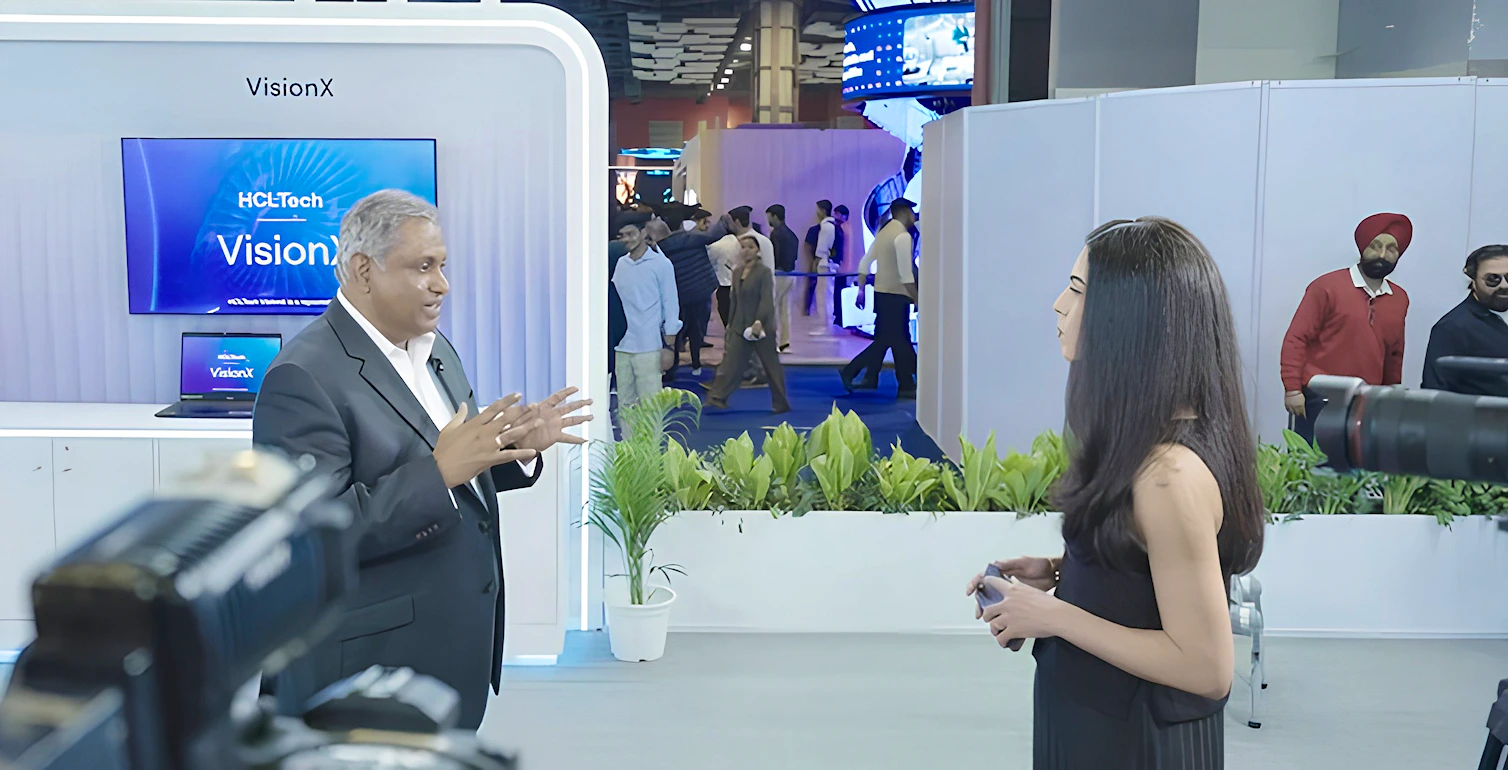
Key questions answered
- Is the “SaaS apocalypse” hurting India’s IT services industry?
- Will AI compress margins or expand them?
- What is the growth outlook for Indian IT services?
- What is Advanced AI revenue and how large can it become?
- How important are partnerships like OpenAI and Anthropic?
- Is Physical AI really a trillion-dollar opportunity?
- Are fears of obsolescence overdone?
Interview context
During the India AI Impact Summit 2026, C Vijayakumar, CEO and Managing Director of HCLTech, sat down with Shereen Bhan from CNBC TV18 to explore the current challenges and possibilities shaping the AI era.
With nearly ₹2.6 lakh crore (approximately $31 billion) erased in market capitalization across the IT services sector in February, questions around disruption, margin pressure and long-term growth dominated the conversation.
February has been a difficult month for the IT services sector…Is the so-called “SaaS apocalypse” real?
Short answer
No. The disruption is real but anticipated. AI will deflate some traditional services, but it also opens far larger structural opportunities.
Expanded transcript section
Vijayakumar rejected the notion of surprise or panic. According to him, AI’s disruptive force was anticipated years ago.
“If you recall, two years ago we clearly articulated that AI would be a major disruption, and as a company we wanted to embrace it proactively. None of what we are seeing today surprises us.”
Rather than reacting defensively, HCLTech focused on building intellectual property that bridges large language models and enterprise-grade reasoning systems.
He emphasized that while AI technology evolves rapidly, enterprise transformation is inherently slower.
“In the real enterprise world, however, there are complex installed systems. It’s not plug-and-play. That’s where service providers like us come in.”
In his view, trust, integration expertise and contextual enterprise understanding remain indispensable, even in an AI-first world.
As billing moves from effort-based to outcome-based models, what should we expect in terms of margins?
Short answer
Margins are more likely to expand than compress if outcome-based risk is managed effectively.
Expanded transcript section
The industry’s shift from time-and-material billing to outcome-linked pricing is deliberate, not reactive.
“The shift toward outcome-based engagement is very deliberate. Typically, outcome-based models can deliver higher margins because they allow us to leverage technology and optimization levers more effectively.”
He pushed back against widespread assumptions of margin erosion.
“There is a perception of margin compression, but in reality, margins should improve.”
While outcome-based contracts involve greater accountability and risk, they also create structural upside.
“Outcome-based models carry slightly higher risk, but they also come with higher rewards.”
With more than 50% of HCLTech’s business already operating under some form of outcome-based model, the transition is well underway.
What is the growth outlook for the industry?
Short answer
Some legacy services will deflate by 2-3%, but AI-driven growth segments can more than offset that decline.
Expanded transcript section
Vijayakumar acknowledged that traditional application development faces deflationary pressure due to automation.
“Overall, we anticipate a 2-3% deflation impact at an industry level, and we have modelled this carefully.”
However, he identified several offsetting growth engines.
The AI factory represents a trillion-dollar capital expenditure opportunity globally, translating into at least $100 billion in services demand. Physical AI, Agentic AI implementations, legacy modernization and enterprise transformation all require complex integration capabilities.
He also pointed to the scale of the core market.
“At the same time, the core IT services market remains massive; about $1.5 trillion globally.”
In other words, disruption does not erase demand. It reshapes it.
What is Advanced AI revenue, and are you on track?
Short answer
Yes. Advanced AI revenue, derived from IP-led platforms, is growing at 20% quarter-on-quarter and could scale to $2.5-3 billion.
Expanded transcript section
Vijayakumar distinguished between generic AI adoption and monetizable AI platforms.
“We had guided to approximately $600 million in annualized Advanced AI revenue.”
Crucially, this excludes internal AI usage across traditional services.
“What we call advanced AI revenue comes from IP-led solutions and new platforms.”
The growth trajectory is steep.
“This segment is growing at around 20% quarter-on-quarter. We believe it can scale to $2.5-3 billion over time.”
Platform-based and agentic service delivery models, he argued, could significantly expand wallet share.
Should we expect more AI ecosystem partnerships?
Short answer
Yes. AI partnerships will mirror the hyperscaler playbook. Ecosystem leverage is essential.
Expanded transcript section
HCLTech was the first IT services major to announce a partnership with OpenAI, and it continues to explore ecosystem alliances, including with Anthropic.
“This mirrors the hyperscaler era, where leveraging ecosystem technologies was critical to delivering value to clients. The same playbook applies here.”
In short, proprietary IP and ecosystem leverage are not mutually exclusive. They are complementary.
How significant is the Physical AI opportunity?
Short answer
It is potentially trillion-dollar in scale and already contributes over $100 million in revenue.
Expanded transcript section
Physical AI, bringing AI into the real world through sensing, autonomous decision-making and system integration is central to HCLTech’s full-stack vision.
“Physical AI is a trillion-dollar opportunity.”
He cited practical applications, such as autonomous robots in hazardous industrial environments and VisionX solutions enhancing port safety.
“Today, Physical AI already contributes over $100 million of our Advanced AI revenue. We believe this can scale to a billion-dollar business over time.”
This signals a shift beyond digital transformation into intelligent physical infrastructure.
Are fears of obsolescence for Indian IT services overdone?
Short answer
Yes. The disruption is significant but so is the opportunity.
Expanded transcript section
Vijayakumar acknowledged the scale of change but rejected narratives of decline.
“Yes, they are overdone. While this is undeniably a major disruption, it also creates enormous new opportunities.”
He positioned the transition as both inevitable and navigable.
“As leaders, we have a responsibility to ensure that this transformation benefits all stakeholders.”
With early recognition of AI’s impact and investments in IP-led propositions, he expressed confidence that HCLTech is positioned to emerge stronger, even in a deflationary environment.
Key takeaways
- AI will deflate parts of traditional IT services by ~2-3%
- Outcome-based pricing can expand margins, not compress them
- Advanced AI revenue (IP-led) is growing at ~20% QoQ
- Physical AI is already a $100M+ revenue stream with billion-dollar potential
- Partnerships with OpenAI and others mirror the hyperscaler strategy
- The IT services industry is evolving, not facing extinction
About the speaker
C Vijayakumar is the CEO and Managing Director of HCLTech, a global technology company providing IT services, digital engineering, cloud, and AI-led transformation solutions across industries worldwide.
Related interviews