


 Artikel anhören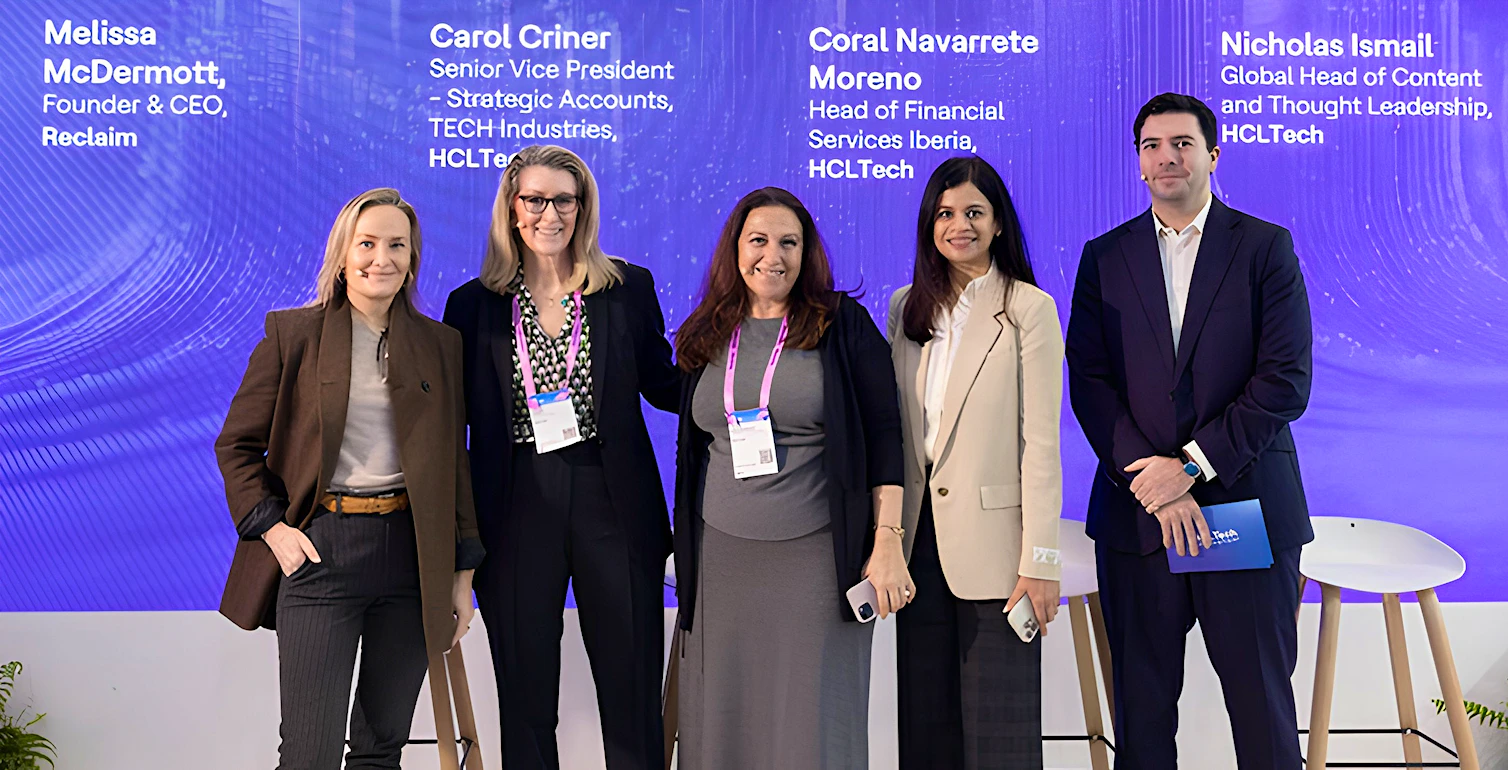
At MWC 2026, a discussion on inclusion and collective leadership brought together Melissa McDermott, Founder and CEO of Reclaim; Carol Criner, Senior Vice President of Strategic Accounts at HCLTech and Coral Navarrete Moreno, Head of Financial Services Iberia at HCLTech.
The panel explored a question increasingly relevant to organizations navigating technological disruption: how can leaders translate the concept of inclusion into practical cultural behaviors that strengthen teams, improve decision-making and ultimately deliver better business outcomes?
Across sectors, from fashion and circular commerce to financial services and enterprise technology, the discussion highlighted a common theme: inclusion is not simply a diversity initiative. It is a leadership discipline embedded in how organizations learn, collaborate and make decisions.
Expanding the definition of inclusion
McDermott argued that conversations about inclusion often focus narrowly on representation, when the real barrier can also be access to knowledge and confidence with new technologies.
Drawing on her own experience moving from the fashion industry into a technology-driven startup, she described the learning curve she faced as a founder entering a technical domain.
“I’m not a technical founder. I’m an area expert,” she said, reflecting on her background leading multinational fashion businesses before launching a technology-enabled circular commerce platform.
That transition required significant self-education and close collaboration with technical teams.
“I had to go and learn courses,” she explained. “My own responsibility was to understand what is possible with technology.”
For McDermott, inclusive organizations are those where people feel comfortable asking questions and learning across disciplines, allowing industry expertise and technical knowledge to complement each other.
Building inclusion deliberately
Criner emphasized that inclusion rarely happens automatically. Leaders must intentionally shape environments where people feel able to contribute.
“Influence happens at the micro level. I think about it as a two-way street. On a daily basis, where do you have influence and how do you create an environment that is open to ideas? And if you happen to be one of the people benefiting from being in the room, what are you doing with that opportunity?” she said.
For Criner, inclusion is not only about formal programs but about the everyday behaviors leaders' model across teams.
“Inclusion is really a daily practice,” she said.
That practice includes paying attention to how conversations unfold, who participates and whether people feel comfortable contributing their perspectives.
“Who’s in the room? Are there allies? Those are the kinds of things that help create an environment where people feel encouraged to contribute,” she said.
By fostering collaboration and encouraging different viewpoints, leaders at every level can strengthen decision-making and unlock the full potential of their teams.
Measuring inclusion through impact
Moreno brought a financial services perspective to the conversation, emphasizing that inclusion becomes more effective when it is treated as a measurable organizational priority.
“I would treat it as any other critical infrastructure. If you treat it as such, it will be funded, measured and governed with the same discipline. Then you actually make it happen,” she said.
However, she cautioned that programs alone are not enough to drive cultural change.
“If it’s not been instilled in all levels of the organization, nothing will change,” she said.
Instead, she emphasized the importance of embedding inclusive behaviors throughout teams and leadership structures. Small changes across organizations, such as creating space for more voices in decision-making, can gradually reshape culture.
Inclusion as a business advantage
The discussion also explored how inclusive thinking can influence business strategy.
McDermott described how Reclaim designed its circular commerce platform to avoid unintentionally excluding products that do not retain high resale value.
If resale platforms only focus on luxury items, she explained, they risk creating a system that benefits only a small portion of products while ignoring the broader lifecycle of garments.
“If we were to only focus on those higher ticketed items, we wouldn’t have created an inclusive environment,” she said.
Instead, Reclaim built partnerships with non-profit organizations that can process or recycle lower-value items, allowing the platform to support a more inclusive product ecosystem.
Although this approach introduces additional operational complexity, she said it ultimately creates greater long-term value across the fashion supply chain.
Creating environments where voices matter
Across the discussion, the panellists returned repeatedly to the idea that inclusion is fundamentally about enabling participation.
Moreno emphasized the importance of ensuring that decision-making environments do not default to the same perspectives.
“You have to make the space to hear those voices,” she said.
McDermott reflected on an early career experience that shaped how she thinks about leadership and inclusion today.
“I remember being the lowest rung in the organization and the CEO asking for our opinion,” she said, describing how that experience created a sense of empowerment and ownership early in her career.
For the panellists, these everyday leadership moments, who is invited to contribute, whose perspective is heard and how teams collaborate, ultimately shape whether organizations can fully benefit from diverse viewpoints.
Inclusion as a leadership discipline
The panel concluded that inclusion is less about isolated initiatives and more about leadership mindset.
Organizations that embed inclusive practices successfully tend to integrate them into everyday operations: how teams collaborate, how decisions are made and how opportunities are distributed.
For leaders navigating rapid technological change and evolving industries, the ability to draw on a wide range of perspectives may become an increasingly important source of resilience and innovation.


