
Every churned customer leaves a trail of signals. The question is - who in your organization actually captured them?
A subscriber downgrades to month-to-month billing. Support ticket volume escalates. Two failed payments occur within 90 days. Network outages in their service area hit double digits. Their once-regular streaming activity ceases entirely.
Each warning signal exists in isolation. Billing captures the contract modification. Network operations logs the service disruptions. Support documents the complaints. Yet the retention manager, who is one positioned to intervene, learns of the risk when the cancellation notice arrives.
This represents the true cost of telecom churn, not merely lost revenue, but squandered opportunity. The data existed. The warning signs were present. The critical insight came too late.
ChurnGuard is purpose-built to eliminate this gap.
What ChurnGuard actually does
ChurnGuard is a customer retention platform that bridges the gap between ML-driven churn prediction and the teams empowered to act on it.
The platform generates real-time churn risk scores using XGBoost models deployed on Amazon SageMaker. These predictions, along with complete customer profiles and identified risk signals, are then processed through role-specific AI advisors built on Amazon Bedrock.
The core principle is straightforward
A churn probability of 0.83 is meaningful to a data scientist. It's meaningless to a call center representative about to engage that customer. That representative needs key talking points and a recommended opening.
A retention manager requires comparisons of offers with projected ROI. An executive needs revenue-at-risk quantification. A compliance officer needs fairness validation.
One customer. One prediction. Tailored intelligence for each role.
ChurnGuard operationalizes this through 14 specialized AI advisors mapped to 5 business personas, each grounded in ML predictions and actual customer data.
How does this look for a real customer?
Consider a specific case: A subscriber, three months into service on a month-to-month contract with fiber-optic internet, paying via electronic check. Operational data reveals 8 outages over 90 days, network latency averaging 145ms and 5 open support tickets.
When ChurnGuard's Advanced prediction engine analyzes this customer using 38 features, including operational signals, it returns a high-risk classification, with a churn probability that significantly exceeds the 70% threshold.
The system surfaces key risk indicators from the customer's actual data:
- Month-to-month contract with no commitment period
- Electronic check payment method-the highest churn-correlated payment type in training data
- No value-add services (tech support, online security)
- 8 service disruptions in 90 days, 145ms average latency, 2 payment failures
From prediction to action
The AI advisors activate, each grounded in this customer's prediction and profile:
- The Churn Signal Narrator translates the score into plain language, explains the risk drivers and quantifies the business impact.
- The Retention Action Planner generates a targeted retention strategy with a recommended channel, a specific offer and a budget allocation (within the $80 per-customer retention threshold).
- The Offer Simulator models three retention scenarios, comparing cost, retention probability and projected ROI.
- The Winback Email Generator produces deployment-ready messaging aligned with the recommended strategy.
Nothing is templated or generic. Every output derives directly from the prediction score and verified customer data.
Role-based intelligence
When a Customer Service Representative views this same customer, they receive entirely different outputs: a conversational risk summary and a 30-second call preparation card with recommended talking points and guidance on what to avoid.
Same prediction. Different intelligence for different roles.
Why the persona model matters
Most churn prediction solutions fail at the same critical juncture. They generate a score, then leave operationalization entirely to the business.
The data science team builds the model, publishes a dashboard and considers the work complete. Meanwhile:
- Call center representatives never access the dashboard; they simply answer the phone
- Retention managers see the score but lack guidance on which offer to present or which channel to use
- Executives receive quarterly churn reports, weeks after the revenue has been lost
- Compliance officers have no mechanism to audit demographic fairness in model decisions
The problem isn't model accuracy. It's the last mile: delivering the right insight to the right stakeholder in an actionable format before the customer churns.
ChurnGuard solves this through 5 role-based personas, each supported by tailored AI advisors.
Five personas, role-specific AI advisors
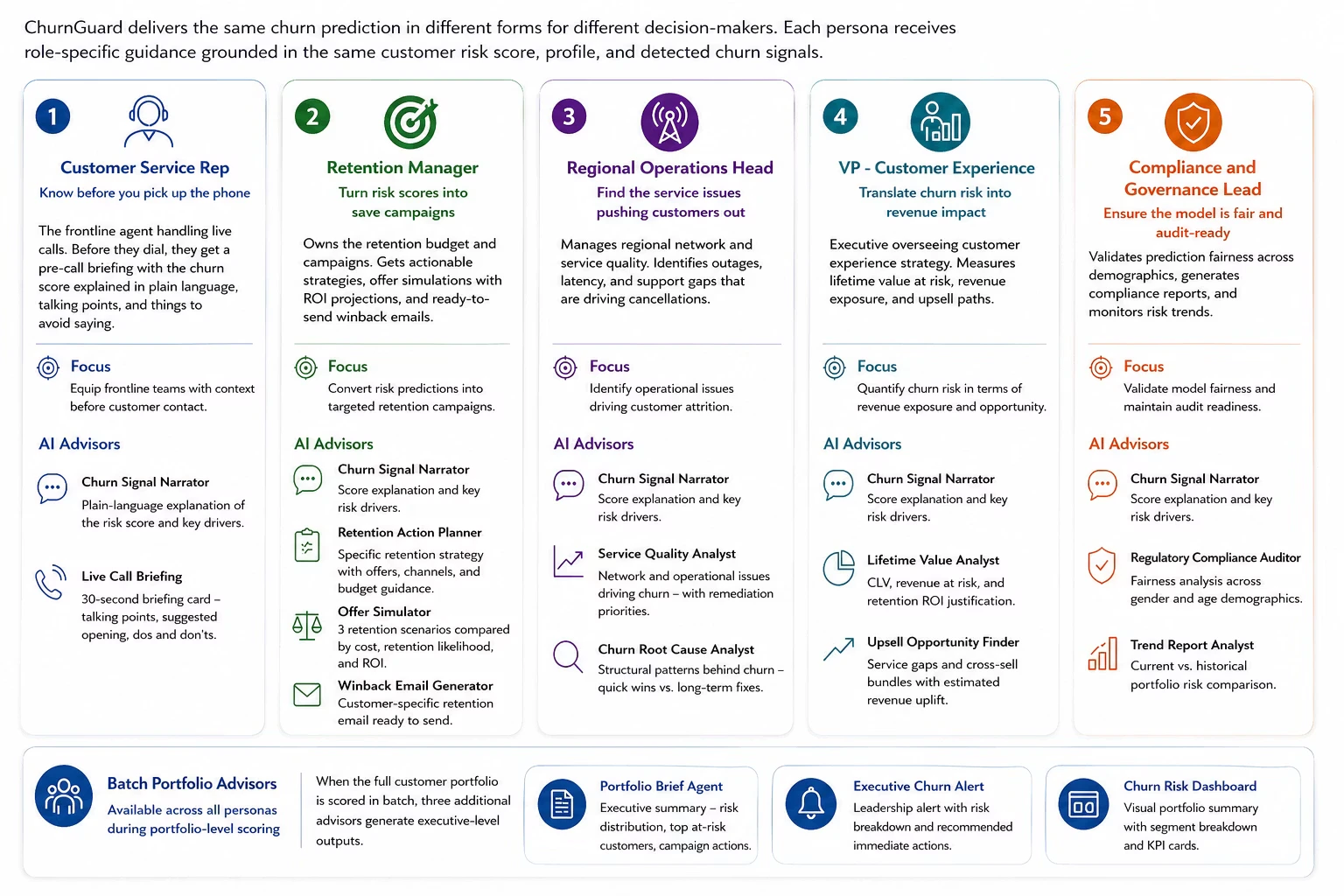
Fig. 1: Role-based personas and AI advisors
How it works - the end-to-end flow
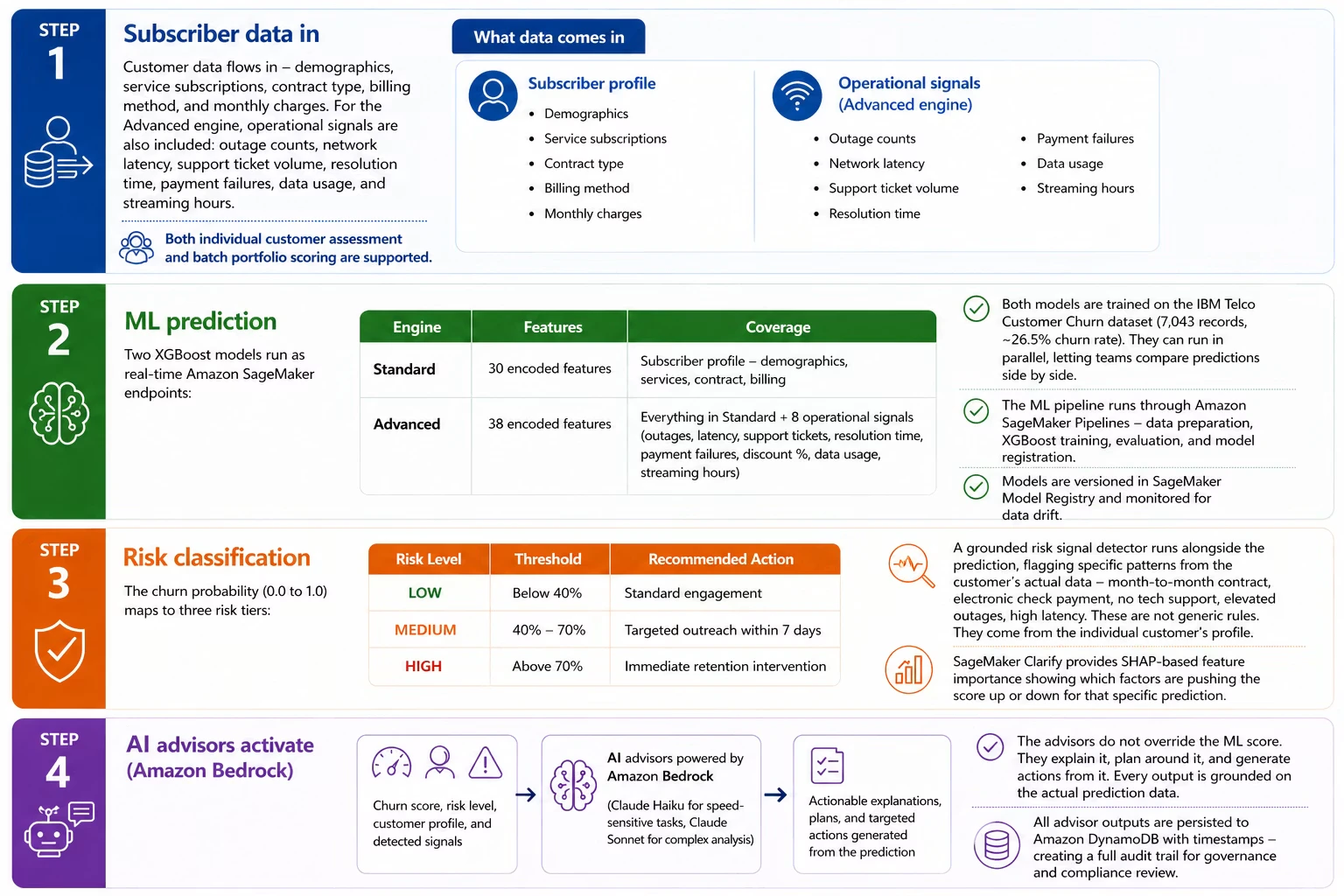
How it works - the end-to-end flow
AWS tech architecture
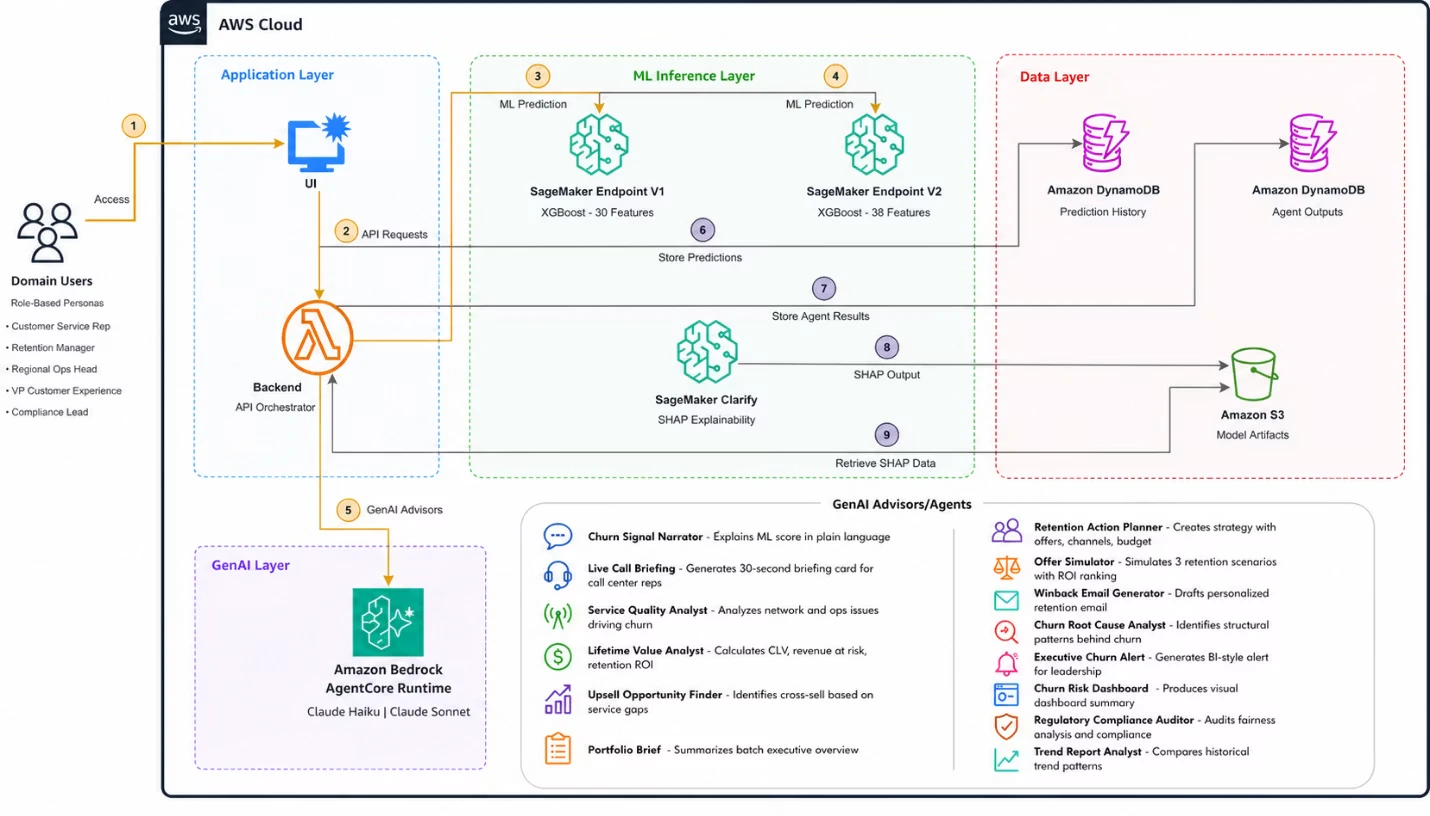
Fig. 3: AWS Architecture for ChurnGuard
| Step | Component | Description |
1 | Domain Users → UI | Role-based users access ChurnGuard through the application interface. |
2 | UI → Backend | The frontend sends API requests to the backend orchestration layer. |
3 | Backend → SageMaker Endpoint V1 | Standard XGBoost model (30 features) generates churn prediction. |
4 | Backend → SageMaker Endpoint V2 | Advanced XGBoost model (38 features, incl. operational signals) generates prediction. |
5 | Backend → Amazon Bedrock | Prediction context (score, profile, risk signals) is passed to GenAI advisors for action generation. |
6 | ML Layer → DynamoDB | Prediction results are stored as prediction history for traceability. |
7 | GenAI Layer → DynamoDB | Advisor outputs are stored as agent results for audit and governance. |
8 | SageMaker Clarify → Amazon S3 | SHAP explainability outputs are generated and stored as model artifacts. |
9 | Amazon S3 → Application | SHAP data is retrieved and surfaced for explainable insights. |
Built for Telecom today, adaptable to any industry tomorrow
The churn problem is not unique to telecom. Insurance companies lose policyholders. Banks lose account holders. Media platforms lose subscribers. The pattern remains consistent; only the data differ.
ChurnGuard is currently trained on telecom subscriber data, but the architecture is domain-agnostic. The ML pipeline, AI advisor prompts and risk thresholds are fully configurable.
Adaptation process: (BYOD -Bring Your Own Domain/Data set)
- Data – Ingest domain-specific customer data
- Train – Retrain models using the existing SageMaker pipeline
- Prompts – Customize advisor prompts with industry context
- Tune – Adjust risk thresholds and retention parameters
- Deploy – Same infrastructure, new domain
Applicable industries: Banking (account attrition) | Insurance (policy lapse) | Media and OTT (subscription cancellation) | Retail (loyalty erosion) | Logistics (fleet operator retention) | Energy (service disconnection) | EdTech (student dropout prediction)
What distinguishes ChurnGuard from standard churn models
Most churn models end at prediction. ChurnGuard operationalizes it:
- Explains the drivers – Every score includes a plain-language explanation of risk factors, tailored to the audience
- Generates actionable strategies – Retention plans, offer simulations, winback messaging, call briefings, all within budget constraints and with channel recommendations
- Serves multiple stakeholders from one prediction – A call center representative and a VP receive entirely different outputs from the same underlying score
- Maintains complete auditability – Every prediction and advisor output is persisted to DynamoDB with timestamps for governance, audit and compliance review
Conclusion
Customer churn in telecom is a longstanding challenge. ML-based prediction is well-established.
What remains absent in most organizations is the operational bridge, the system that converts a churn score into specific, actionable guidance for the stakeholder positioned to intervene.
ChurnGuard serves as that bridge. Standard and Advanced (feature-rich) ML models offering different levels of analytical depth. Fourteen AI advisors grounded in actual prediction data. Five business personas, from frontline service to executive leadership, each receive the intelligence they need in a format they can immediately use.
Retention managers receive simulations of offers with ROI projections. Call center representatives receive briefing cards before customer contact. Compliance leads receive fairness audits. All are derived from the same prediction. All stored for traceability.
This is what effective churn prevention requires and what ChurnGuard delivers.