Redefining OTA as a continuous value engine: Scalable, secure and intelligent

As vehicles become software-defined platforms, OTA updates are shifting from basic maintenance to continuous value drivers that enhance scalability, security, intelligence and long‑term monetization
ニュースレターを登録する
6 min 20 sec 所要時間
Kannan Kasturirangan
Senior Director, Consulting, ERS
6 min 20 sec 所要時間
microphone microphone 記事を聴く
30秒戻る
0:00 0:00
30秒進む
Redefining OTA as a continuous value engine: Scalable, secure and intelligent

Key takeaways

  • OTA has evolved from post-sale maintenance to a core, platform-level capability in SDVs
  • Continuous OTA delivery enables vehicles to improve, adapt and remain relevant over time
  • Scalable OTA requires modern E/E architectures and centralized orchestration
  • Security, predictability and governance are essential to customer trust and regulatory compliance
  • Intelligent, closed-loop OTA platforms transform vehicles into long-lived digital platforms

The automotive industry is undergoing a fundamental reset. As vehicles evolve into software-defined platforms, the mechanisms that govern how software is delivered, updated and governed have shifted from the periphery to the core of OEM strategy. Over-the-Air (OTA) updates, which were once considered a post-sale convenience, are now redefining how vehicles are engineered, experienced and monetized across generations.

In the era of , OTA is no longer about remote defect fixes. It is about platform longevity through continuous delivery, a model where vehicles improve over time, adapt to changing customer expectations and remain commercially relevant well beyond their original launch window. Industry analysis highlights that OTA functionality supports continuous software enhancement, post-sale feature activation and recall-free security patching, driving the fastest growth among application segments at a projected 15.33% CAGR. 

Forward-thinking OEMs are recognizing that OTA maturity directly influences product agility, system reliability, ecosystem scalability and long-term brand trust. OTA has evolved beyond being a mere feature, and it is now a foundational, platform-level capability that underpins the entire vehicle lifecycle and customer experience.

 How scaling OTA creates architectural complexity

Legacy vehicle architectures relied on siloed Electronic Control Units (ECUs), each with independent update logic and tooling. While functional in early connected vehicles, these fragmented approaches introduced operational complexity, inconsistent update experiences and limited scalability.

As SDV architecture matures, OEMs are transitioning toward modern E/E architecture with centralized compute, zonal controllers and cloud-native integration. This shift enables a service-oriented software architecture, where updates are orchestrated centrally and executed safely across infotainment, ADAS, powertrain and safety-critical domains.

This architectural evolution is foundational. Without a unified OTA platform, OEMs cannot reliably scale updates across fleets, geographies or vehicle generations. With it, OTA becomes predictable, governed and enterprise-ready – unlocking true scalability and lifecycle agility.

How continuous OTA delivery creates ongoing value

OTA updates have become the primary mechanism through which vehicles evolve post-sale. Instead of degrading with age, modern vehicles gain new capabilities, refinements and performance optimizations – transforming ownership into a dynamic experience.

Through continuous delivery, OEMs can (but not limited to):

  • Introduce new features/capabilities such as ADAS/AD
  • Enrich infotainment and UX
  • Optimize energy efficiency and range
  • Improve features / performance, enhance safety and security
  • Add intelligence / update AI models
  • Adapt vehicle behavior using real-world data

Each update represents an infinite number of possibilities and a moment of brand engagement. Customers experience visible improvement without visiting a dealership, while OEMs benefit from stronger retention, higher satisfaction and sustained differentiation. In competitive markets, this ability to deliver continuous value beyond the showroom is no longer optional; it is foundational to long-term relevance.

How OTA shifts OEMs from products to platforms

OTA is fundamentally reshaping the automotive business model. Emerging industry trends show OEMs moving toward a Feature-as-a-Service paradigm, delivering on-demand capabilities through continuous software updates.

Subscription-based features, personalized upgrades and post-sale enhancements unlock new revenue streams across the vehicle lifecycle. At the same time, OTA enables cross-generation software updates, allowing core functionality and UX improvements to reach older vehicle models, keeping them aligned with newer offerings.

This continuity transforms vehicles from one-time product sales into long-lived digital platforms. In this context, OTA is not merely a cost-saving mechanism. It is a strategic growth engine driving recurring revenue, customer loyalty and competitive differentiation.

How secure and predictable OTA rollouts build trust

OTA success ultimately rests on trust. Every update is a visible expression of an OEM’s commitment to safety, reliability and quality. In this high-stakes environment, a single failure, particularly within safety-critical systems, can erode years of brand equity.

Enterprise-grade OTA platforms embed:

  • End-to-end encryption and authentication
  • Policy-based deployment controls
  • Robust rollback and recovery mechanisms
  • Staged and targeted rollout strategies

Security is no longer a backend concern. In a connected vehicle ecosystem, it is a core component of customer confidence and regulatory compliance.

The intelligence loop: From reactive updates to autonomous evolution

The next phase of OTA evolution is defined by intelligence, not just speed of delivery. Modern OTA platforms operate as closed-loop systems, continuously learning from real-world vehicle behavior.

Redefining OTA as a continuous value engine: Scalable, secure and intelligent

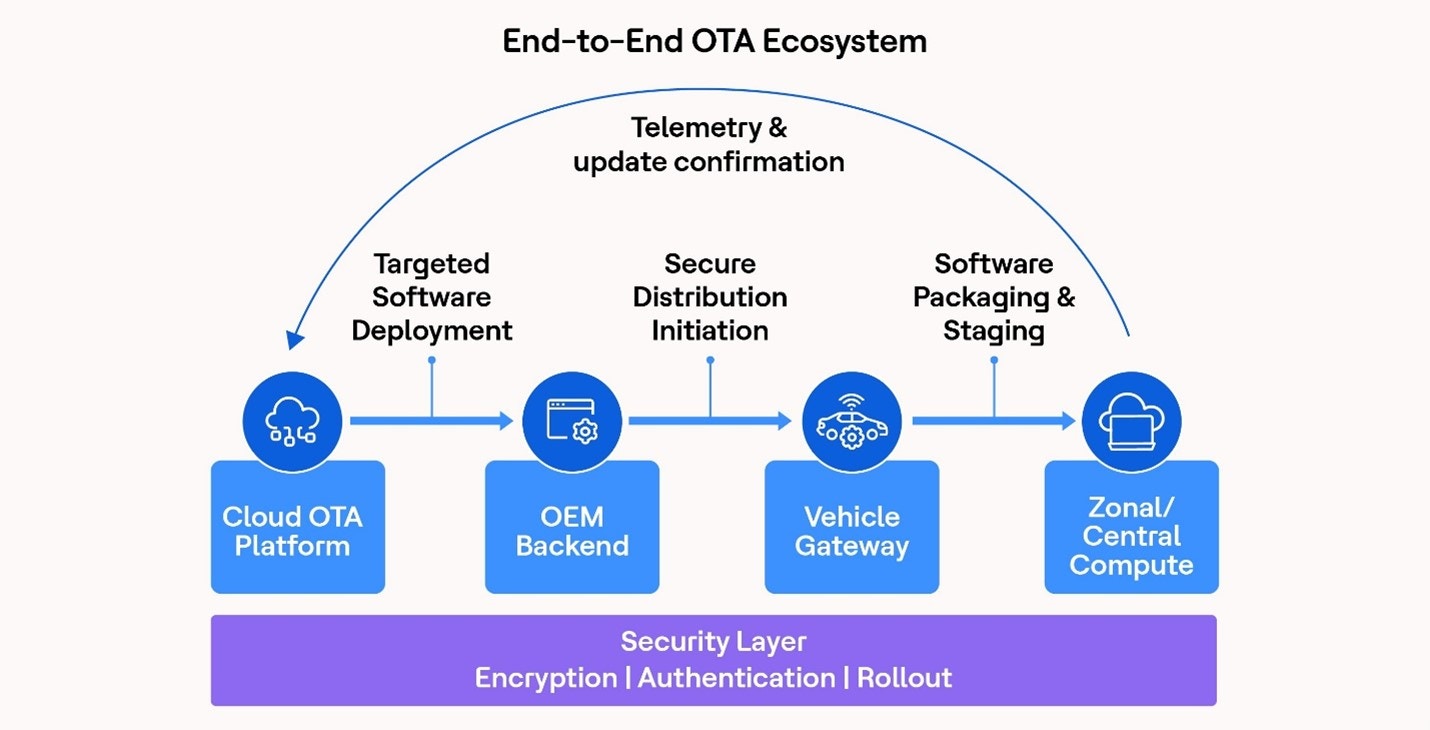
Cloud-based OTA platforms enable targeted deployments based on vehicle configuration, usage patterns and risk profiles. The OEM backend and vehicle systems infused with  function as the intelligence layer, correlating telemetry, update outcomes and performance signals to dynamically control rollout timing and scope.

Within the vehicle, secure gateways enforce policy validation while zonal and central compute platforms execute updates and generate post-update telemetry. This data flows back to the cloud, continuously refining future updates.

This intelligence-driven model enables:

  • Predictive diagnostics
  • Autonomous and pre-emptive update management
  • Safer, more resilient rollouts at fleet scale

OTA evolves from a reactive mechanism into a proactive, self-reinforcing platform transformation. By harnessing artificial intelligence, including deep learning and reinforcement learning methods, as well as  systems, vehicles can now autonomously optimize performance over time while remaining within validated safety boundaries.

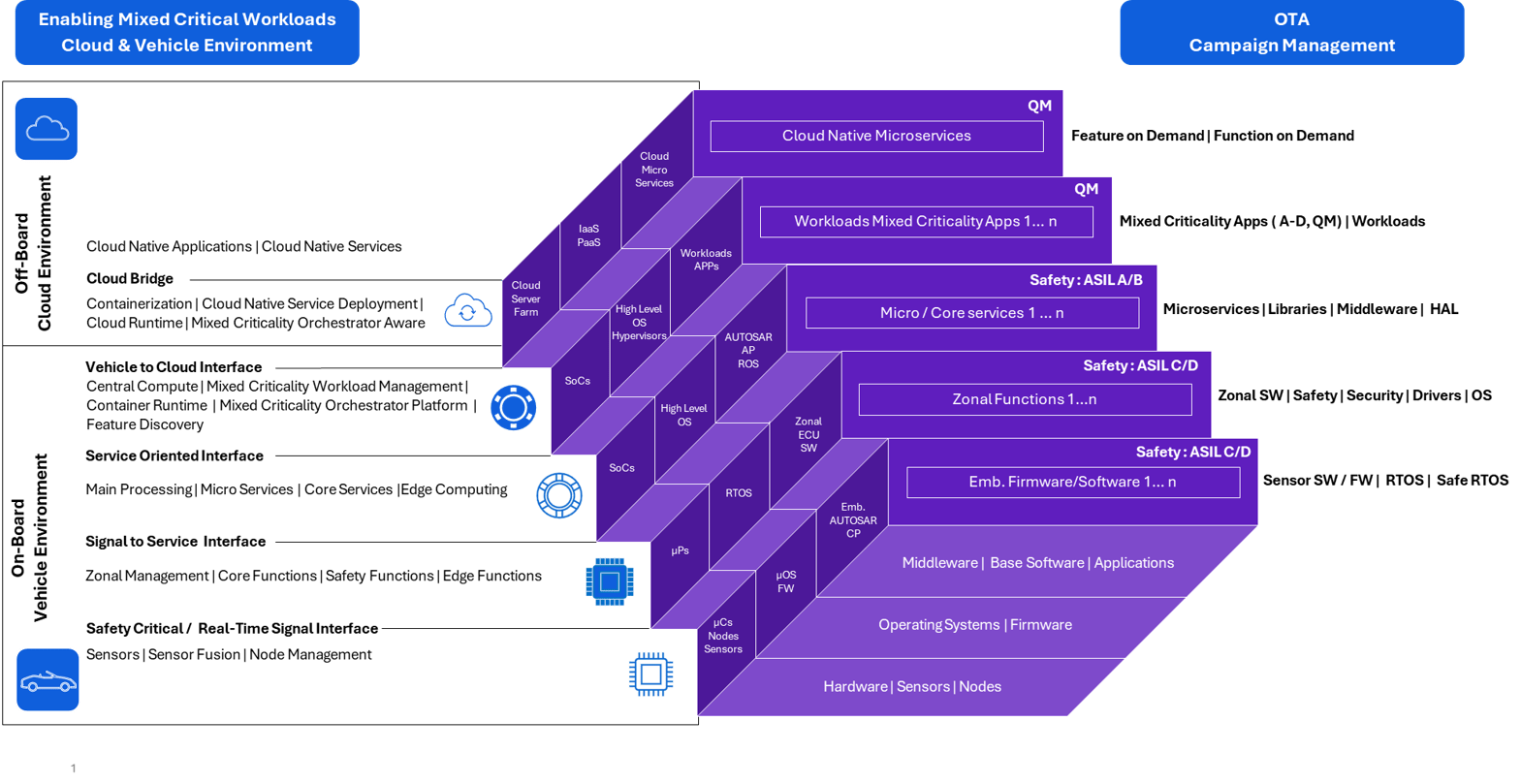
Envisioning the architecture for OTA platform updates in a mixed-criticality environment

OTA platforms for software-defined vehicles are developed using service-oriented architecture principles, specifically designed for mixed-criticality environments spanning from chip to cloud. Clearly delineating layers based on safety criticality and integrating robust security measures at each layer is essential to enabling seamless, secure and reliable updates.

To operationalize OTA at an enterprise scale, OEMs require an architecture purpose-built for mixed-criticality systems.

Redefining OTA as a continuous value engine: Scalable, secure and intelligent

The above illustration presents an OTA orchestration framework tailored for mixed-criticality environments within software-defined vehicles, covering end-to-end integration from chip to cloud.

Mixed-Criticality Orchestrators (MCOs), combined with a modular design approach, enable greater flexibility and efficiency in managing SDV services. This orchestration layer provides a structured mechanism to address the dual requirements of automotive-grade safety and the agility of cloud-native architecture.

MCOs manage OTA updates by isolating critical functions, applying adaptive scheduling to prioritize safety and leveraging Platform Feature Discovery (PFD) to understand device capabilities. This enables secure and granular update strategies, such as ASIL A/B updates, ensuring that high-safety-critical functions (ASIL C/D) remain unaffected while non-critical components are updated in parallel.

Adaptive scheduling further ensures that high-priority tasks are guaranteed deterministic execution times. The scheduler dynamically adjusts resource allocation to ensure safety-critical deadlines are consistently met, even during updates to less critical components, thereby enabling disruption-free, seamless OTA updates.

This architecture supports the automotive industry’s shift toward software-defined and software-driven transformation, enabling advanced technologies while upholding functional safety, multi-layered security, data-driven intelligence and service-oriented design principles that will shape the future of mobility.

How to architect an enterprise-grade OTA platform

The future of OTA will be shaped by platforms that are secure by design, scalable by architecture and infused with data-driven intelligence. These platforms will not merely deliver updates; they will orchestrate transformation across engineering, operations and business models.

OEMs that elevate OTA into a core enterprise capability will set the benchmark for modern mobility. In the SDV era, OTA is no longer an engineering enhancement. It is the strategic backbone enabling intelligence, scalability, security, platform longevity, continuous innovation and sustainable customer-centric growth.

FAQs

Why is OTA central to software-defined vehicles?

OTA is the primary mechanism that enables SDVs to evolve after production. It supports continuous software delivery, feature activation, security patching and intelligence updates, allowing vehicles to improve over time while extending platform longevity, customer value and commercial relevance.

What challenges come with scaling OTA systems?

Scaling OTA introduces architectural complexity, especially in legacy ECU-based environments. OEMs must manage mixed-criticality systems, ensure predictable deployment across fleets and geographies, and maintain security, governance and reliability while coordinating updates across multiple vehicle domains.

How do OTA updates create ongoing value?

OTA enables continuous feature enhancement, performance optimization, safety improvements and AI model updates. Each update becomes a touchpoint for customer engagement, strengthening satisfaction and retention while supporting subscription services, post-sale upgrades and long-term differentiation beyond the initial vehicle sale.

How do secure OTA rollouts build trust?

Secure OTA rollouts demonstrate an OEM’s commitment to safety and reliability. Enterprise-grade security, policy-based controls, staged deployments and robust rollback mechanisms reduce risk, protect safety-critical systems and reinforce customer confidence in connected, continuously evolving vehicles.

How does an enterprise OTA platform support a platform-based business model?

An enterprise OTA platform enables Feature-as-a-Service, cross-generation updates and recurring revenue models. By combining scalability, security and intelligence, OTA transforms vehicles from static products into dynamic platforms that support long-term customer relationships and continuous digital value creation.

Tags:
共有
ERS エンジニアリング 記事 Redefining OTA as a continuous value engine: Scalable, secure and intelligent