


Composable services have become a foundational strategy for enterprises seeking speed, modularity and resilience. By decomposing capabilities into autonomous components, organizations can rapidly assemble new experiences, streamline workflows and scale innovation.
However, as enterprises expand across multiple countries, composable systems encounter increasing complexity—differences in data models, workflows, policies, compliance requirements and integration patterns can create fragmentation and slow the pace of change.
In such environments, composability alone is not sufficient. While modular services improve reuse, hard-coded country configurations and static workflows limit the ability to scale, adapt to regulatory change and maintain global consistency. The challenge shifts from building services to managing variability and change at speed.
This is where AI becomes essential. AI enables enterprises to move away from rigid, hard-coded implementations toward intelligent, adaptive platforms—maintaining global consistency while supporting local regulatory requirements. Together, composability and AI allow organizations to scale across countries without proportional increases in cost, risk or complexity.
The following use case illustrates how these challenges manifest in practice and how AI-native composable architecture addresses them.
Logistics use case:
An enterprise invoicing platform responsible for invoice generation, tax calculation, compliance validation and financial document orchestration across global logistics operations.
A global logistics provider needed this platform to support operations across 36 countries. Each country introduced unique tax rules, invoice formats, compliance requirements and workflow variations.
The core business challenge was not generating invoices but maintaining global consistency while meeting local regulatory needs—without building and maintaining dozens of country-specific systems.
Business problem:
The organization was running fragmented, country-specific invoicing solutions. This created a series of critical issues:
- Inconsistent processes across countries
- Duplication of effort as teams rebuilt similar logic in silos
- High compliance risk due to varying tax rules and audit needs
- Slow change management whenever onboarding to a new country or when a country updates its fiscal regulations
- Escalating cost and operational overhead
The table below maps the real operational issues observed in the invoicing platform to their underlying architectural challenges and shows the specific AI-native composability patterns used to solve them.
Case study challenges and how AI-native composability addresses them
| Case study problem | Challenge category | How AI + composability address it |
|---|---|---|
| Country teams implemented tax and invoice rules differently over time, leading to inconsistent outputs and reconciliation issues. | AI hallucinations and inconsistent reasoning (caused by ungoverned rule variations) | Authoritative country rule pods + AI grounding: AI agents rely only on approved tax rules, schemas and exemplar datasets stored in the grounding and validation plane. Every execution is validated against version-controlled rule pods -preventing incorrect reasoning and ensuring global consistency. |
| Multiple teams rebuild similar invoice APIs and validation logic, resulting in duplicate services, inconsistent schemas and integration failures. | API / service sprawl and inconsistent event contracts | Unified capability catalog + Intent agent: The intent agent must first search the catalog for an existing PBC and prevent teams from recreating logic. Enforces standardized schemas and prevents redundant microservices. |
| There was no end-to-end visibility across 36 countries to trace data flow, understand rule execution or identify compliance deviations. | Fragmented policies and limited observability | Grounding and validation data plane: All invoice data is validated against country-specific schemas and exemplar datasets. AI correlates lineage, flags deviations and triggers proactive compliance alerts. Ensures traceability and uniform policy enforcement across countries. |
| Onboarding a new country requires building new workflows and any regulatory change frequently breaks existing invoice flows. | Brittle workflows and static orchestration | Configurable PBCs + Assembly agent: The AI assembly agent uses PBCs as modular tools, assembling workflows from metadata instead of hard-coded logic. This enables rapid onboarding of new countries while keeping existing flows stable and unaffected. |
| Lack of auditability and explainability for tax decisions | Responsible AI requirements | Responsible AI controls + Traceability: Each AI decision records the input contract, schema version, rule-pod and explanation trace, enabling deterministic replay and audit-grade transparency across markets. |
To scale globally without recreating 36 different systems, the organization required a country-agnostic architecture capable of enforcing global consistency while preserving local compliance.
Solution: AI-native composable architecture for multi-country invoicing
The following architecture diagram visualizes how global capabilities, AI agents and country-specific adapters work together to maintain consistency while supporting local regulations.
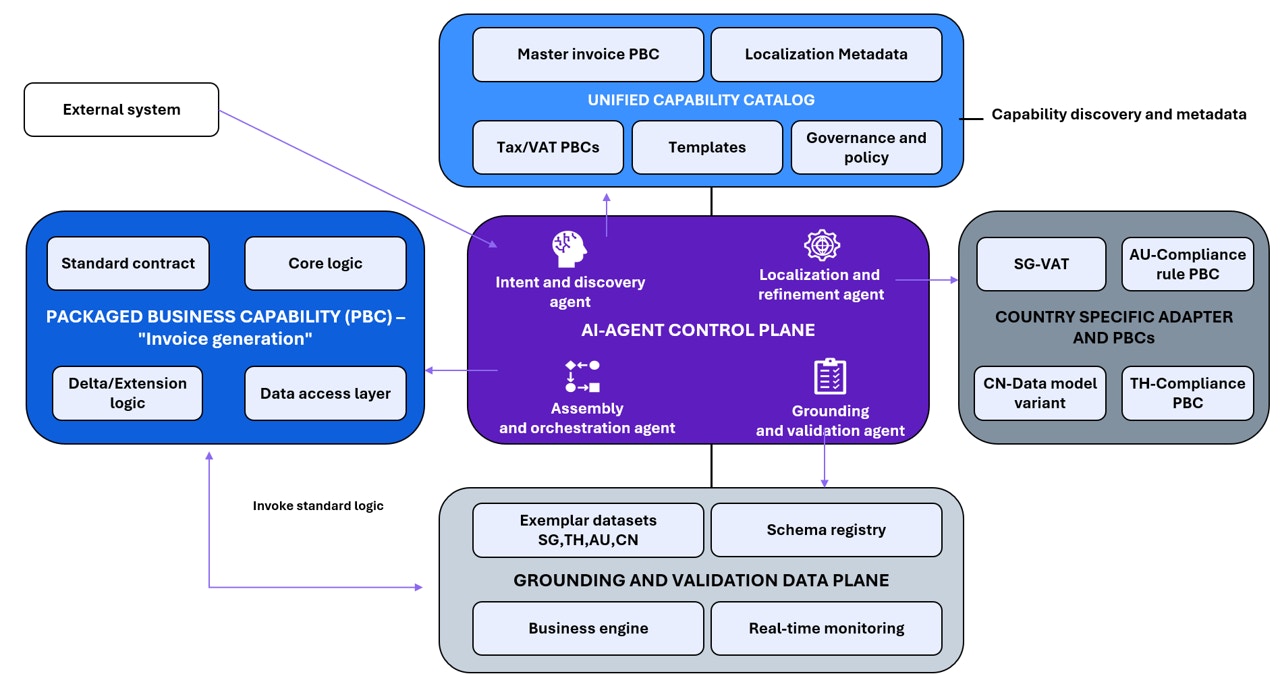
The invoicing solution is built on an AI-enabled composable architecture that separates global capabilities from country-specific rules, with AI orchestrating and optimizing execution.
Core components of the architecture:
- Packaged Business Capabilities (PBCs): Modular microservices that encapsulate core business logic and expose standardized contracts, supporting both global and local requirements.
- Unified Capability Catalog: Central registry for all PBCs, storing metadata, API contracts, governance policies, and localization templates to enable discovery and compliance.
- Grounding and validation data plane: Source of truth for compliance, including exemplar datasets, schema registry, business rule engine, and real-time monitoring.
- Country-specific adapter and PBCs: Extensions or variants of core PBCs tailored for local regulations, tax rules, and data models.
- AI-agent control plane: To manage complexity at scale, governance and orchestration are distributed across specialized AI agents—each focused on a specific business outcome rather than a monolithic control layer.
| Agent | Role | Challenges addressed |
| Intent and discovery | Interprets functional requests, identifies required PBC and existing template from the Unified Catalog. | API / Service sprawl, schema drift and inconsistent event contracts |
| Assembly and orchestration | Dynamically assembles workflows based on metadata. | Brittle workflows and slow change management. |
| Grounding and validation | Validates data flows against schemas and exemplar datasets. | AI hallucinations, compliance violations and inconsistent reasoning |
| Localization and refinement | Monitors rule changes, apply configuration updates within guardrails. | Country-specific divergence, fragmented policies and limited observability |
Execution flow:
- The intent and discovery agent interprets the request (e.g., invoice) and identifies the required PBC microservices and country-specific components from the Unified Capability Catalog.
- The assembly and orchestration agent dynamically generates a resilient workflow sequence, preventing orchestration fragility.
- During runtime, the grounding and validation agent enforces real-time governance by comparing data flows against the schema registry and exemplar datasets in the grounding and validation data plane. This prevents AI hallucinations and contract drift, ensuring outputs are locally compliant and globally consistent.
- The localization and refinement agent monitors for rule changes and autonomously updates localized PBC logic, enabling instant adaptation to new country regulations.
Key benefits:
By leveraging modular Packaged Business Capabilities, a Unified Capability Catalog and specialized AI agents, enterprises can overcome the fragmentation and complexity of global operations. This architecture delivers:
- Global consistency with local adaptability
- 70% - 80% logic reuse across countries
- Resilient workflows that respond to changing regulations and business needs
- Enhanced governance, compliance and observability
- Rapid onboarding, reducing rollout timelines from traditional multi-month efforts to around one month
Conclusion:
AI-native composable architectures empower organizations to innovate faster, adapt to evolving requirements and deliver seamless experiences across countries. This blueprint positions enterprises to build reliable, future-ready platforms that evolve at the pace of business.
This approach enables enterprises to respond faster to regulatory change, reduce operational risk and scale globally without proportional increases in cost or complexity.
