

 記事を聴く
記事を聴く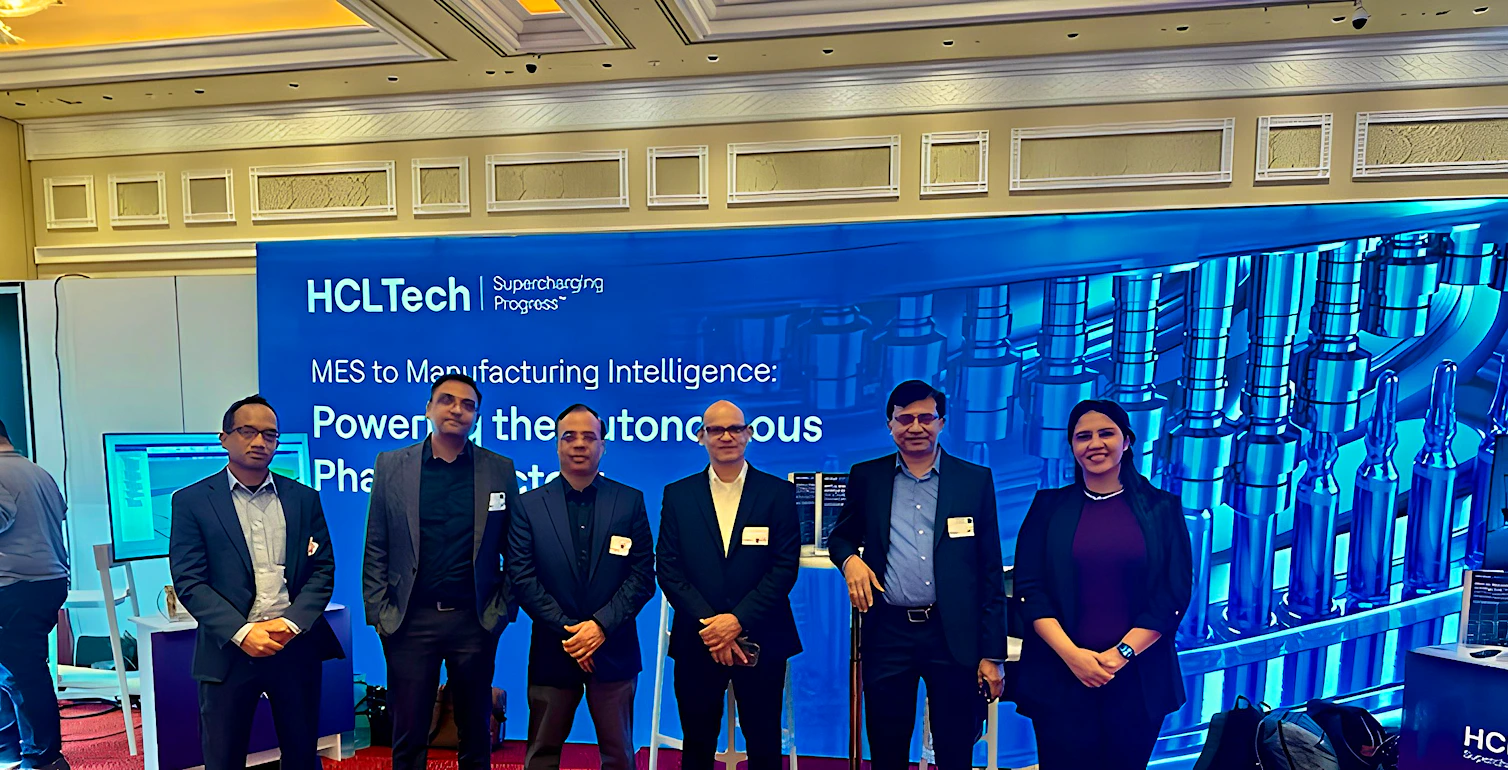
The pharmaceutical manufacturing industry is at an inflection point. MES and MOM platforms, long treated as execution and workflow tools, are now being asked to carry a far heavier load, to serve as the semantic backbone of intelligent, AI-driven factories.
During HCLTech’s presence at Pharma MES USA 2026, the conversation in the room made one thing clear: the question is no longer whether AI belongs in pharmaceutical manufacturing. The question is what kind of AI, applied how and governed by what.
Where the industry actually stands
Most pharmaceutical manufacturers today sit in the first two stages of the manufacturing maturity curve: digital systems are in place, some are integrated, data is visible. That is a meaningful starting point, but it is not a destination. Trusted, contextualized data is the prerequisite for any AI to function with credibility. Without it, the most sophisticated model operates blind.
The next three to five years will determine which organizations move from integrated to predictive to autonomous. Autonomous manufacturing in the pharmaceutical context does not mean removing operators or QA oversight. It means self-adjusting schedules, real-time release, proactive deviation prevention and AI-assisted root cause analysis all within validated, compliant workflows.
In this environment, the human role shifts from executor to adjudicator. AI becomes the copilot, not the captain.
Why hybrid AI is the only credible path in compliance-driven industries
One of the most consequential points raised at the event concerns the architecture of AI itself. Large Language Models (LLM) and probabilistic systems have genuine utility, but they can’t be the primary engine in a GxP environment. A probabilistic model can reach 99% accuracy. That remaining 1% or even 0.5% is not a rounding error in pharmaceutical manufacturing. It is a deviation, a batch failure or a compliance risk.
The model that holds up under scrutiny in this industry is a hybrid: deterministic engineering and physics models combined with machine learning trained on time-series process data. Chemistry, physics and industrial engineering guardrails don’t constrain AI, they make it trustworthy. Small Language Models (SLMs), tuned on contextual manufacturing vocabularies, outperform general-purpose LLMs for shop floor intelligence because they operate on precision, not approximation.
The analogy that resonates: trust in a system comes when it is deterministic. Force equals mass times acceleration. That is not a probabilistic statement. Building AI architectures that anchor probabilistic outputs to deterministic foundations is the engineering discipline the industry needs to invest in.
MES as the semantic model for the factory
At one biologics facility, close to 150 systems were running on the shop floor simultaneously some of them 15 to 20 years old, maintained on the principle of if it works, don't touch it. That reality describes most large pharmaceutical plants. The AI and data backplane model addresses this directly. Rather than replacing legacy systems or forcing a rip-and-replace, the backplane sits above them connecting historians, QMS, MES, and ERP data into a unified layer where deviation prediction, advanced analytics and machine learning models can operate.
The practical output is a single pane of glass: OEE trends, deviation categories, batch cycle times and release performance all drawn from the intersection of multiple systems, all available to an executive or a process engineer without switching contexts.
Four use cases that create the strongest starting position
Among the high-value starting points for pharma manufacturers beginning or accelerating this journey, four use cases stand out for their combination of impact and feasibility: predicting deviations before they occur, enabling review by exception rather than full-record review, implementing dynamic scheduling that responds to real-time conditions and building a digital backbone for production.
These are not aspirational concepts. They are executable with current technology, provided the MES foundation is stable. Stabilizing MES is step one not a prerequisite to be deferred, but the literal first move. A contextualized, batch-centric data model built on a stable MES is what makes every downstream AI investment defensible.
The flight simulator for the plant
Perhaps the most compelling idea to emerge from the session at Pharma MES USA is the concept of a plant flight simulator, a digital environment that models the behaviour of an entire production line using physics, chemistry and statistical process control models. Just as a flight simulator captures weather, traffic patterns and equipment parameters before a pilot commits to a course of action, the manufacturing equivalent allows plant engineers to test interventions, scenario-plan shutdowns and validate changes before touching a live production environment.
Reaching that capability requires traditional machine learning and deterministic models far more than it requires LLMs. Simulated OEE improvements of 15 to 20 percentage points become achievable when the model is trained on the right combination of process science and operational data. But the science has to lead the data science. That sequencing matters.
The strategic signal for manufacturing leadership
Our presence at Pharma MES USA 2026 reinforced a perspective that experienced manufacturing leaders already sense but don't always see clearly articulated: the tools available today represent a genuine step change. Thirty years of working around data fragmentation, manual deviation reviews and disconnected systems is a long time. AI and the AI data backplane offer a structured path out of that fragmentation not by eliminating complexity, but by making complexity navigable.
MES is the beginning of the autonomous manufacturing journey. Organizations that stabilize it, contextualize their data and embed data science across the full value chain will build a compounding advantage. Those that wait for perfect conditions will find the distance to close is only getting larger.
Learn more about our engineering services.