


For years, integration platforms have been an enterprise plumbing system that has integrated our CRM, ERP and other enterprise systems, making sure data is in sync and available in formats and standards as required. Now, a new era has arrived and Agentic AI is having its moment. AI agents are very good at understanding the user’s intent and figuring out next best actions, executing tasks, but Agentic AI cannot work in isolation; it needs access to enterprise data, it needs a way to talk to our existing systems like ERPs, CRMs, databases, ticketing systems, API’s, identity systems and so on. That’s where iPaaS platforms, which specialize in enabling access to enterprise data, platforms like MuleSoft, Boomi, Workato and others quietly become one of the most important pieces of the Agentic AI story.
What are iPaaS platforms and why are they important for the success of Agentic AI initiatives?
When teams start building agentic flows, the early approach is often to write direct API calls from agents to enterprise systems, write some custom connectors, have some logging and get done, but this will ultimately lead to the following pain points:
- Tool sprawl with agents calling services in unapproved ways
- Too many point-to-point integrations
- Inconsistent security practices
- Zero to limited observability
- Higher development timelines due to all custom integrations
iPaaS platforms we designed to handle all the above messes long before AI agents entered the picture. We can now think of iPaaS as the action and integration layer between agents and the enterprise. iPaaS is a cloud-based platform that connects applications and data and typically provides the capabilities depicted below:
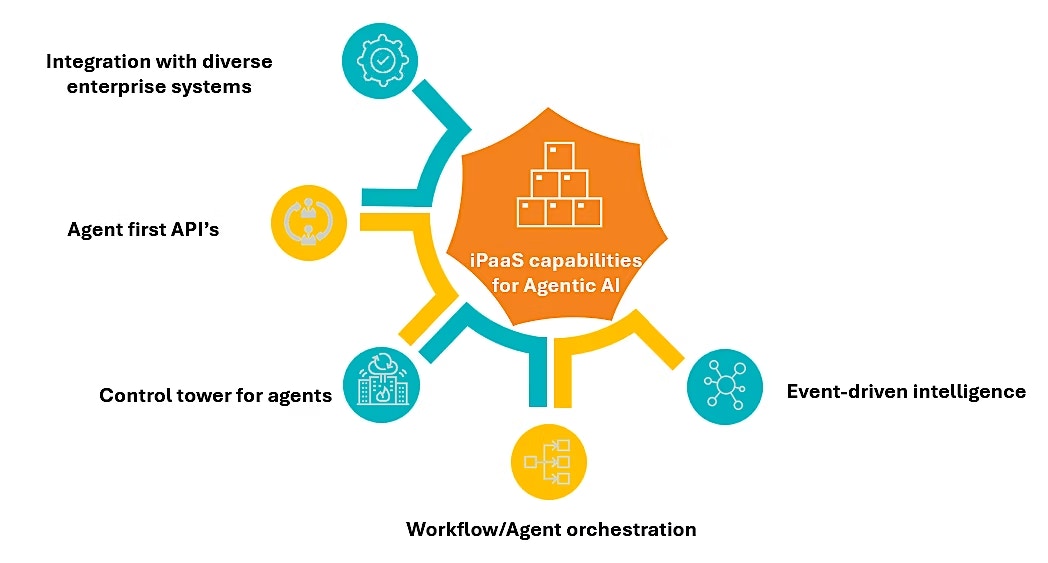
Connecting AI agents to enterprise systems: iPaaS platforms provide hundreds of prebuilt connectors to applications like Salesforce, SAP, Workday, NetSuite, Slack, etc. By leveraging iPaaS platforms, you give agents the power to instantly read, write and move data across your whole software landscape across your company. Moreover, agents will also struggle with logging into various enterprise applications and here in iPaaS platforms can handle API keys, session management and OAuth flows, making agents’ lives easier.
Agent first APIs: We used to design APIs for human developers to consume and iPaaS platforms are now enabling us to move to agent-centric APIs. APIs now include metadata so an AI agent can figure out how to use the API. Most of the iPaaS platforms now support Model Context Protocol (MCP) that empowers agents with contextually relevant data and communicate effectively with APIs and other applications. Just in a few clicks, even the existing APIs within the enterprise can be made available for agentic consumption and standard API management and governance policies, including throttling, rate limiting, etc., still apply. iPaaS platforms enable us with the capability to build API first Integrations in a 3-layered architecture of System API’s, Process APIs and Experience APIs. This layered architecture with flexible, isolated and scalable components maps perfectly to the needs of an AI agent as depicted below:
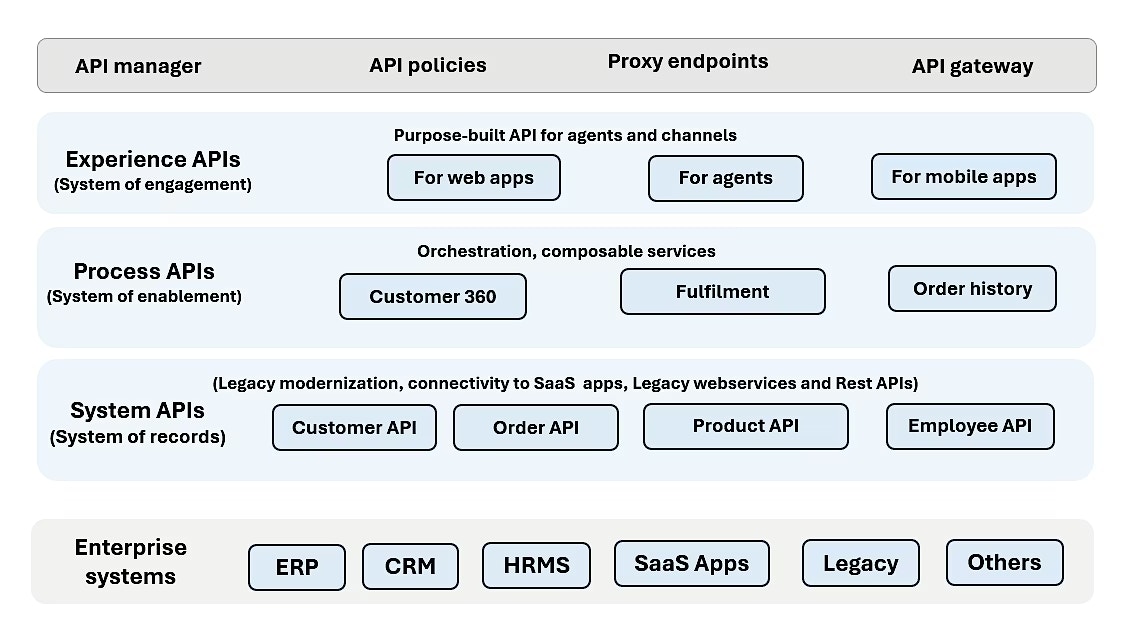
- Agents don’t need to know how to talk to various enterprise systems; rather, they can consume the System API’s exposed over MCP as a tool and get the work done. System API layer abstracts data and functionality from core systems into discrete building blocks and ensures that the data provided aligns with enterprise data models.
- Instead of an agent trying to figure out the 10 steps to accomplish a business objective, it can call a single process API and get the work done. Process API’s orchestrate multiple System APIs to achieve a specific business objective (e.g., contract generation, customer 360, fulfilment, etc.).
- Experience API layer enables agents with tailor-made sets of data they need to solve a specific problem, avoiding the irrelevant data fields, as agents typically perform better with smaller and clearer schemas.
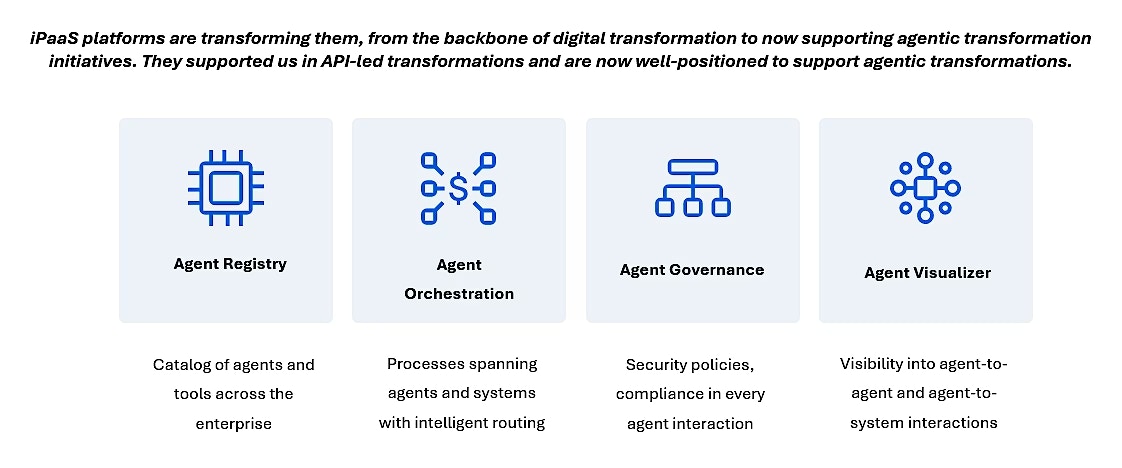
Control tower for agents: An autonomous agent being given access to our key enterprise systems is a risky affair and guardrails are essential. iPaaS platforms provide logging, retries, access control and monitoring, ensuring AI agents act safely and predictably. Many iPaaS platforms have launched offering like Agent Control Tower, where agents created anywhere can be managed on a single control plane. For Example, MuleSoft has an offering in MuleSoft Agent Fabric and Boomi has an equivalent offering in Boomi Agent Garden.
iPaaS platforms have been leaders for a long time in helping integrate disparate systems. Uncontrolled agents are unsustainable and iPaaS platforms have come up with offerings revolving around the following four pillars to solve the agent sprawl and governance challenges:
Workflow and Agent Orchestration: IpaaS has come up with offerings in agent brokers that orchestrate tasks between agents as well as MCP servers. Almost all iPaaS platforms support agent-to-agent protocol as well as Model Context protocol now, and both play a vital role in ensuring agentic orchestrations. iPaaS platforms have traditionally been very strong when it comes to workflow orchestration and the ability to execute multi-step business processes, manage state across steps, manage events and triggers supported by control flow logic. In agentic architecture, these workflows become a tool for agent consumption. Moreover, not all decisions can be taken autonomously: human in the loop is a very important and relevant pattern and iPaaS platforms support this as they have capabilities to do approval steps, task assignments, etc.
Event-driven intelligence: iPaaS platforms are event-driven by design for a very long time, with support for events and event platforms like JMS, AQMP, MQTT, etc., which have existed for a long time. We have out-of-the-box capabilities in iPaaS platforms to integrate with key eventing platforms like Solace, Kafka, Azure Service Bus, AWS SQS/SNS, IBM MQ and many others. iPaaS platforms can easily capture events from various systems like applications, APIs, databases and message brokers, do intelligent routing and act as triggers for AI agents to initiate actions they are supposed to take by sensing changes rather than waiting for instructions.
To realize the benefits of Agentic AI powered by iPaaS platforms, enterprises need a clear architectural direction to define how agents, data and applications should be integrated. Here is a simplified version of how this AI First Integration reference architecture could look:
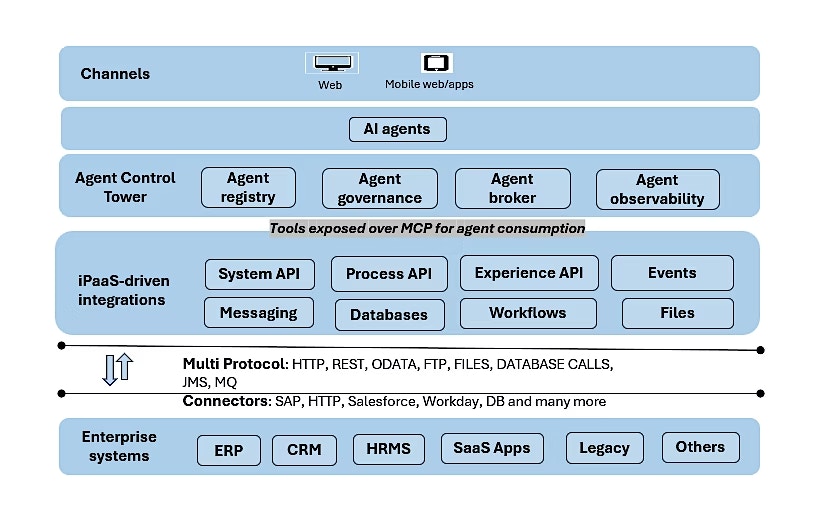
In this model, AI agents could be served through a variety of digital channels and at the heart of this architecture is IPaaS platforms, which seamlessly enable, govern and secure our enterprise data for the Agentic AI era. iPaaS platforms like MuleSoft can play a foundational role in the Agentic AI story by standardizing the tool layer, orchestrating workflows, enforcing governance and playing the role of a strong integration backbone, which is crucial to the success of Agentic AI use cases within an enterprise.
How HCLTech can help:
Talking about our Digital Integration Practice, it’s a strong and established practice with close to 2 decades of experience in the integration space. iPaaS platforms are a mature capability within HCL’s integration practice. We are implementing greenfield projects, right from helping our utility customers with the integration platform setup and with their first integration implementation on iPaaS platforms like MuleSoft, Boomi, Workato and others. We have built strong GenAI-driven accelerators to help in new integration development, integration maintenance and accelerators to give thrust to migration initiatives from legacy to modern iPaaS technologies. We understand this area and can be very strong partners to support your enterprise integration needs in your Agentic AI initiatives.
