What are network services?
As enterprises advance digital transformation, networks have evolved from simple connectivity layers to strategic business enablers. For CIOs and IT leaders, understanding what network services is essential to building resilient, scalable and secure digital environments.
Network services refer to the technologies, platforms and operational capabilities that enable communication between users, devices, applications and data across an organization’s infrastructure. These IT and network services support connectivity across offices, data centers, cloud environments and remote locations while ensuring performance, security and governance.
Unlike basic networking, modern enterprise networking integrates automation, software-defined architectures and intelligent operations to manage increasingly complex environments. As enterprises adopt hybrid and multicloud strategies, enterprise network infrastructure must evolve to support distributed workloads, real-time applications and secure access at scale.
Evolution of enterprise networking
Enterprise networks have transformed significantly over the past decade. Traditional networks were primarily hardware-based and designed to support centralized systems within corporate data centers. However, the rise of cloud computing, mobile workforces and digital services has fundamentally changed networking requirements.
Today, enterprise environments often span on-premises infrastructure, private clouds and public cloud platforms. This shift has led to the adoption of multicloud networking, enabling organizations to manage connectivity and performance across multiple cloud providers.
At the same time, intelligent technologies such as intent-based networking are redefining how networks operate. Instead of manually configuring infrastructure, IT teams define the desired network outcomes—such as performance, security or application priorities—and automated systems dynamically configure the network to meet those objectives.
Core components of network services
Understanding what network services are requires examining the key building blocks that enable modern enterprise network infrastructure.
Connectivity (LAN, WAN, SD-WAN)
Connectivity forms the backbone of enterprise networks. It ensures seamless communication between users, devices and applications across local and global environments.
Key technologies include:
- Local area networks (LAN): High-speed connectivity within campuses and offices.
- Wide area networks (WAN): Links geographically distributed branch offices and corporate locations.
- Software-defined WAN (SD-WAN): Uses software to intelligently route traffic across multiple network paths, improving performance and reliability.
These technologies allow enterprises to maintain consistent connectivity while optimizing bandwidth and reducing dependency on legacy network circuits.
Security
Security is a fundamental component of modern IT and network services. As organizations expand digital ecosystems and remote access, network-level security helps protect critical systems and data.
Core network security capabilities include firewalls, access control mechanisms, encryption and zero-trust frameworks. Many enterprises are also adopting secure access service edge (SASE) architectures that combine networking and security into a unified model.
Embedding security into the network layer enables organizations to enforce consistent policies across the entire enterprise network infrastructure.
Cloud networking
Cloud adoption has made multicloud networking a core capability for modern enterprises. Cloud networking services ensure reliable connectivity between on-premises environments and public cloud platforms.
These services enable organizations to:
- Connect applications across cloud environments
- Optimize traffic routing between regions
- Maintain consistent security and access policies
For global organizations operating in markets such as the US and India, cloud networking ensures that distributed applications deliver consistent performance and reliability.
Data center networking
Despite increasing cloud adoption, enterprise data centers continue to support mission-critical workloads. Data center networking services provide high-speed connectivity between servers, storage systems and applications.
Technologies such as software-defined networking (SDN) and network virtualization allow organizations to manage complex data center environments more efficiently while supporting scalable and dynamic workloads.
Network services operational capabilities
In addition to infrastructure components, modern network services include operational capabilities that ensure networks remain reliable and optimized.
Management: Centralized network management platforms allow IT teams to configure devices, enforce policies and maintain network health across distributed environments.
Monitoring: Continuous monitoring tracks performance indicators such as latency, bandwidth utilization and packet loss. Advanced analytics help detect potential issues before they affect users.
Orchestration: Network orchestration automates the coordination of multiple network functions. Automated provisioning accelerates service deployment and reduces manual configuration tasks.
Troubleshooting: Intelligent diagnostic tools analyze network behavior to quickly identify root causes and minimize downtime.
Together, these operational capabilities ensure that enterprise networks remain stable, efficient and responsive to changing business needs.
Networking software and virtualization
Software-driven architectures are reshaping modern enterprise networking. Technologies such as SDN allow organizations to separate network control from hardware infrastructure, enabling centralized management and faster configuration changes.
Network virtualization further enhances flexibility by allowing multiple virtual networks to run on the same physical infrastructure. Automation and artificial intelligence are also increasingly integrated into network operations, helping organizations optimize performance, detect anomalies and support emerging intent-based networking models.
Business benefits of network services
Enterprises invest in advanced IT and network services to drive measurable business outcomes.
Resilience: Intelligent routing and automated failover capabilities improve network reliability and reduce downtime.
Agility: Software-defined architectures allow organizations to quickly deploy new applications and expand operations.
Cost optimization: Modern connectivity models such as SD-WAN help reduce infrastructure costs while improving bandwidth utilization.
By strengthening the enterprise network infrastructure, organizations can support innovation while maintaining operational efficiency.
Managed vs inhouse network services
Organizations typically manage networks internally or partner with specialized service providers.
Inhouse management provides direct control over infrastructure but requires significant investment in tools, expertise and ongoing maintenance.
Managed network services offer an alternative approach, allowing enterprises to leverage external expertise for monitoring, optimization and operational management. Many organizations adopt a hybrid strategy, combining internal governance with external operational support.
Future trends of network services
The future of enterprise networking will be shaped by increasing automation and service-based consumption models. Key trends include AI-driven network operations, expansion of intent-based networking and the emergence of Network-as-a-Service (NaaS).
Security and networking will also continue converging through frameworks such as SASE, enabling more integrated and scalable architectures.
How enterprises should approach network modernization
Modernizing network infrastructure requires a strategic approach that aligns technology investments with business priorities. Enterprises should assess their existing enterprise network infrastructure, identify performance gaps and adopt software-defined architectures that support cloud-first strategies.
Integrating automation, analytics and multicloud networking capabilities can significantly improve scalability and operational efficiency. Many organizations also partner with experienced providers such as HCLTech to design and manage modern enterprise networking environments that support long-term digital growth.
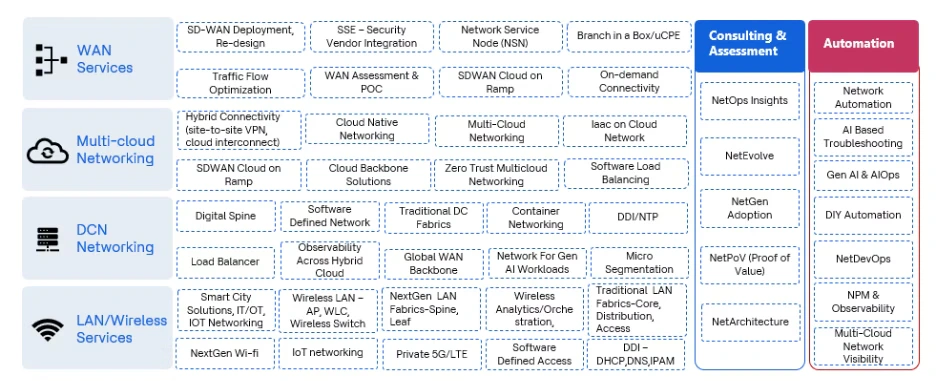
The HCLTech suite of network offerings