


The aerospace industry operates at the cutting-edge of engineering innovation and documentation is the backbone that keeps this edge sharp. Every component, subsystem and maintenance action is governed by thousands of interlinked pages of technical content. Yet, despite significant advances in engineering and manufacturing, much of this mission-critical information remains locked in legacy formats and manual workflows - creating unnecessary risk, cost and delays.
Modernizing documentation is no longer a back-office support function, it has evolved into a strategic imperative. Today, it is a key enabler of operational agility, safety and regulatory compliance. At the heart of this transformation are AI and automation, reshaping how organizations create, validate, manage and publish compliant technical content.
Following the discussions at the 2025 S1000D User Forum/ATA e-Business Forum, this article explores how AI-enabled, standards-driven modernization can transform the entire technical publications lifecycle – empowering aerospace organizations to operate faster, safer and more efficiently.
The documentation gap: Industry challenges
Despite widespread awareness of standards such as S1000D and ATA iSpec 2200, documentation operations continue to face persistent challenges:
- Legacy content debt: Decades of monolithic ATA-style manuals and unstructured content restrict reuse and make targeted updates cumbersome.
- Manual compliance overhead: Schema validation, BREX and ASD-STE100 (STE) checks that demand time and niche expertise.
- Fragmented, siloed toolchains: Weak integration across PLM/ERP, CMS and publishing environments creates inefficiencies and data silos.
- Slow release cycles: Heavy review stages and disconnected workflows delaying updates and impacting operational agility.
These challenges are particularly pronounced in traditional ATA-based documentation, where all tasks for a system reside in a single manual. Even a minor procedural change often requires teams to review, re-approve and re-release the entire document - following by pushing a full update through Integrated Lifecycle Support (ILS) or Integrated Product Support (IPS) pipelines. This slows change and makes it difficult to consistently reuse common content.
Together, these challenges create documentation ecosystems that struggle to keep pace with product evolution and regulatory expectations, making modernization not just beneficial but essential.
Why S1000D is becoming a global benchmark for documentation
S1000D is an international standard for producing and exchanging technical publications. Originally developed by the Aerospace, Security and Defense Industries Association of Europe, it has evolved into a global benchmark adopted across aerospace, defense and other high complexity sectors.
At its core, S1000D structures content into modular units called Data Modules (DMs), all managed within a Common Source Database (CSDB). This XML-based, modular approach delivers significant advantages:
- Content reuse and consistency across manuals and platforms.
- Version control and traceability throughout the product life cycle.
- Compliance with global defense documentation standards.
- Efficiency in authoring, validation and publishing.
- Cleaner migration from the ATA book manuals to the S1000D data modules, supporting technical documentation conversion and long-term maintainability across ILS/IPS.
For operators with existing ATA iSpec 2200 manuals, technical documentation conversion and modernization, essentially a structured migration from ATA to S1000D, allows the CSDB and data modules to become the backbone of wider ILS/IPS and S1000I-aligned processes. Updates are applied once at the data module level instead of reissuing entire books and the same data can drive maintenance planning, spares provisioning, e-tech pubs and training. This transformation streamlines reviews and approvals, improves search, shortens turnaround times and reduces the overall economic and process effort of lifecycle support.
Driving the technical documentation workflow with HCLTech AIA framework
Implementing S1000D at scale is resource intensive. Skilled authors, rigorous schema validation and multi-format publishing make technical documentation a specialized, high-effort function. As content volumes grow and standards evolve, organizations are increasingly adopting AI-driven documentation ecosystems to augment, not replace the expertise of human authors. These solutions streamline compliance tasks, improve accuracy and accelerate delivery while preserving the vital role of human oversight.
Modernizing technical documentation is about more than digitization; it’s about smart orchestration. HCLTech’s Artificial Intelligence and Automation (AIA) framework for S1000D reimagines the documentation process by:
- Integrating the entire S1000D lifecycle, from creation to publishing
- Reducing manual work while improving version control
- Empowering authors and reviewers with AI-assisted tools rather than replacing human judgment
Centered around five core modules, it transforms authoring and publishing into a streamlined, insight-driven process.
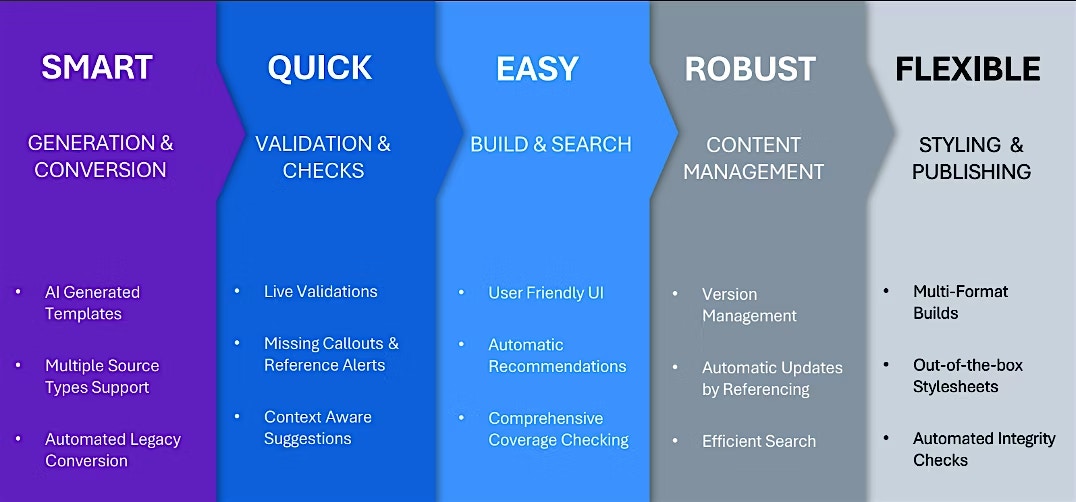
- Smart content generation and conversion uses AI to create templates, draft documents aligned with S1000D schemas and seamlessly convert legacy documents to XML automatically. Voice-to-XML authoring enhances convenience and speeds up content creation and graph-based context linking helps reduce errors and ensure consistency.
- Compliance and validation embed quality checks from the start. Real-time schema validation, BREX enforcement, STE compliance and AI auto-corrections cut validation effort and produce audit-ready, structured outputs.
- During assembly, build and search speeds up workflows with user-friendly drag-and-drop functionality, smart search, auto-recommendations and intelligent package generation. Teams see previews in real-time and enjoy easier sequencing, reducing integration time.
- For large programs, content management offers centralized governance through a CSDB connected to PLM/ERP systems. Semantic search, knowledge linking and AI summary tools make retrieval, change management and team coordination smoother.
- Closing the lifecycle, multi-format publishing allows one-click release across IETP, PDF and HTML, with watermarking, style controls and accessibility checks, ensuring consistent branding and compliance.
Together, these modules elevate documentation operations from manual, error-prone tasks to an intelligent, connected and scalable system. The AIA framework isn’t just an upgrade; it’s a blueprint for the future of technical publications.
The business impact: Efficiency, accuracy and ROI
The AI and Automation (AIA) framework can enable organizations to achieve:
- Significant reductions in authoring, validation and publishing time
- Higher compliance accuracy and fewer non-conformities
- Faster approvals from regulators
- Better content quality and consistency across fleets and programs
- Lower costs from rework, conversions and delayed updates
HCLTech is among the early pioneers reimagining documentation end-to-end with this AIA-aided approach, as showcased at the 2025 S1000D User Forum / ATA e-Business Forum.
We recently worked with a leading provider of in-flight entertainment and communication systems to modernize their documentation. Our team swiftly automated the conversion of the older PDF files into an open, editable XML format to streamline more accessible updates and revisions, followed by implementing documentation standards relevant to the aviation industry, specifically S1000D and ATA iSpec 2200. The company saved over $10 million annually compared to their previous vendor, achieved 100% on-time delivery for two years and saw a marked boost in customer satisfaction. This demonstrates how a structured, standards-aligned intelligent documentation model, enhanced by the AIA framework, can create predictable workflows, ensure reliable delivery and unlock measurable business value.
The road ahead: Why intelligent documentation ecosystems are essential
The future of aerospace documentation isn’t static PDFs stored in shared drives. It is dynamic, connected and constantly evolving, reflecting engineering changes in near real time and assisting maintenance teams with contextual insights.
AI and automation are not replacing aerospace subject matter experts, authors or maintainers. They amplify their expertise, handle repetitive checks and automate manual validations so experts can focus on engineering insights, safety-critical communication and readiness.
As aerospace moves toward Industry 5.0, technical documentation will be crucial in enabling smarter, safer and more sustainable operations. Our vision is to help enterprises build AI-enabled, optimally automated, compliant and future-ready documentation ecosystems that bridge engineering complexity with operational excellence at ease and with less effort.
