


Introduction: The shift in cyber-physical systems engineering
Engineering is transitioning from hardware-centric design to software-defined products (SDPs). Across automotive, aerospace, industrial and medical systems, product value is increasingly shaped by software architecture, embedded intelligence, connectivity and data-driven functionality. System behavior, once determined by physical design, is now increasingly governed by programmable logic.
This evolution presents a dual dynamic of opportunity and risk. Unlike traditional products, SDP’s evolve after deployment through modular software, over-the-air updates and performance optimization. This transforms products into adaptive platforms capable of continuous improvement, lifecycle value expansion and new service-led business models. However, this evolution introduces complexity. Software can be changed and redeployed at speed, while hardware remains governed by physical laws, manufacturing timelines, validation cycles and safety requirements. Software changes are often coupled with processor limits, sensor tolerances, thermal thresholds, mechanical behavior and safety boundaries, creating tightly interdependent cyber-physical architectures.
Without explicit dependency management and end-to-end traceability, localized changes can trigger unintended system-level effects. The strategic imperative is digital continuity: a unified, semantically linked digital thread across Application Lifecycle Management (ALM), Product Lifecycle Management (PLM) and Model-Based Systems Engineering (MBSE). This enables coordinated change governance, system transparency, impact analysis and controlled evolution.
The core engineering challenge: Differential development speeds
Software evolves rapidly through agile methods, DevOps practices and continuous delivery. Hardware moves through longer cycles shaped by physical constraints, manufacturing readiness, supply chain certification and validation. This creates an engineering misalignment: software often operates on idealized assumptions, while hardware is subject to real-world limitations such as thermal behavior, signal variation, material fatigue, power constraints and environmental conditions.
As software advances, it may demand performance beyond what the hardware baseline can safely support, introducing system-level risk. The response is not to treat software as an overlay on hardware. In SDP’s, software is a a co-equal driver of system behavior. Hardware and software must be co-developed within an integrated engineering framework, supported by unified models, shared assumptions, synchronized configurations and continuous validation.
The dual nature of software-driven features: Opportunity and existential risk
Software-driven features create significant opportunity. They enable functionality to be enhanced after release, extend lifecycle value, support personalization, unlock data-led services and create new business models. The same capability introduces critical risk. As systems move toward drive-by-wire software-controlled architectures, software becomes the primary controller of physical safety. In these environments, minor logic errors, parameter mismatches or configuration inconsistencies can cause critical failures.
This demands strict alignment between software and hardware configurations, with precise version mapping, unified configuration control and traceability across domains. Without this alignment, software may be technically correct in isolation but unsafe in the physical system context.
Configuration management and validation complexity in software-defined systems
Configuration management is no longer limited to physical parts, mechanical assemblies or bill-of-material structures. It now extends into logic, behavior and parameterized performance. A single software baseline can exhibit multiple behaviors depending on parameters and hardware variants. This creates an exponential increase in validation effort, as each change must be tested across operating conditions and configurations. Physical testing alone is insufficient, leading to reliance on simulation methods.
However, simulation is only valuable when models, software definitions and hardware configurations remain synchronized. If the simulation does not reflect software logic or physical product configuration, the misalignment leads to false validation confidence and increased risk.
Validation lessons from highly coupled cyber-physical systems
Failures in managing software-hardware dependencies demonstrate the risks of disconnected engineering, weak validation and incomplete configuration control. The following examples highlight how software and physical system behavior can become misaligned when engineering domains are not sufficiently integrated.
Incident / System | Core software/Hardware disconnect | Validation / Granular parameter failure | References |
| Boeing 737 MAX (MCAS) | Software used to compensate for aerodynamic changes due to engine placement | No redundancy, over-reliance on single angle-of-attack sensor leading to erroneous activation | JATR Report (FAA, 2019) |
| Toyota Drive-by-Wire | Electronic throttle system lacked robust fail-safe and independent overrides in edge cases | Complex interaction of mechanical faults and control logic, insufficient system-level validation under all conditions | NASA/NHTSA Technical Assessment |
| Air France AF447 | Flight control software misinterpreted inconsistent airspeed sensor data (pitot tube icing) | Loss of reliable input data led to incorrect system behavior and inadequate pilot/system response | BEA Final Accident Report (2012) |
These examples reinforce an important lesson: as software gains greater control over physical systems, validation must become more integrated, traceable and system aware. Disconnected engineering domains can no longer support the complexity of software-defined product development.
Digital continuity: An integrated engineering architecture
To survive the immense complexities of the differential speed of development and to safely govern the granular control of software parameters, engineering enterprises need a connected architectural approach. Digital continuity provides that foundation.
Digital continuity is a seamlessly, traceably and secure flow of engineering data across the entire product lifecycle, from concept and requirements definition to design, validation, manufacturing, deployment, service and retirement.
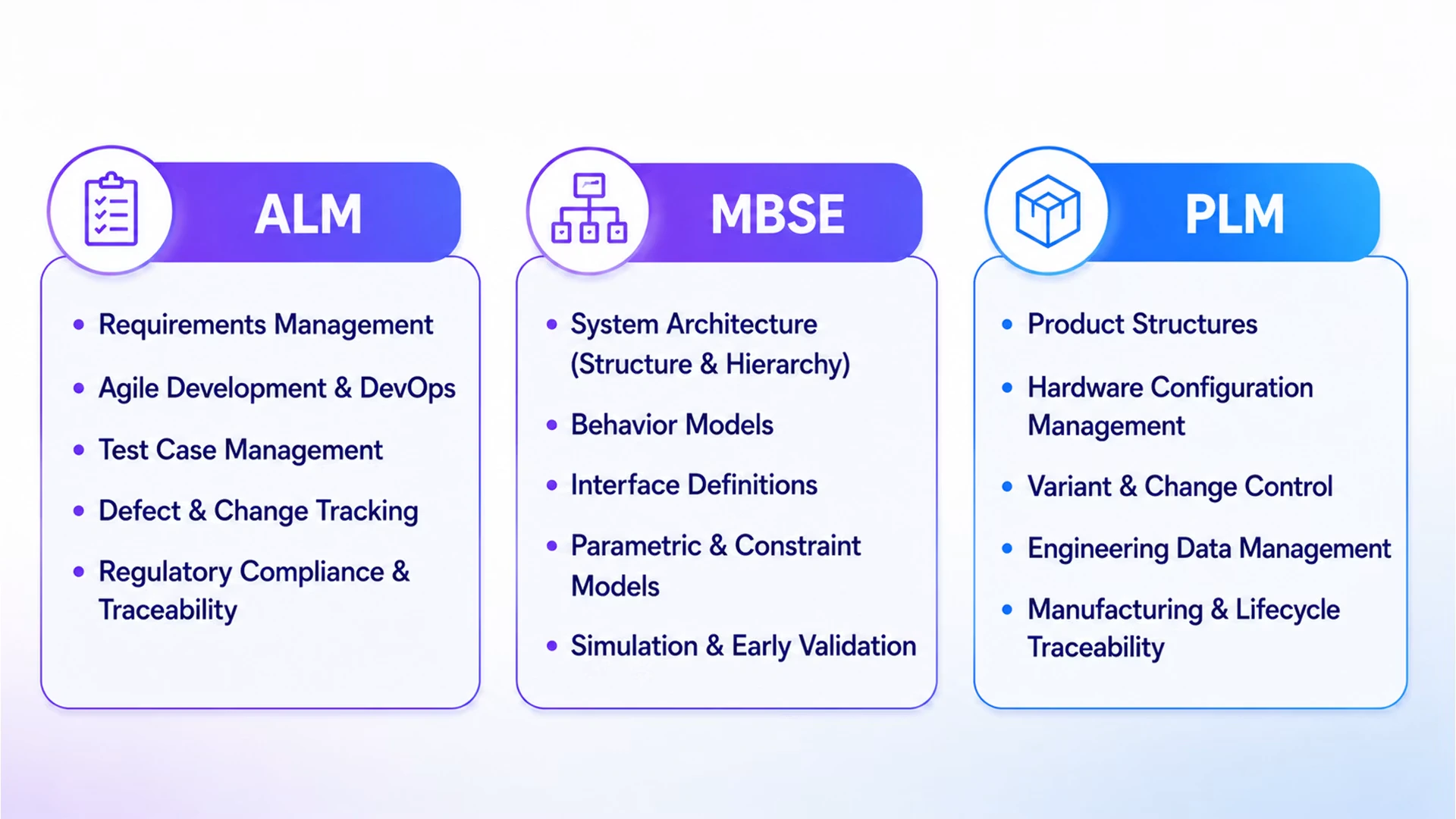
This connects requirements, system models, software logic, physical configurations, validation evidence and change governance into a consistent digital thread.
This continuity is enabled by the convergence of three core domains:
ALM (Application Lifecycle Management) governs software execution including requirements, code, testing, defects, releases and parameter control, but operates in the logical domain.
MBSE (Model-Based Systems Engineering) provides the system-level architecture, defining behavior, interfaces and constraints, while enabling early validation through executable models.
PLM (Product Lifecycle Management) anchors the physical domain, managing product structures, hardware configurations, variant and lifecycle control.
Individually, ALM, MBSE and PLM often create isolated “islands of excellence.” When integrated, they form a cohesive digital engineering environment where changes are traceable across software, system models and hardware. This ensures that a requirement or parameter change in software is immediately validated against system behavior and physical constraints, enabling early risk detection, controlled evolution and reliable deployment in complex cyber-physical environments.
The International Council on Systems Engineering (INCOSE) Digital Engineering Information Exchange Working Group (DEIXWG) emphasizes that true digital continuity must address critical lifecycle views. Engineers need to demonstrate that designs are consistent with requirements, that simulation test plans cover relevant software parameters and that technical baselines remain unified across traditionally siloed domains. By uniting these three pillars into a continuous digital thread, organizations can achieve a unified Enterprise Architecture (EA).
Beyond tool connectivity: The HCLTech MBSE connector advantage
HCLTech’s Cameo connector for Teamcenter and Cameo connector for Polarion help operationalize the digital thread across ALM, MBSE and PLM by enabling a seamless, traceable flow of requirements, system architecture, product configurations and validation data through native, semantically aligned workflows.
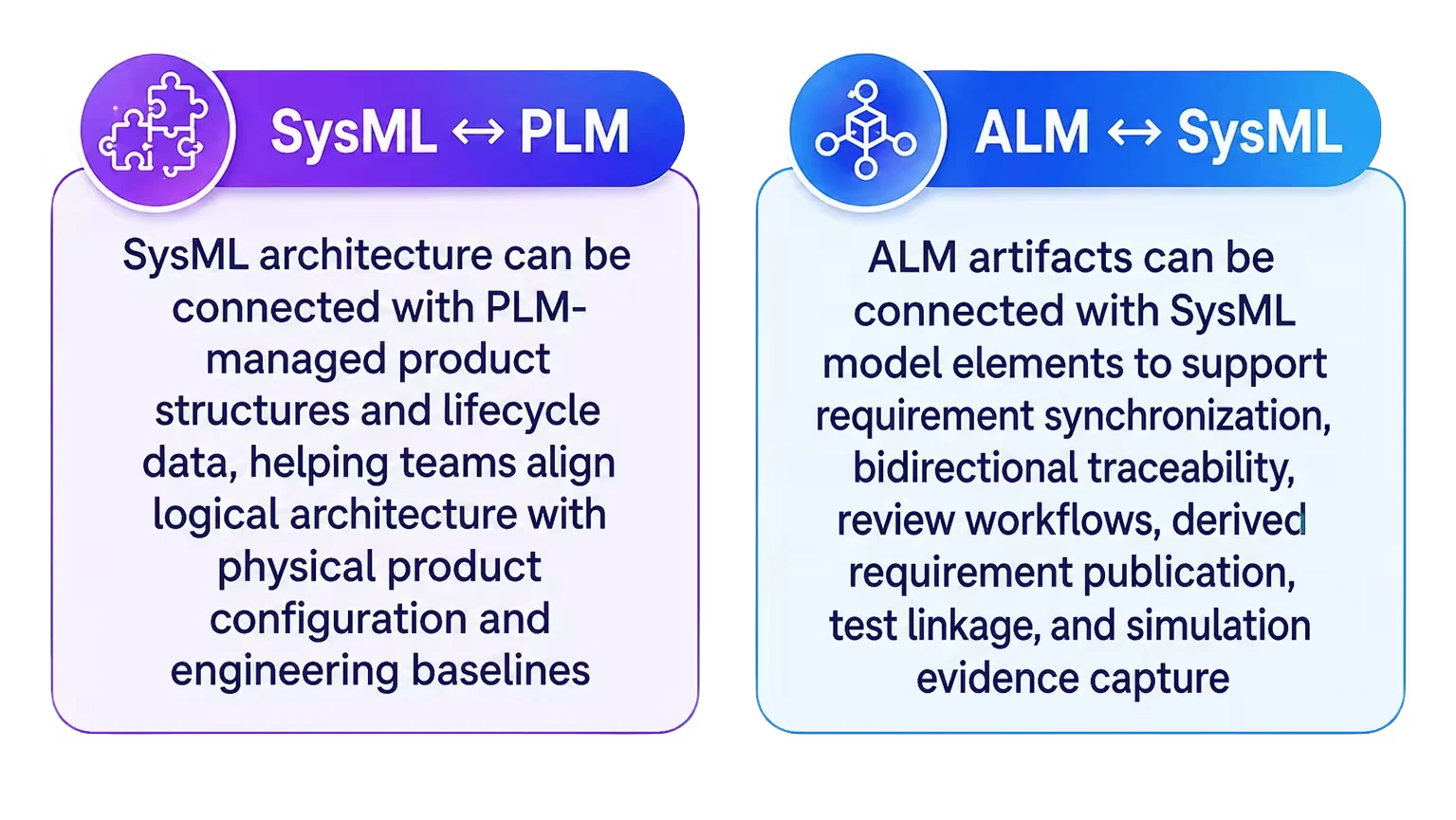
Delivered as lightweight Cameo plugins, they integrate directly into existing environments without additional infrastructure, preserving native user experiences across tools like Cameo Systems Modeler, Siemens Polarion and Siemens Teamcenter while accelerating deployment.
Core capabilities include native data transformation — ensuring lifecycle-ready, platform-specific objects — along with built-in yet configurable mappings for enterprise flexibility. The connectors enforce clear system-of-record ownership and controlled synchronization, improving traceability, governance and audit readiness while enabling early validation and reducing downstream risks. Developed in collaboration with Dassault Systèmes and other leading vendors, they align with product roadmaps and future tool versions, ensuring long-term stability and confidence in enterprise MBSE integration strategies.
Key differentiators
- Native data transformation: Converts data into platform-specific, lifecycle-ready objects rather than simple hyperlinks
- Lightweight deployment: Uses Cameo-based plugins with no need for additional integration infrastructure
- Seamless user experience: Allows engineers to continue working in native tools without disrupting established workflows
- Configurable and scalable integration: Provides predefined mappings with flexibility to adapt to enterprise methods and data models
- Strong governance and system-of-record clarity: Supports controlled synchronization, clear data ownership audit readiness and compliance alignment
- Semantic traceability: Preserves relationships, context and engineering meaning across ALM, MBSE and PLM environments.
Conclusion
Software-defined products are reshaping modern engineering, shifting product value toward intelligent, adaptive systems that evolve continuously. While this creates significant opportunities, it also introduces critical risks due to the differential speed between fast software cycles and slower, constraint-bound hardware development. As software gains granular control over physical systems, traditional validation is no longer enough.
Digital continuity : integrating ALM, MBSE and PLM into a unified digital thread is now essential. By connecting development within a traceable, model-driven framework, organizations can improve synchronization, reduce risk and enable safer, faster, more scalable innovation in the software-defined era.
