


For many enterprises, the most critical applications are also the most difficult to change. These aren't inhouse systems; they are the aging Commercial Off-The-Shelf (COTS) applications that run core business functions. Once a wise investment, these legacy platforms have become a primary source of technical debt, hindering cloud adoption, slowing integration and stalling the development of new features. This creates a significant dilemma for IT leaders: the need to modernize is clear, but a unique and formidable set of obstacles stands in the way.
Modernizing legacy COTS applications is notoriously difficult. Unlike inhouse systems, organizations often lack access to COTS source code, which limits their ability to modernize these systems without vendor support.
Key challenges include:
- Limited insight: Many legacy systems lack proper documentation and critical business logic is hidden in code. This forces teams into time-intensive reverse engineering and guesswork.
- Outdated tech and skills gap: Legacy COTS products often use old technologies that few developers today specialize in. A shrinking pool of experts and the retirement of original developers leave modernization efforts with knowledge gaps.
- High risk and cost: Traditional rewrites are costly and risky. Manual analysis and code conversion are slow, error-prone and expensive. Organizations fear multi-year projects with unclear ROI, so they defer necessary upgrades.
- Vendor lock-in: When COTS vendors lag in their own modernization, customers are stuck on outdated versions. They may face poor cloud support, integration hurdles or performance issues, yet cannot easily change the software.
These issues result in technical debt that drags down innovation. It’s too slow and costly to modernize legacy systems via conventional means, but GenAI offers a promising alternative.
Automated modernization using AI and exemplars
Exemplar-driven modernization is a solution that leverages AI agents and real usage examples to modernize COTS modules while preserving their behaviour. Instead of relying on source code, this approach uses exemplars – a large set of input/output pairs from the legacy system – as the specification for what the new system must do. In plain English, we supply the intent of each module (its functional description) along with hundreds or thousands of real examples of how that module behaves. From there, a coordinated team of AI agents can rebuild the module in a modern tech stack, test-first, as shown in the diagram below:
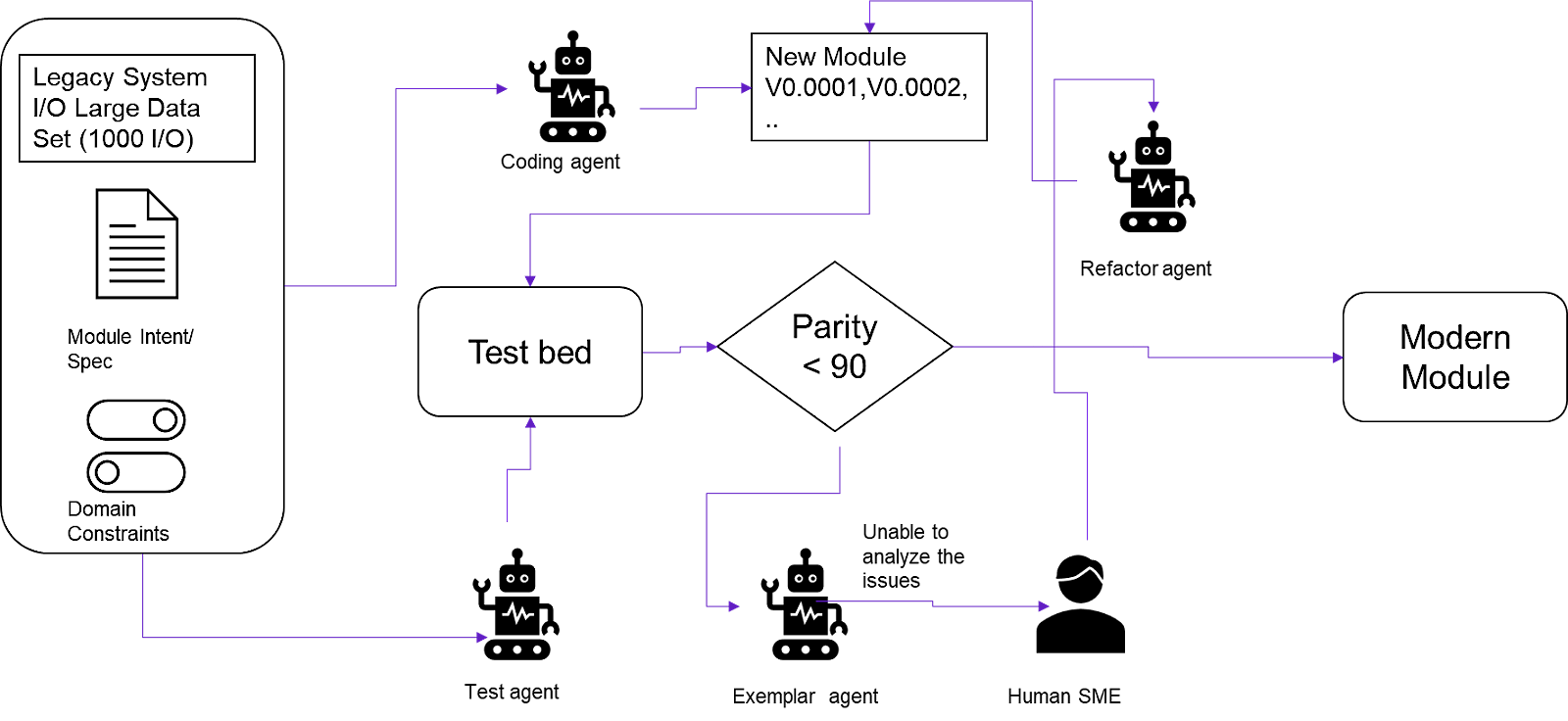
The activities in this approach are summarized as follows:
- Generate code from intent: A coding agent (powered by an LLM) takes the module’s intent (e.g. “calculate invoice tax and totals based on item list and region rules”) and produces an initial code implementation in the target modern language. This is essentially an AI pair-programmer that writes a first-cut module based on the requirements.
- Validate with legacy examples: We then run the new module against the collected legacy inputs and compare its outputs to the legacy system’s outputs for each test case. This test bed of exemplars acts as the truth source. Any differences or failing cases indicate where the new code’s behavior diverges from the legacy logic. (This concept mirrors “test-driven modernization”, where extracted legacy business rules are turned into tests and new code is generated to pass those tests; the tests become a safety net to ensure functional equivalence.)
- Iterative AI refinement: An exemplar agent analyzes the discrepancies for any failing tests. This agent examines why the new output doesn’t match the legacy output. For example, it might detect a missing business rule or an edge-case input not handled. The agent then provides feedback or hints (e.g., “New code fails for state=NY because legacy applies an additional tax exemption rule for NY customers”). A refactor agent consumes these hints to adjust the code, fixing logic or edge cases that were identified. The updated module is then re-tested against the exemplars. This loop repeats, with the AI agents iteratively bringing the new code closer to the legacy behavior.
- In practice, this AI-driven workflow continues until diminishing returns. Once the agents can no longer improve (e.g., the remaining failing cases involve very complex logic or subtle conditions), the process exits the loop. A human Subject Matter Expert (SME) then reviews the toughest discrepancies and provides guidance or code fixes for those last 10% of cases. The goal is to achieve around 90% parity between the new module and the old system before needing human intervention. This ensures that the bulk of straightforward logic is handled by AI automation and human effort is reserved for tricky edge cases.
- Each module of the legacy application undergoes this cycle. Over time, module by module, the legacy COTS system is reconstructed in a modern form, with high confidence that its core behaviors remain unchanged (because the new code was validated against real legacy outputs). Notably, this approach doesn’t require diving into the old COTS code – it treats the legacy system as a black box, using its observed behavior as the specification. This can be a game-changer for COTS scenarios where source code is unavailable or impractical to analyze.
Benefits of the exemplars-driven approach
By leveraging AI agents and exemplar data, organizations can significantly de-risk and accelerate their modernization efforts:
- Preserves business logic: The use of real legacy I/O examples as test cases guarantees that critical business rules aren’t lost in translation. The new system is validated to produce the same outputs as the old for the same inputs, ensuring functional equivalence (the tests are a “safety net” for correctness). This drastically reduces regression risk.
- Faster modernization cycles: Automating code generation and refactoring can speed up the replacement of legacy modules. AI agents operate 24/7 and efficiently handle routine conversion tasks. Industry experience suggests that harnessing generative AI can accelerate modernization timelines by ~40–50% and cut costs by around 40%. Instead of multi-year projects, this approach delivers results in months.
- Reduced manual effort: Much of the tedious analysis and coding is offloaded to AI. Developers no longer need to comb through decades-old COBOL or proprietary scripts for every rule. The SME input is only required for complex cases, allowing experts to use their time more efficiently. This augmented development means teams can tackle modernization with fewer specialized legacy experts.
- Incremental, repeatable process: The exemplar-driven loop can be applied module by module, which aligns with an incremental modernization strategy. It’s a repeatable pipeline – an “assembly line” of agents that systematically rebuild and validate functionality. This makes large-scale legacy transformation more manageable by breaking it into smaller wins and continuously measuring parity.
- Modern architecture and flexibility: The result is a modernized codebase (e.g., microservices, cloud-ready components) that retains the old system’s capabilities. New modules can be better integrated, scalable and easier to maintain. This approach essentially transfers business value from an aging COTS platform to a future-ready solution, without incurring lengthy downtime or significant risks associated with a big-bang approach.
Implementation challenges
This modernization strategy delivers rapid advancement through extensive automation while preserving essential business operations. Nevertheless, specific challenges and implementation bottlenecks must be addressed to realize the advantages of this method fully. The following outlines key obstacles and recommended approaches for effectively addressing them:
| Area | Challenge | How to overcome |
|---|---|---|
| Exemplar coverage and quality | Gaps or skew in legacy I/O pairs lead to missed rules. | Automate data capture from prod logs/batch jobs; de-duplicate; track coverage metrics (inputs, ranges, rules touched); iteratively expand the set. |
| Ambiguous or incomplete module intent | Natural-language specifications often overlook rules embedded in legacy systems. | Use a structured intent template like SpecKit; capture BDD-style acceptance criteria and reference to the enterprise context. |
| False mismatches due to formatting or tolerance | Byte-for-byte diffs fail when outputs are semantically equal (e.g., rounding, ordering). | Normalize outputs (rounding, casing, field order); define equivalence functions and numeric tolerances; distinguish exact match vs semantic match metrics. |
| LLM non-determinism and reproducibility | Different runs yield different code or analyses. | Pin model versions; set decoding parameters (temperature, seeds); checkpoint prompts/artifacts; use CI to re-run the same tests on each change. |
| Hidden side effects and external integrations | Legacy modules call services, rely on jobs or mutate shared state. | Build a harness with mocks/stubs and contract tests; surface all side effects; use idempotency keys; verify parity in a sandbox; release via canary/blue-green with fast rollback. |
| Security, privacy and IP constraints | Exemplars may contain PII or sensitive business data. | Mask/redact PII; enforce DLP policies; isolate data; prefer private/on-prem models where required |
| Change management and SME bandwidth | Experts become a bottleneck late in the loop. | Define crisp handoff criteria (e.g., ≥90% pass rate); implement batch triage; offer playgrounds with pre-filtered failures; time-box reviews; and incorporate SME fixes back into prompts/tests. |
By addressing the technical and process aspects of legacy replacement, this AI-driven exemplar-based approach enables engineering teams and IT leaders to modernize with confidence.
Conclusion
Exemplar-driven, agent-assisted modernization provides a practical path to safely retire legacy COTS. By automating module reconstruction and validation, teams can achieve rapid transformation and minimize manual effort, even in the absence of legacy source code. This method not only accelerates modernization timelines and reduces costs but also ensures functional equivalence and mitigates risks throughout the process. Ultimately, leveraging AI agents and exemplar data enables businesses to unlock the full potential of modern technologies while overcoming the limitations of outdated systems.
