Listen to article
Engineering and manufacturing organizations are rapidly adopting AI. Organizations across industries are investing heavily in AI to improve productivity, accelerate innovation, optimize operations and unlock new revenue streams. Yet despite the hype and investment, many enterprises continue to struggle with scaling AI initiatives and realizing measurable business value.
HCLTech’s The AI Impact Imperatives, 2026 report finds that organizations expect an average of 43% of major AI projects starting over the next 24 months to ultimately fail.
In January 2026, Gartner reported that at least 50% of GenAI projects had been abandoned after proof of concept by the end of 2025 due to poor data quality, inadequate risk controls, escalating costs or unclear business value. Gartner also predicted that more than 40% of Agentic AI projects will be canceled by the end of 2027 due to escalating costs, unclear business value or inadequate risk controls.
With AI adoption now widespread, the challenge is turning investment into sustained business impact. A critical but often overlooked barrier is the lack of context needed to connect AI with enterprise knowledge, processes and decisions.
The hidden challenge: Data abundance, knowledge scarcity
Engineering and manufacturing organizations generate enormous volumes of data every day. Product lifecycle management (PLM) systems, enterprise resource planning (ERP) platforms, manufacturing execution systems (MES), operational technology (OT), connected products and industrial IoT environments continuously generate information across the product lifecycle.
Yet more data has not necessarily translated into better decisions.
Many organizations find themselves overwhelmed by information while remaining starved of actionable insights. Leaders continue to ask familiar questions:
- Where should we begin our AI journey?
- Which use cases will deliver measurable ROI?
- Why are our AI initiatives not scaling?
- How can we move beyond isolated pilots?
The problem is not a shortage of data. It is the inability to connect and interpret data within the context of business processes, engineering workflows and lifecycle knowledge.
Data, by itself, does not create intelligence. It only becomes valuable when it is connected, contextualized and transformed into knowledge that can drive decisions.
This distinction is becoming increasingly important as organizations move from AI experimentation to enterprise-wide deployment.
From data to foresight: The new value chain
For decades, organizations have focused on collecting and storing data. However, competitive advantage is no longer determined by who has the most data. It is determined by who can derive the most meaningful insights from it. A useful way to understand this evolution is through the Continuum of Understanding framework.
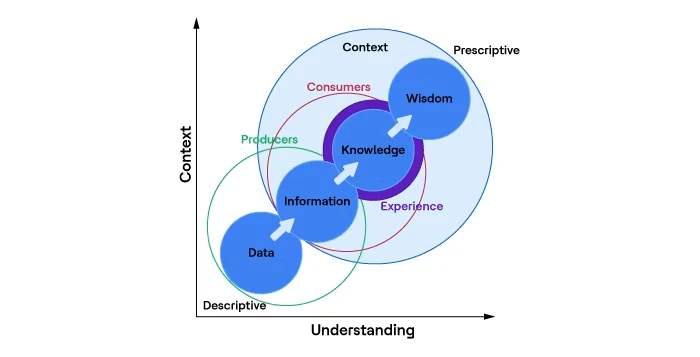
Figure 1: Information theory framework
At the foundation lies raw data. Data becomes information when it is placed within context. Information evolves into knowledge when relationships, patterns and dependencies are understood. Knowledge develops into wisdom when organizations can consistently make informed decisions. Ultimately, foresight emerges when enterprises can anticipate future outcomes and act proactively to maximize opportunity and minimize risk.
This progression highlights a fundamental truth: AI does not create business value simply by processing data. Its greater potential lies in helping organizations move toward foresight, shifting the objective from better reporting to better anticipation.
Can a manufacturer predict a quality issue before it impacts production?
- Can an engineering team identify a design flaw before it reaches the field?
- Can a service organization anticipate failures before customers experience downtime?
These outcomes require more than algorithms because they depend on contextual understanding across systems, processes and lifecycle stages, which is where many AI initiatives encounter their greatest limitation.
Why engineering needs more than AI models
Modern AI models are remarkably capable. They can classify information, generate content, detect patterns and make predictions with impressive accuracy. However, engineering environments demand something more.
Engineering decisions require traceability, explainability, consistency and precision. Organizations need to understand not only what happened but why it happened and what is likely to happen next.
Correlation-based models alone may be insufficient. Organizations also need causal models to answer questions such as:
- Why did this defect occur?
- What design change contributed to this failure?
- Which supplier introduced the risk?
- What downstream systems will be impacted by this modification?
A predictive model might identify a quality issue, but without access to design history, supplier relationships, manufacturing conditions and service records, it may be unable to explain the root cause or recommend the most effective corrective action. This lack of context can contribute to AI initiatives stalling after the pilot phase because sophisticated models remain isolated from the broader enterprise knowledge ecosystem. With sufficient context, AI can move beyond isolated predictions to support better decisions and outcomes.
The next competitive advantage will belong to organizations that can provide AI with a deeper understanding of their products, processes and operational environments.
Digital thread: The foundation for contextual intelligence
To achieve this, enterprises need a mechanism for connecting fragmented information across the product lifecycle. This is where the digital thread becomes essential.
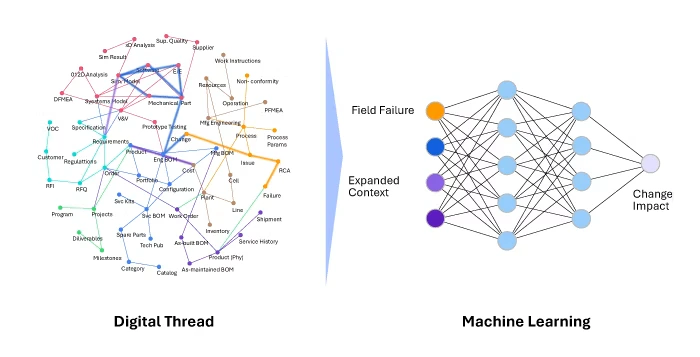
Figure 2: Expanded context enabled by the digital thread provides better insights
As PLM evolves from a system of record into a system of intelligence, the digital thread provides the foundation for contextual intelligence. It connects engineering, manufacturing, service and operational data to create a continuous flow of information across the enterprise.
Rather than treating data as isolated records, the digital thread establishes relationships between requirements, designs, simulations, manufacturing processes, quality outcomes, field performance and service activities. This creates three critical capabilities:
- Lifecycle intelligence: Organizations gain visibility across the entire product lifecycle, enabling more informed decisions at every stage.
- Traceability and digital continuity: Teams can understand how changes in one area affect downstream systems, reducing risk and accelerating issue resolution.
- Contextual decision-making: AI systems gain access to the relationships and dependencies necessary to generate actionable recommendations rather than isolated observations.
When context becomes available, AI's role changes dramatically.
- Instead of simply identifying anomalies, AI can diagnose root causes.
- Instead of generating reports, AI can recommend actions.
- Instead of reacting to problems, AI can help organizations prevent them altogether.
This shift represents the difference between intelligence generation and intelligence application.
From AI experiments to measurable business outcomes
For organizations seeking to scale AI successfully, the focus must shift from technology deployment to business value creation. Not every use case is equally suited for AI. The most successful organizations are those that identify opportunities where context, confidence and business impact intersect.
Before deploying AI, leaders should ask several critical questions:
- What is the cost of error?
- Is the required knowledge explicit and machine interpretable, or does it reside primarily in human expertise?
- Are the processes and parameters well understood?
- Does the use case require prediction, recommendation or autonomous action?
These questions help determine where AI can create meaningful value while minimizing operational risk.
The objective should not be to deploy AI everywhere. Instead, organizations should prioritize high-value scenarios where contextual intelligence can drive measurable outcomes, such as improving product quality, accelerating engineering cycles, reducing downtime, optimizing supply chains, reducing compliance risk or enhancing customer experiences.
This disciplined approach transforms AI from a technology initiative into a strategic business capability.
The road ahead: Building context-rich enterprises
As models and computing power become more accessible, the richness of enterprise context will increasingly define the next wave of AI transformation.
As AI capabilities become increasingly accessible, differentiation will come from an organization's ability to connect knowledge across products, people, processes and systems. Organizations that build connected, contextual and traceable knowledge ecosystems will be best positioned to:
- Scale AI initiatives successfully
- Accelerate innovation cycles
- Improve quality and reliability
- Reduce operational risk
- Deliver sustainable ROI from AI investments
The future of AI is not simply about intelligence. It is about contextual intelligence. Enterprises that can connect lifecycle knowledge through digital threads, unify information across IT, OT and engineering systems and transform data into actionable foresight will be better positioned to move beyond experimentation and achieve lasting business impact.
In a world where AI models are becoming increasingly commoditized, context is emerging as the true competitive advantage. The organizations that recognize this shift today will define the next generation of engineering and manufacturing excellence.