


Your strategy is clear. Your ambition is strong. But be honest — are your people spending their time on what truly moves the business forward… or on chasing approvals, searching for information, and fixing small system issues?
Most enterprises have modernized the stack. The technology works. And yet “simple” still feels complicated for employees. That gap between “available” and “effortless” is where productivity quietly “leaks out” — one small friction at a time, every day.
The uncomfortable truth is: complexity has crept into the operating system of work. McKinsey’s research echoes what many leaders feel but rarely say out loud — two-thirds of leaders see their organizations as overly complex and inefficient. If you are trying to introduce AI into that environment without redesigning the experience of work, you don’t get acceleration — you get amplified chaos.
At the same time, the bar for employee experience is rising fast. Gartner predicts that 50% of digital workforce leaders will have a digital employee experience (DEX) strategy and tool in place by 2026 (up from 30% in 2024). That’s not a tooling trend — it’s a signal: leaders are realizing that in an AI-disrupted era, experience is not a “nice-to-have. Experience is the delivery mechanism for outcomes
So, what is the new approach enterprises can take — one that helps employees reach productivity, efficiency, and flow without adding yet another layer of complexity?
It starts with a simple provocation: What’s standing between your people and their best work?
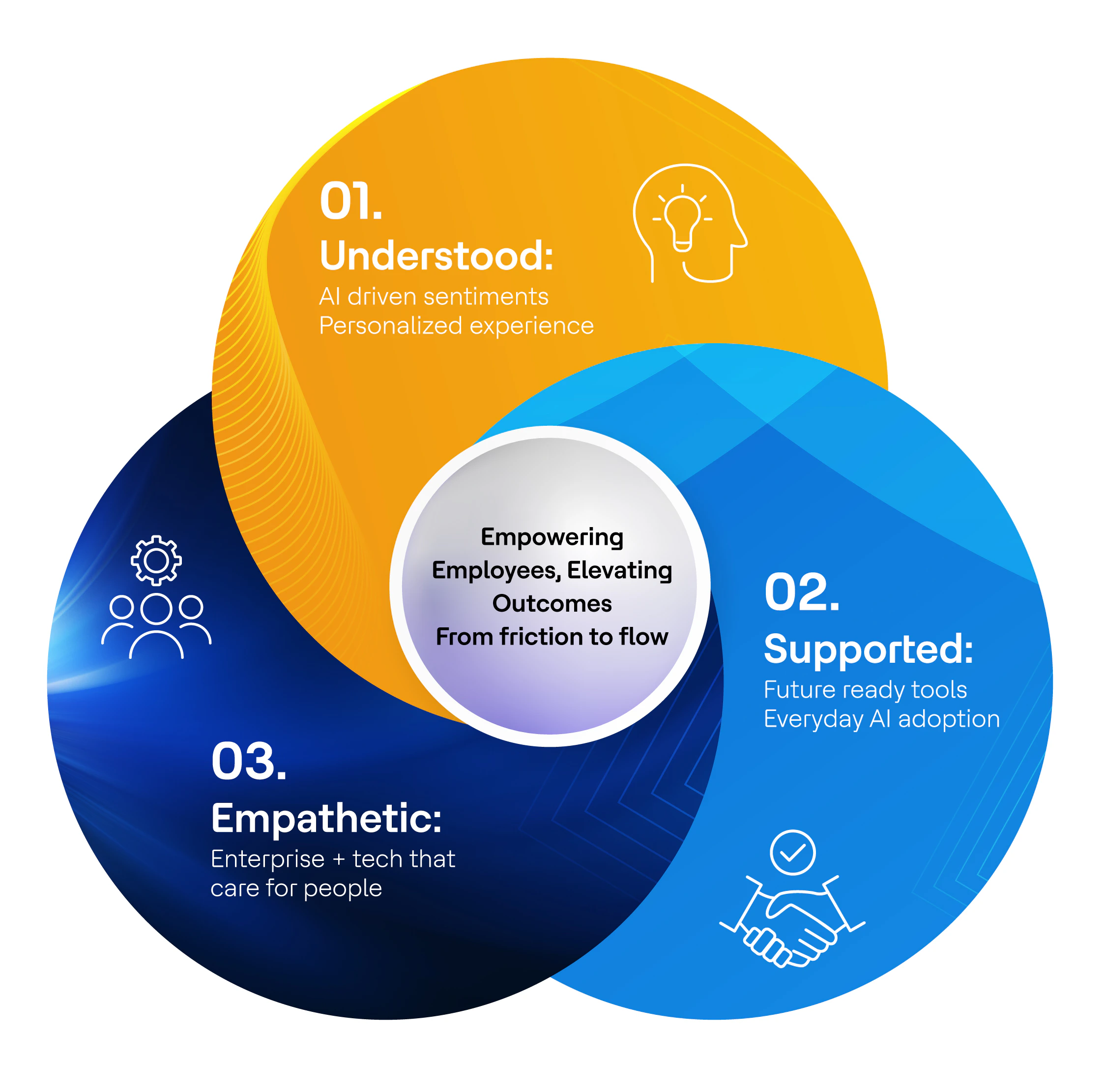
And then it answers that question with three commitments employees can actually feel — every day: they are understood, supported and treated with empathy.
A practical foundation for “Empowering employees, elevating outcomes”
1) Understood: detect friction before it becomes disengagement
If you want better outcomes, ask a sharper question: Do you truly know what work feels like for your employees — today, not last quarter? Experience is dynamic. One policy change, one upgrade, one security control, one new AI tool — and suddenly the employee journey changes.
The most forward-leaning enterprises are moving from “we assume” to “we know.” They are instrumenting the digital workplace to understand experience signals: where employees struggle, where processes slow down, where support loops fail, where sentiment quietly turns negative. Gartner’s forecast about DEX strategies is telling — leaders are treating digital experience as something that must be measured and continuously improved, not just launched.
What should you do differently (starting now)?
- Stop relying on lagging indicators like ticket volume alone. Tickets tell you what people reported — not what they endured.
- Create a “friction map” of the employee day: the moments that repeatedly interrupt flow (logins, approvals, searching, crashes, slow apps, tool overload).
- Make experience a leadership metric, not an IT metric. If the workplace is where value is produced, then the experience of work is a value-creation system.
Because here’s the pivotal insight: work should feel simple, intuitive and fast. When it doesn’t, it’s not because employees aren’t capable - it’s because the workplace is not designed to help them make daily progress
2) Supported: make AI adoption a daily advantage, not a side project
Now the question shifts: Even if employees have access to modern tools — do they feel enabled to use them with confidence? AI is not being adopted in boardrooms; it is being adopted (or resisted) in the messy reality of day-to-day work.
BCG’s research captures the promise: in its global survey, about half of employees reported saving at least five hours a week by using GenAI at work. Five hours isn’t a marginal gain — it’s a weekly return of time that can be reinvested in customers, innovation, learning, coaching, and quality.
But time savings only materialize when support is designed intentionally.
What should you do differently?
- Move AI from “tool access” to “workflow advantage.” Employees don’t need one more app. They need AI embedded where work happens: drafting, summarizing, searching, decision support, automation of repetitive steps.
- Treat adoption as a product, not a rollout. Build role-based playbooks: “Here are the 5 moments in your day where AI can remove toil.”
- Upgrade enablement from training to coaching. Training tells people what’s possible; coaching helps them build confidence and judgment in real work.
And keep asking the most important support question of all: Is AI reducing effort… or increasing cognitive load? If employees need workarounds, it’s not seamless.
3) Empathy: design trust into the workplace — or employees will route around it
Empathy in enterprise technology is often misunderstood as softness. It’s not. Empathy is an operational discipline — the ability to design systems that respect human time, attention, and trust.
This matters even more with AI. KPMG’s findings show the tension clearly: 70% of U.S. workers are eager to realize AI’s benefits, yet only 41% are willing to trust AI. That gap — excitement without trust — is where adoption becomes fragile and risk quietly expands.
What should you do differently?
- Make trust visible. Clarify what AI is allowed to do, what it is not allowed to do, and how outputs should be validated.
- Reduce “fear friction.” If employees worry they will be judged for using AI, they will hide it. If they fear AI will replace them, they will resist it. Empathy is acknowledging those realities — and leading through them.
- Design security and governance as enablers, not obstacles. The goal isn’t “more controls.” The goal is safe speed — enabling flow while protecting the enterprise and the employee.
Because when employees feel the workplace is built with them, not done to them, something changes: adoption accelerates, confidence rises, and performance becomes more natural.
The moment the workplace transforms: when friction turns into flow
Now bring the three together. When employees are understood, friction is identified early and removed deliberately. When employees are supported, AI becomes a practical advantage inside daily workflows, not a theoretical capability. When the enterprise operates with empathy, trust grows — and change becomes sustainable.
And that’s when the workplace stops being a collection of systems and becomes a performance engine. So, ask yourself one final question: Where is effort being quietly wasted — and what would happen if you gave that time back to your people?
Because the next era of digital workplace leadership will not be defined by how many tools you deploy. It will be defined by something far more human — and far more measurable:
Complexity where there should be clarity. Effort where there should be flow. Remove the friction — and you don’t just improve experience. You elevate outcomes.


