


Telecom operators struggle with a higher order fallout rate, impacting operating cost and revenue growth. This is a common challenge across all telecom operators, irrespective of any homegrown or Commercial Off-The-Shelf (COTS) tools in the order management domain.
Key challenges:
- High-order fallouts
- ~2.5k orders per day, ~ 2% order fallout rate
- Reactive identification of order fallouts
- Higher order cancellations
- ~45 orders per day
- Increasing operational (AHT) cost
- Operational silos across domains
- SLA penalties due to fallout delays
- Lack of visibility and inconsistent processes
- Data and validation inconsistencies during order capture and fulfillment journeys
- Lack of order data analysis repeats the errors
These challenges highlight the need for a proactive, data-driven, intelligent approach.
The need for an intelligent framework
In the order management domain, the fulfillment process covers multiple workflows and order-level stages to achieve order closure in the given lead time. With catalog-driven architecture, it ensures product decomposition and required rules are executed to enrich the data required for fulfillment flows. Jeopardy solution provides order tracking based on lead time and the capability to take different actions in case of an SLA breach. All these are industry-standard solutions and processes within the order management domain.
However, telecom operators are still facing higher fallouts, despite such a strategic industry-standard architecture. Fallouts can occur due to insufficient data captured, a lack of validations during the order capture stage or other reasons in the order provisioning and fulfillment flow.
With an AI-powered, proactive fallout prediction framework, operators can address such gaps using AI LLM models. By creating a structured error taxonomy with a feedback loop, it helps to identify historical error patterns and is referred to by analyzing in-progress orders. With the help of enhanced LLM prompts, the solution provides more accuracy to the business in predicting possible delays/fallouts for in-progress orders at the milestone level. The solution predicts the risk level with possible reasoning that determines the fallouts.
The framework helps transform from a reactive "fix-it-later" model to a pre-emptive strategy by identifying at-risk orders before they enter a failed state.
Integrating ML and Agentic AI into business support systems enables proactive operational intelligence through several key features below:
- Anomaly detection: AI models analyze historical data from thousands of successful and failed orders to identify patterns that typically precede fallout, such as missing attributes, incorrect address details or integration issues.
- Validations: AI automates real-time availability checks during the sales process, ensuring that the service offered is actually deliverable, which significantly reduces "quote fallout”.
- Real-time analysis: Analyze data in near-real time to flag potential roadblocks as an order moves through different milestones during the fulfillment journey.
- Remediation: With the help of ‘Order Fallout Agents’, it can autonomously resolve issues like billing mismatches and stock unavailability by providing alternative fulfillment paths.
Below is the Proactive Order Fallout Prediction Framework:
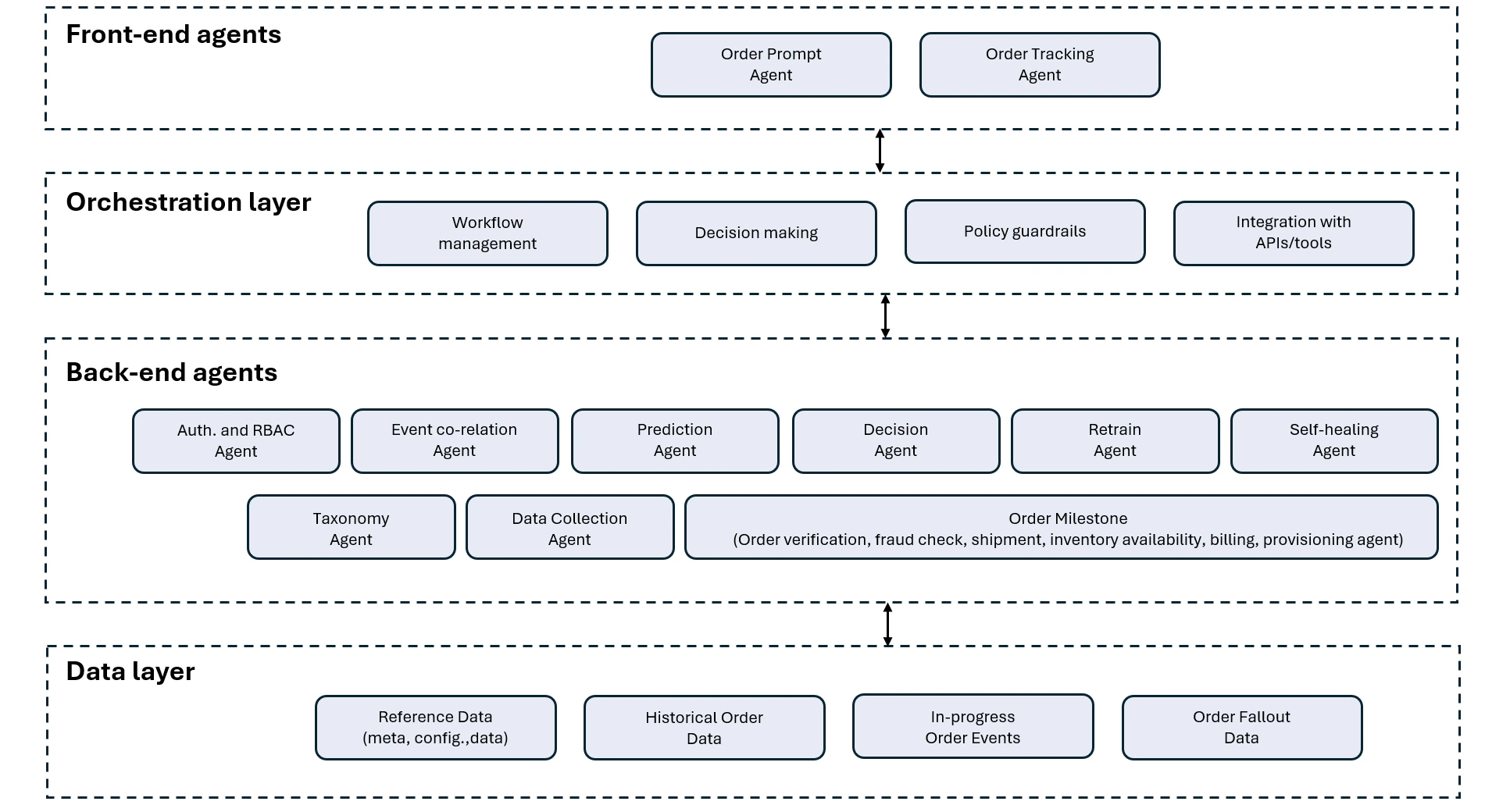
Diag. 1 – Order Fallout Prediction Framework
The above framework is divided into frontend (user interaction), backend (systems and tools) and orchestrator agents.
The frontend layer interprets user intent or interactive components as input, such as forms and JSON structures. It delegates tasks to the backend via an orchestrator that transforms user intent into structured inputs.
Orchestrator is a core component, managing interactions between multiple agents.
Backend agents use ecosystems via API’s, a database to retrieve data.
Few agents are defined below:
- Order prompt agent: Receives the orders and events for specific order types across all orders.
- Order tracking agent: Provides order prediction details, including risk level and reasons per event.
- Orchestrator agent: Acts as the central manager, demonstrating the coordination between frontend and backend agents. Performs workflow and policy guardrails.
- Prediction agent: Forecast events, autonomously takes actions to make real-time, self-correcting decisions in complex workflows.
- Decision agent: Context-aware decision making based on the latest and relevant data. Analyze complex data, evaluate and make independent and real-time decisions.
- Order milestone – verification agent: Based on order events, performs order validations and verification tasks.
With multiple agents, it ensures each agent’s responsibility for performing tasks, which identify and remediate order fallouts at an early stage.
The framework’s maturity can be further improved and aligned with the business needs and the current order management stack.
Transformative business outcomes
AI-powered Order Fallout Prediction model not only provides proactive fallout predictions but also provides remediation, reducing fallout rate, operational costs, increasing customer satisfaction and revenue.
By leveraging advanced AI and automation capabilities, operators can unlock significant benefits across key financial and operational metrics across different business verticals.
- Increase in order conversion rate and customer satisfaction with faster order closure time
- Operation efficiency, scalable, improved accuracy
- Revenue uplift with enhanced customer value
- Self-healing and remediation
- Complex orders management and tracking
- Improved customer experience
- Scalable across industries
A brighter future for telecom
The telecom industry is at a tipping point, where traditional methods of managing order fallouts, operational cost and driving revenue growth are no longer sufficient. The AI-Powered Order Fallout Prediction Model offers a way forward by combining sophisticated AI models, automation, remediation and seamless ecosystem compatibility to revolutionize the way telcos operate.
This advanced platform not only predicts the order fallouts but also actively improves the customer experience, shortens time to order completion and enhances operational efficiency, ensuring telecom operators can thrive in a hyper-competitive environment.
