A target operating model for the frontier-AI vulnerability storm.
From vulnerability signal to verified risk reduction-in hours, not weeks.
Executive Summary
Frontier AI is rewriting the speed and economics of cybersecurity. Anthropic’s Project Glasswing partnership has used Claude Mythos Preview to surface over 10,000 high-or critical-severity vulnerabilities across critical infrastructure software in one month (Anthropic, May 2026), with similar capabilities expected from OpenAI Daybreak, Microsoft MDASH and other frontier labs. These models reason across codebases, dependencies and attack paths-compressing vulnerability discovery, disclosure and weaponization into a single operational window.
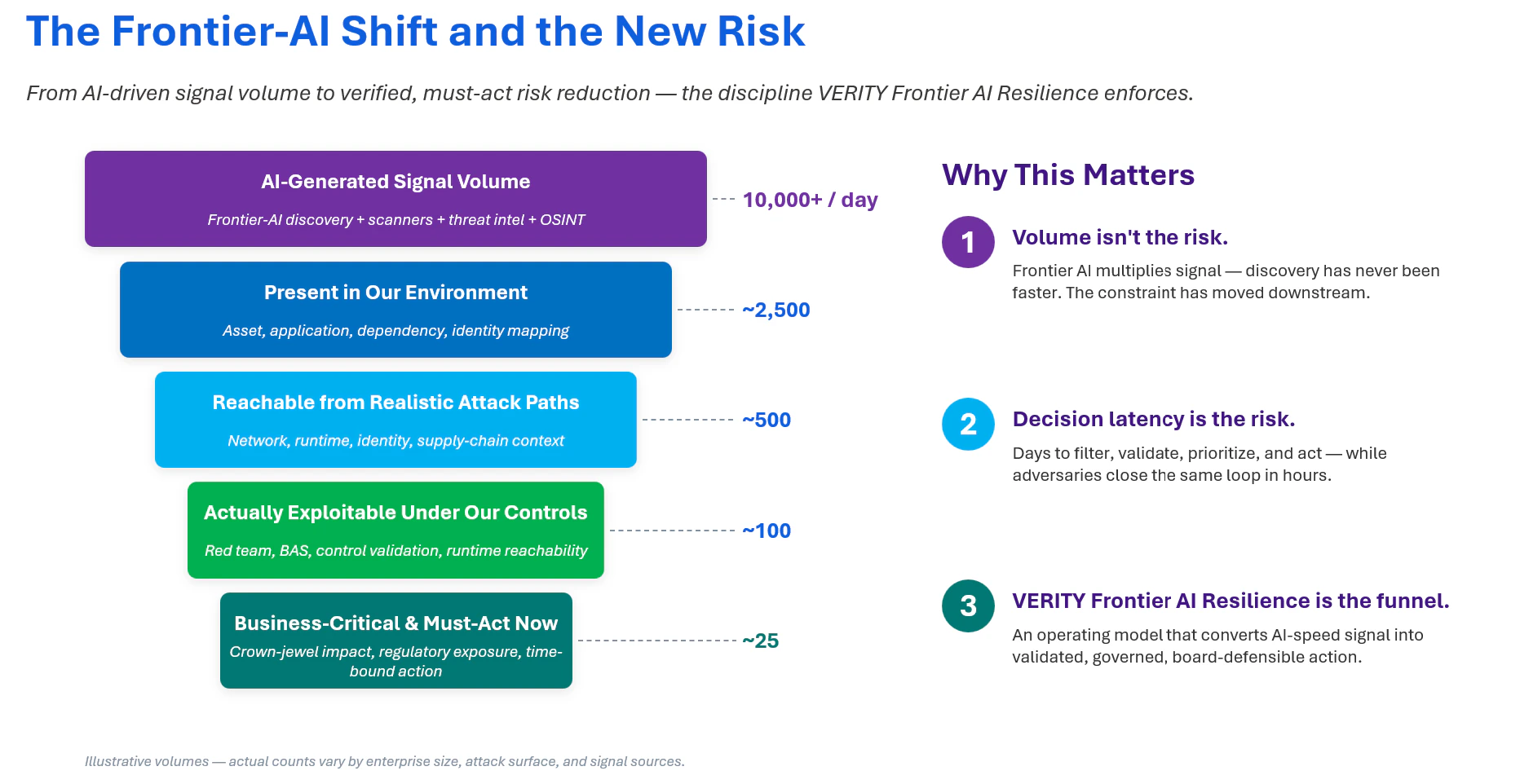
The strategic risk is not vulnerability volume; most enterprises already carry significant backlog. It is the collapse of time between discovery, exploitability and required response. We call this exposure-decision latency-and in the frontier-AI era, it is the gap between awareness and breach.
Traditional vulnerability management-periodic scanning, severity queues, scheduled change windows-was engineered for a slower threat tempo and is no longer fit for purpose.
VERITY Frontier AI Resilience is HCLTech's target operating model for converting AI-driven vulnerability intelligence into validated exposure decisions, governed remediation and proven cyber resilience.
The five executive questions VERITY Frontier AI Resilience is built to answer:
| Executive question | Why it matters |
|---|---|
| Are we exposed? | Determines whether the AI-generated signal applies to our actual environment. |
| Is it exploitable? | Separates material business risk from theoretical severity. |
| What reduces risk fastest? | Moves the organization from ticket routing to measurable risk reduction. |
| Can we prove control? | Creates defensible evidence for the board, regulators, auditors and major clients. |
| Can the business continue? | Links cyber response to resilience when remediation cannot move fast enough. |
The Frontier-AI Shift and the New Risk
Frontier AI is moving cybersecurity from human-paced discovery to model-assisted, continuous analysis of software environments. Mythos, Daybreak, MDASH and parallel initiatives across AI labs and security vendors all point one direction: AI-native vulnerability discovery, exploitability validation and remediation are now structural features of the threat landscape-available to defenders and adversaries alike.
| Capability class | Enterprise implication |
|---|---|
| Deep software reasoning | Higher discovery volume across proprietary code, open-source dependencies and software artifacts. |
| Exploit-chain analysis | Faster identification of attack paths connecting previously isolated weaknesses. |
| Agentic workflows | Automation across triage, validation, remediation and evidence - for defenders and adversaries. |
| Machine-speed response | Existing change-management and patch cycles come under structural pressure. |
The defining issue is not vulnerability volume-it is decision speed. Traditional vulnerability management answers the five questions below in days or weeks. VERITY Frontier AI Resilience answers them in hours.

Progress on software security used to be limited by how quickly we could find new vulnerabilities. Now it is limited by how quickly we can verify, disclose and patch them.”
The Five Exposure-Decision Points
Every frontier-AI vulnerability signal triggers the same five enterprise questions. The speed at which an organization can answer them-with evidence-is the new measure of cyber maturity.
| Decision point | Core question |
|---|---|
| Presence | Do we actually run the affected software, component, service, or identity? |
| Version | Are we on the vulnerable version or configuration? |
| Reachability | Can an attacker actually reach it from where they sit? |
| Exploitability | Can it be exploited under our real controls and runtime conditions? |
| Mitigation | What action reduces risk fastest, safely, with least business disruption? |
If these five questions take days to answer, the organization is already behind the threat tempo.
The VERITY Frontier AI Resilience Operating Model
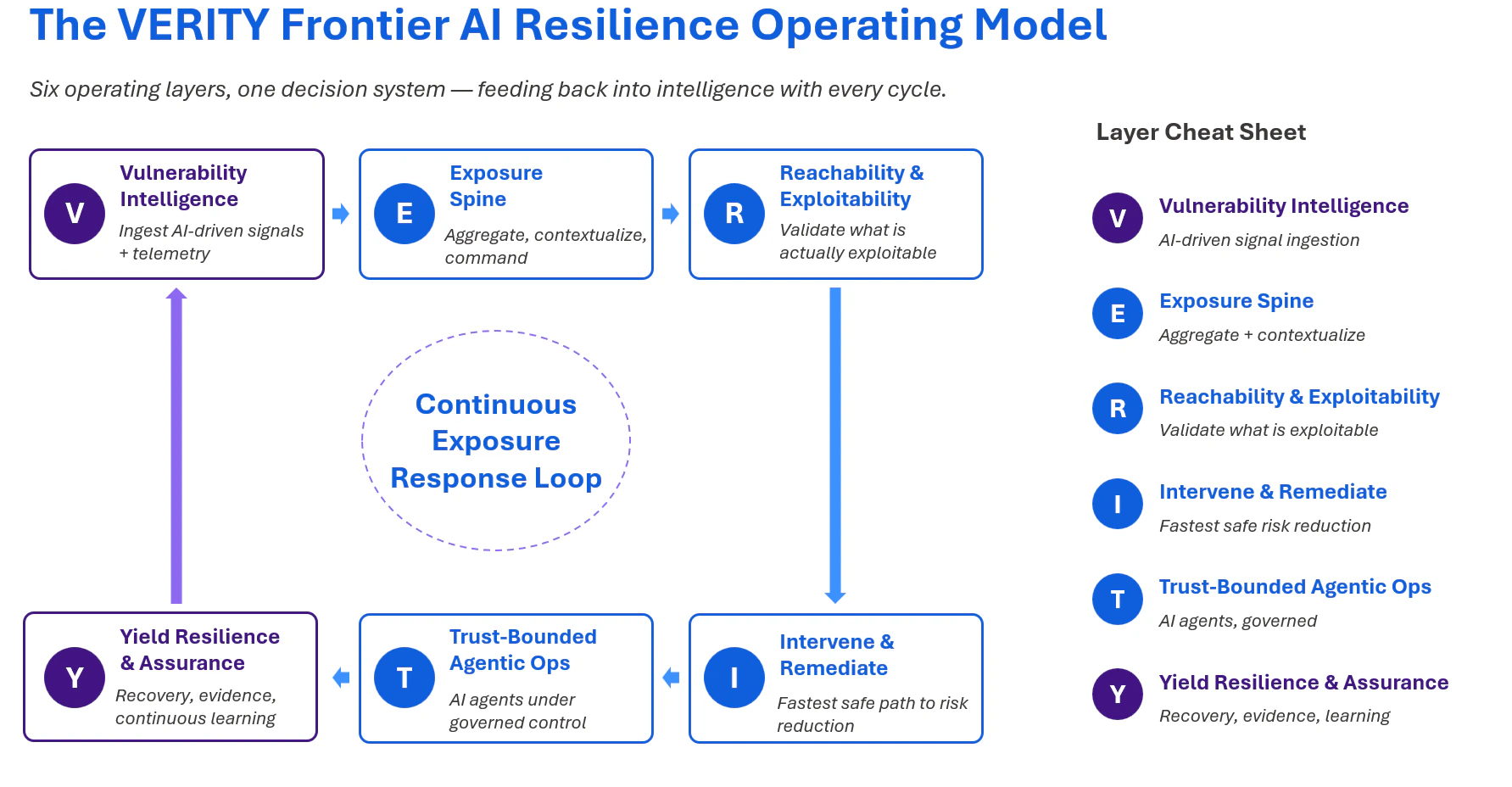
VERITY Frontier AI Resilience is a target operating model-not a scanner, platform, or service catalogue. The six letters of the acronym are the six operating layers, so leaders, operators and auditors share one vocabulary end-to-end. The layers operate as a continuous loop-with the spine treating infrastructure, application, API, cloud, identity and software supply-chain exposure as one decision system, not parallel programs.
| VERITY layer | Role in the operating model |
|---|---|
| V - Vulnerability Intelligence | Ingest signals from frontier-AI discovery (Mythos, Daybreak, MDASH, equivalents), trusted disclosures, threat intelligence, scanners, code repositories, SBOM/SCA, package and container registries, CI/CD telemetry and adversary activity. |
| E - Exposure Spine | Aggregate findings and contextualize against business criticality, asset ownership, application and API portfolios, cloud workloads, identities, third parties and crown-jewel services. AppSec, API, code and CI/CD risk are first-class not a separate stream. |
| R - Reachability & Exploitability Validation | Apply red teaming, BAS, attack-path analysis, runtime reachability and control validation-including whether vulnerable open-source code paths are reached at runtime. |
| I - Intervene & Remediate | Drive the fastest safe risk-reduction path: patch, virtual patch, segment, tighten identity, change configuration, upgrade dependency, deploy detection, or accept risk under time-bounded governance. |
| T - Trust-Bounded Agentic Operations | Use AI agents under policy gates, human approval for material actions, scoped tool permissions, full audit, NHI governance and tested kill switches. |
| Y - Yield Resilience & Assurance | Containment readiness, business continuity, crown-jewel recovery validation, regulatory and crisis-response rehearsal and board-ready evidence-feeding back into V. |
Remediation Must Move Beyond Patching
Patching remains essential but cannot be the default for every exposure. Uptime, safety validation, legacy and OT systems, vendor-managed technology and regulatory change controls all constrain it. VERITY operates a full menu of risk-treatment paths.
| Risk-treatment path | When it applies |
|---|---|
| Patch or upgrade | A safe fix is available and operational risk is manageable within change windows. |
| Virtual patch | Traffic or exploit patterns can be blocked at the edge while patching is staged. |
| Microsegment or isolate | Blast radius must be reduced before full remediation is feasible. |
| Tighten identity | Privilege, service accounts, API keys, or NHIs are the dominant exploit enabler. |
| Deploy detection and hunting | Exposure remains; post-exploitation behavior must be monitored and contained. |
| Governed risk acceptance | Business constraints require a temporary, time-bound exception under documented governance. |
The goal is not to patch everything immediately. The goal is to reduce exploitable risk fastest-and prove it.
Why the patching-only model is breaking. In its May 2026 Project Glasswing update, Anthropic reported that several open-source maintainers asked them to slow down vulnerability disclosures because they could not design and ship patches fast enough. When the supply side of patching cannot keep pace with AI-driven discovery, enterprises must run the full risk-treatment menu above-not just wait for vendor patches.
Trust-Bounded Agentic Operations
AI agents will increasingly support cyber workflows-correlating exposure data, drafting remediation, producing detection logic, summarizing investigations, assembling regulatory evidence. Uncontrolled autonomy in security operations creates new categories of risk. VERITY treats agentic operations as a governed layer:
| Required control | Purpose |
|---|---|
| Agent and NHI inventory | Know which agents, service accounts, API keys and automation identities exist, who owns them, what they touch. |
| Tool permission boundaries | Scope what each agent can read, recommend, or execute - least privilege by default. |
| Human approval gates | Keep authority for material actions under human control. |
| Prompt and context controls | Reduce risk from prompt injection, untrusted inputs and poisoned context. |
| Audit logging and kill switches | Enable accountability, rapid containment and tested emergency shutdown. |
Metrics That Matter
Frontier-AI readiness is measured by decision speed, action quality and demonstrated risk reduction-not vulnerability counts.
| Metric category | Example measures |
|---|---|
| Know | Time to identify affected assets, applications, versions and dependencies after signal ingestion. |
| Validate | Time to confirm reachability and exploitability; percentage of findings validated before remediation effort. |
| Act | Time to deploy compensating controls; time to patch or mitigate critical exposures. |
| Detect | Time to deploy detection logic and launch threat-hunting coverage tied to validated exposures. |
| Prove | Time to produce regulatory evidence and board-ready reporting on residual risk. |
| Recover | Recovery readiness for crown-jewel services and validated RTO/RPO under tested scenarios. |
Board-level questions: How exposed are we? How fast do we know? How fast can we reduce risk? Can we prove it? Can we recover?
The Strategic Case
Frontier AI changes cybersecurity because it compresses time-to discover, to weaponize, to respond. The enterprise response must move beyond traditional vulnerability management: exposure-led, validation-driven, remediation-focused, application-aware, open-source-conscious, agentically governed and resilience-backed.
VERITY Frontier AI Resilience helps enterprises move from vulnerability noise to verified risk reduction-at AI speed, under enterprise control.
Engage with HCLTech Cybersecurity Advisory
To benchmark your current exposure-decision latency, pressure-test your AppSec and software supply-chain readiness, or scope a VERITY Frontier AI Resilience operating-model engagement, contact your HCLTech account team or the Cybersecurity Advisory practice directly.