
Featured

AI-led engineering: Turning product complexity into manufacturing advantage
As manufacturers move AI from pilots into product development and production, competitive advantage will depend on connecting industrial data, digital twins, knowledge graphs and governed Physical AI
Top stories
All content

In oil and gas, disruption is no longer episodic; it is structural and resilience now depends on diversification, real-time visibility and faster decision-making across the supply chain
Read the article
In 2026, the real shift is not more AI pilots; it is enterprise-grade execution tied to measurable business and patient outcomes
Read the article
As AI moves from centralized models to distributed intelligence, telecom networks are emerging as the critical infrastructure that connects creation, distribution and real-world application of AI
Read the article
The path to 6G is being shaped by three converging shifts: AI-native design, simulation-first development and tighter integration between silicon, software and autonomous operations
Read the article
AI has moved quickly from experimentation to enterprise action. Long-term value depends on governance, strong data foundations and clear operational control.
Read the article
Agentic AI is turning supply chains into real-time, autonomous systems, delivering greater resilience, lower costs and faster, better decisions
Read the article
HIMSS 2026 showed that healthcare organizations are moving from AI experimentation to scaled deployment, with governance, interoperability and cybersecurity shaping the next phase of transformation
Read the article
AI is pushing enterprises to move beyond isolated pilots toward a more disciplined model built on workflows, data quality and governance
Read the article
Autonomous, learning systems are ushering in the dawn of a self-improving factory floor and redefining manufacturing economics
Read the article
At ViVE 2026, healthcare leaders discussed how AI is reshaping payer and provider operations while navigating financial pressures, workforce challenges and the need for scalable, integrated solutions
Read the article
Kanda Natarajan, VP of IT at GSK and Vijay Guntur, CTO and Head of Ecosystems at HCLTech, join Sophia Zhang, SVP at Conde Nast to reflect on their experiences and highlight key lessons for leaders.
Watch now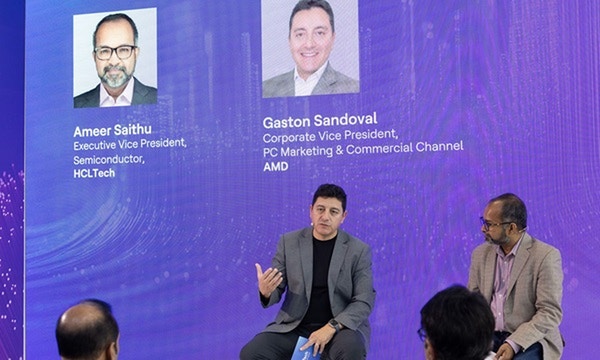
As AI scales across the enterprise, semiconductor companies are evolving from chip suppliers to key partners shaping the architectures, platforms and ecosystems behind intelligent systems
Read the articleTrending questions
The term "artificial intelligence" was coined by John McCarthy in 1956. Alan Mathison Turing, followed by Newell, Simon, McCarthy and Minsky, are key figures in AI development. Newell and Simon's 1956 "Logic Theorist" program marked a milestone. These pioneers, known as the founding fathers of AI, significantly advanced the field.
- Increased productivity
- Increased automation
- Smart decision-making
- Solve complex problems
- Managing repetitive tasks
- Strengthens economy
- Personalization
- Disaster management
- Enhances lifestyle
- Global defense
Machine learning is the brain of AI that emulates logical decision-making based on the data fed to it and an AI model is the creation, training and deployment of the ML algorithms. With advancements in intelligence methodologies, AI models support in tandem with real-time analytics, predictive analytics and augmented analytics using natural language processing (NLP), ML, statistical analysis and algorithmic execution.
Loaded with human capabilities and beyond, the importance of artificial intelligence (AI) is rising and gradually spreading to various industries, making way for new possibilities and better efficiencies. Data in today’s world is an asset and valued across industries. With AI, humans are now able to absorb, interpret and make complex decisions.
While artificial intelligence is a system that mimics or imitates human intelligence, machine learning is the brain that helps it work.
Generative AI refers to a subset of artificial intelligence algorithms and models designed to generate new data that resembles existing data. These sophisticated algorithms can create content in various forms, such as text, images, music and even complex structures like designs and models. Generative AI is primarily powered by advances in neural networks, particularly Generative Adversarial Networks (GANs) and Variational Autoencoders (VAEs).
Subscribe to the HCLTech Newsletter
for our latest news and insights