


Executive summary
As AI moves from assisting teams to co-building software, the hard enterprise question is no longer speed. It is control. Software produced jointly by human teams and autonomous agents must be coordinated, governed and audited and tools adopted in isolation can't do that. They fragment delivery and introduce new compliance, security and governance risk. For organizations, the pressure to cut cycles, hit velocity metrics and drive down costs is incredibly intense. Adding more tools compounds the problem rather than resolving it. What is required is a governed operating model that coordinates AI across the entire delivery lifecycle.
HCLTech's AI-Native SDLC practice, built on the AI-driven development lifecycle (AI-DLC), is that model. At its core, the model has HCLTech's AI Force providing the orchestration and governance layer, defining the work and enforcing organizational standards. AWS Frontier Agents and services (Kiro, AWS Transform and AWS DevOps Agent) provide the execution layer that builds, modernizes and operates the software. Together, they give teams a single, auditable way to coordinate human-agent delivery end-to-end.
For the enterprise, the gains accumulate; each engagement produces reusable use cases and standards that accelerate the next, turning isolated AI gains into a durable, enterprise-wide delivery capability. This guide sets out how technology leaders can adopt AI-DLC across the four domains where it delivers the greatest impact (Application Development, Modernization and Migration, Quality Engineering and Application Support).
The AI-DLC operating model
How do you ship faster without losing control? The speed-versus-governance trade-off is the one every enterprise faces when AI agents enter the SDLC.
HCLTech's AI-DLC practice addresses it with a unified operating model that holds both. Teams use HCLTech AI Force to define the work as reusable use cases (packaging the right agents, context, tools and standards), set the governance and security guardrails. HCLTech AI Force coordinates the work and invokes the execution layer with organization context - AWS Frontier Agents and services.
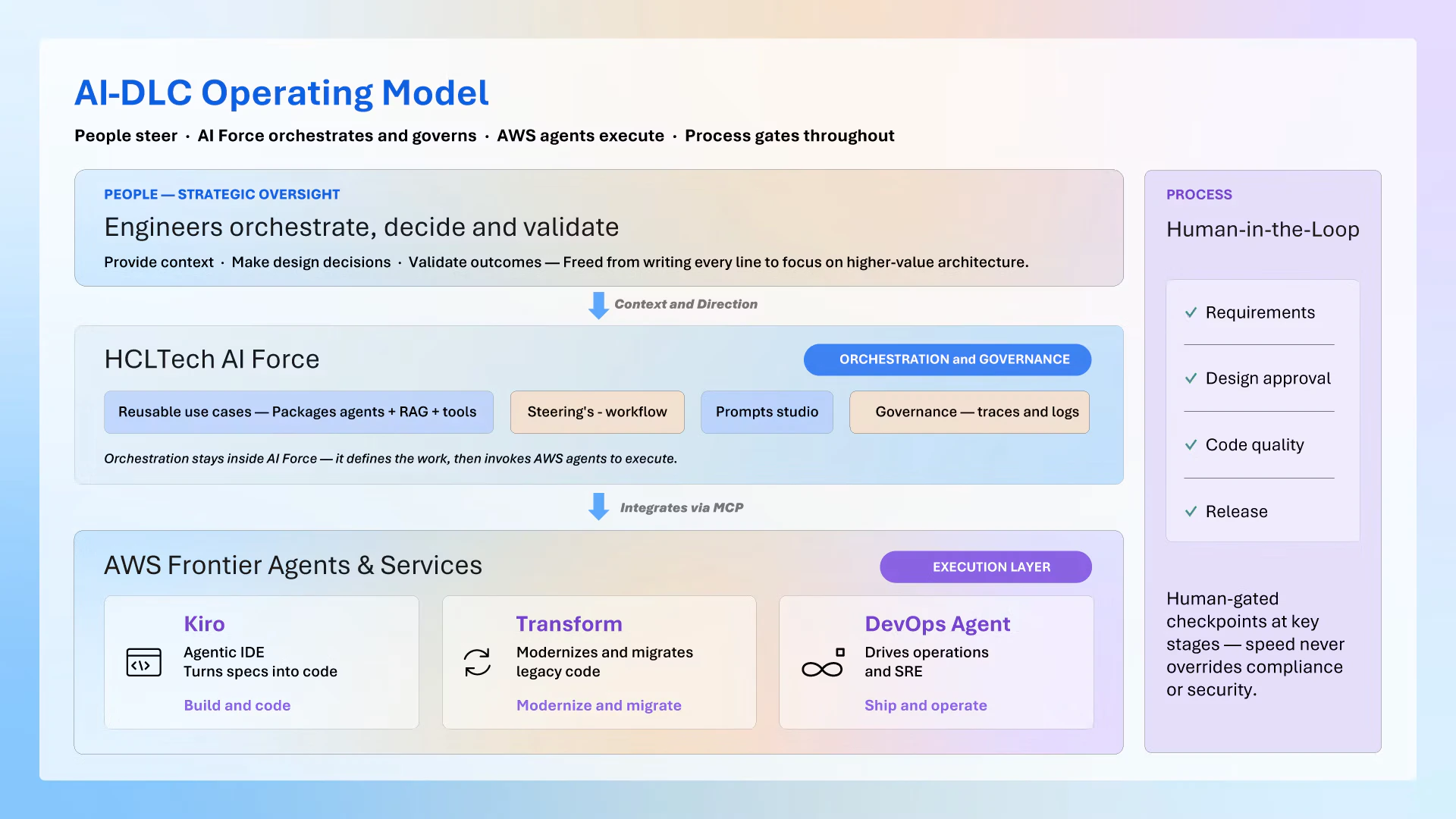
This plays out across three dimensions:
- People (strategic oversight): Engineers move up the stack from writing code to setting direction, making design decisions and validating outcomes
- Process (human-in-the-loop governance): Human-gated checkpoints at the critical stages (requirements, design, code quality and release). Keeps speed from outrunning compliance and security
- Technology (a shared platform): Agents, IDEs and pipelines work with the same context and one set of standards (fewer handoffs, consistent output, faster time-to-value)
The adoption journey
Adopting AI-DLC isn't a big-bang rollout; it's a staged path where each team that adopts makes the next one faster. Work is captured in HCLTech AI Force as reusable use cases and steering files: the assets a pilot project builds become the starting point for subsequent projects, so onboarding a new team inherits a working framework, not starting over.
HCLTech uses a three-phase maturity model: Assess → Pilot → Scale, with clear exit gates to put a structure to the journey.
| Phase | Core Activities | Exit Gate |
|---|---|---|
Phase 1: Assess Objective: Gauge readiness and decide where to start |
| A starting domain chosen, baseline metrics captured and leadership sponsorship secured |
Phase 2: Pilot Objective: Prove value and build reusable assets |
| Pilot in production, Validated ROI, a working use-case/steering baseline and formal expansion commitment secured |
Phase 3: Scale Objective: Expand across teams, compound value. |
| Adoption established across teams, with measured efficiency gains and a growing shared asset library |
Measuring value: Anchor each phase to metrics your organization already tracks - sprint cycle time and lead time for changes (velocity), defect leakage and first-time-right rate (quality), mean time to resolution (stability) and the share of delivery effort completed by agents under human review (leverage). Capturing these baselines during the pilot gives an objective basis for scaling decisions.
Domain playbooks: AI-DLC in action
HCLTech organizes AI-DLC into four domain-specific playbooks, each of which can be adopted independently, so organizations can start in one area without disrupting ongoing operations. Each playbook turns the AI-DLC principles into a concrete, agent-driven workflow.
Application development
Feature delivery velocity suffers due to manual handoffs, unclear design decisions and testing bolted on after the code is written. The application development playbook redefines this with a governed, agent-driven workflow: HCLTech AI Force defines the work and the guardrails; Kiro executes it; an application specialist oversees and approves.
HCLTech AI Force sets up the delivery harness once, it defines the use case (the Requirement-to-Release workflow), defines the skills (the standards and specifications the work must meet) and governs (the approval gates and audit trail). Kiro then executes the development (Inception, Construction and Release), working within the enterprise steering files' context, keeping every output aligned with architectural standards across brownfield enhancements and greenfield developments.
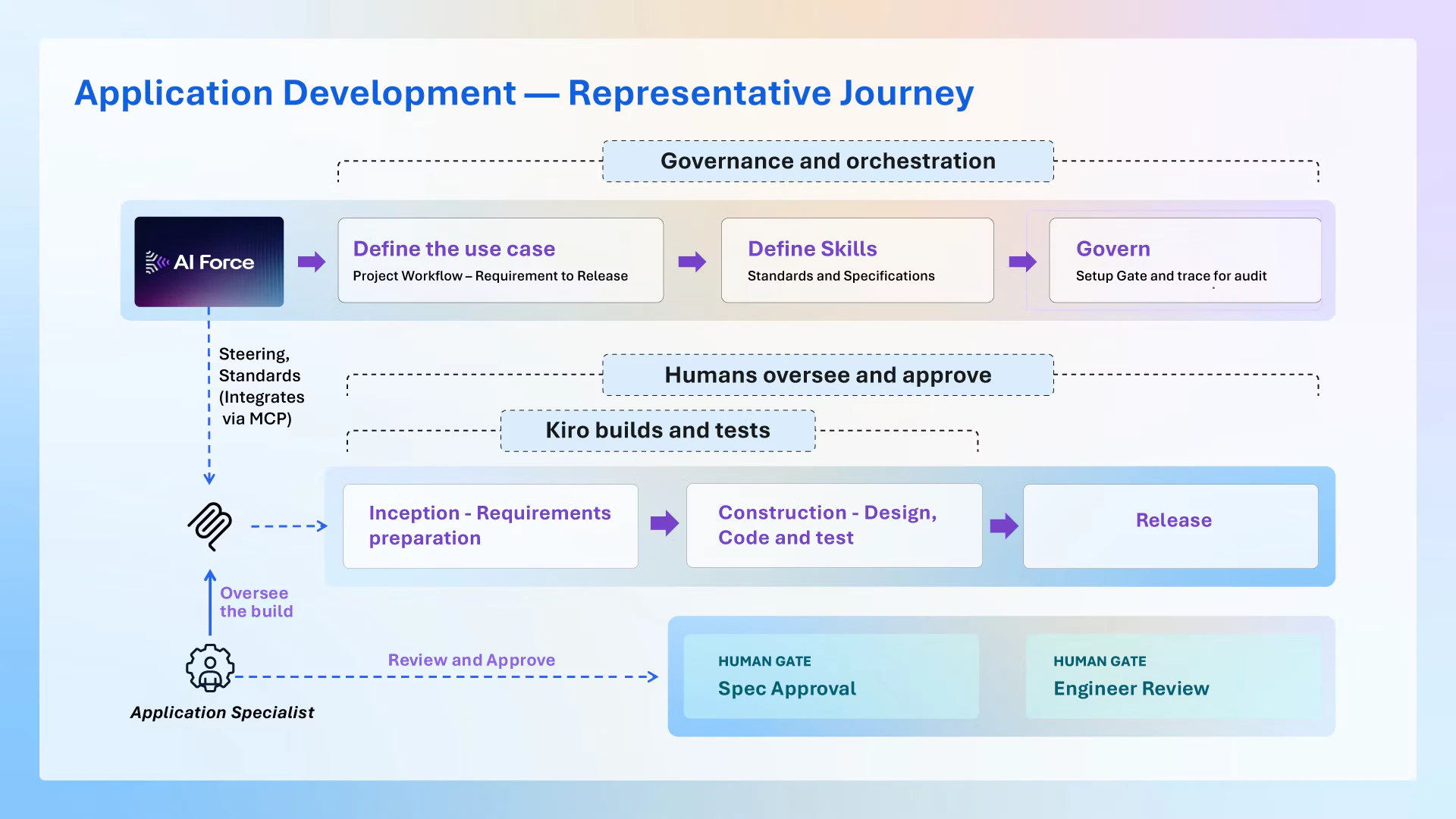
Inception (requirements preparation): Kiro turns the backlog story into design specs, acceptance criteria and API contracts, checked against the steering standards HCLTech AI Force defines.
Spec approval (human gate): The Application Specialist validates intent and design before any code is written.
Construction (design, code and test): Kiro builds the solution and its tests, with steering files enforcing architecture and coding standards throughout.
Engineer review (human gate): Compliance checks run, then the specialist validates and authorizes the change.
Release: The validated build ships with the full workflow traced in HCLTech AI Force for audit.
Every completed story feed lesson learned and architectural rules are back into the steering files, so each sprint runs more consistently and needs fewer review cycles.
Modernization and migration
Undocumented dependencies, outdated code and scarce legacy expertise make modernization one of the hardest areas of enterprise delivery. The Modernization playbook brings structure to it as a governed, agent-driven pipeline. AWS Transform executes the modernization, Kiro assists the last mile and HCLTech AI Force supplies the industry-specific modernization skills, workflows and governance that make the whole program repeatable, with human specialists overseeing, validating and approving throughout.
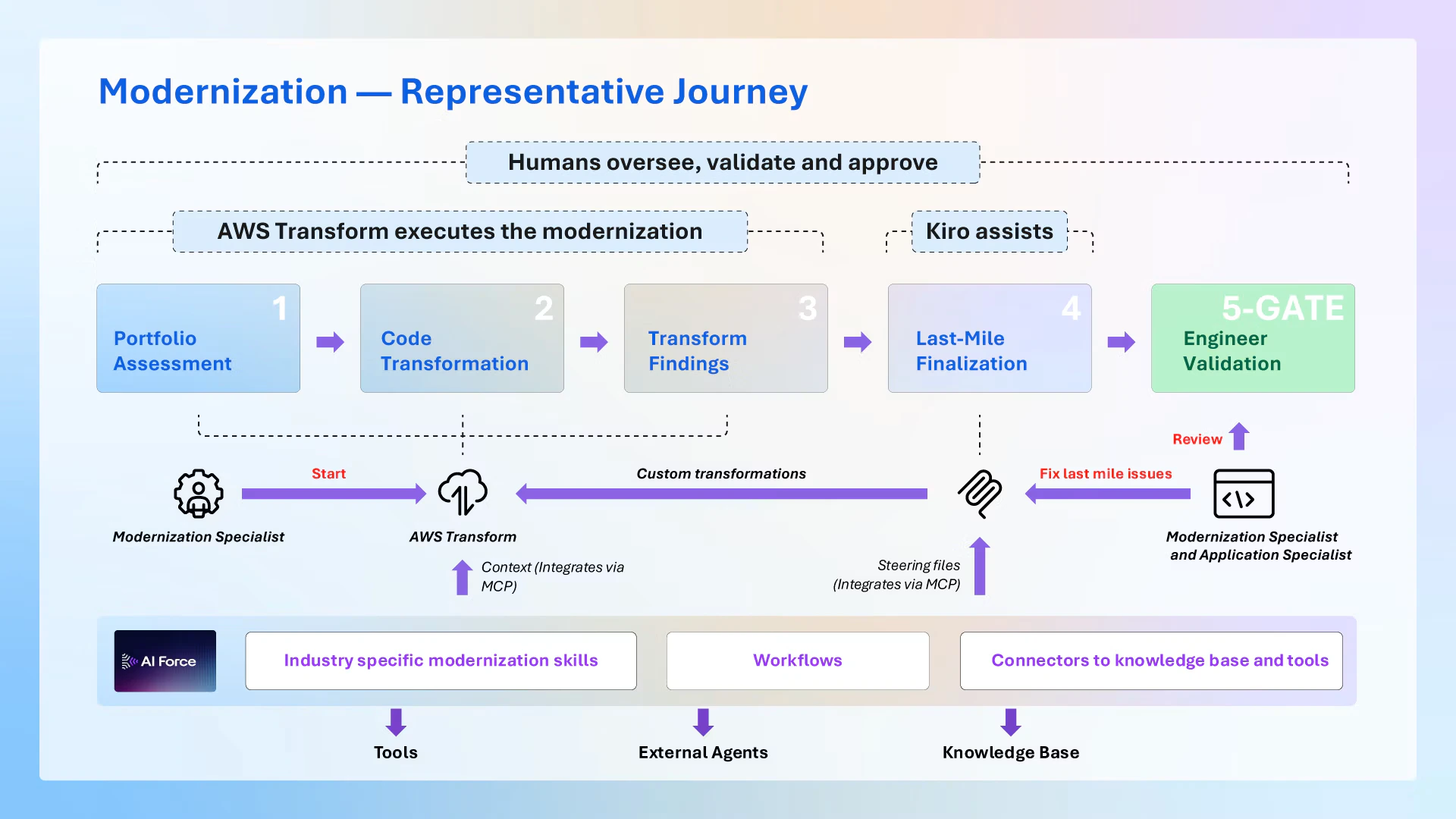
Portfolio assessment: AWS Transform assesses technical debt, maps dependencies, gauges readiness and then prioritizes candidates for a modernization roadmap.
Code transformation: AWS Transform migrates frameworks and modernizes the code at scale, drawing on HCLTech AI Force's industry skills and context.
Transform findings: AWS Transform reports what remains, the open tasks and recommendations.
Last-mile finalization: Kiro assists in resolving edge cases and completing the remaining work, guided by target-state steering.
Engineer validation (human gate): Specialists verify functional correctness and test results before the changes are integrated.
Modernization skills, workflows and steering are captured in HCLTech AI Force. The first modernization builds a reusable framework; every migration that follows starts from it and moves faster.
Testing and quality engineering
As delivery speeds up, validation must keep pace; coverage that grows with the code. The Quality Engineering playbook shifts validation left, tests are generated and run in parallel with development, so quality is built in rather than inspected afterward. HCLTech AI Force supplies the testing context, coverage standards, defect history and the existing test-case repositories. Kiro generates and executes the test matrix and a Quality Engineer owns what gets accepted.
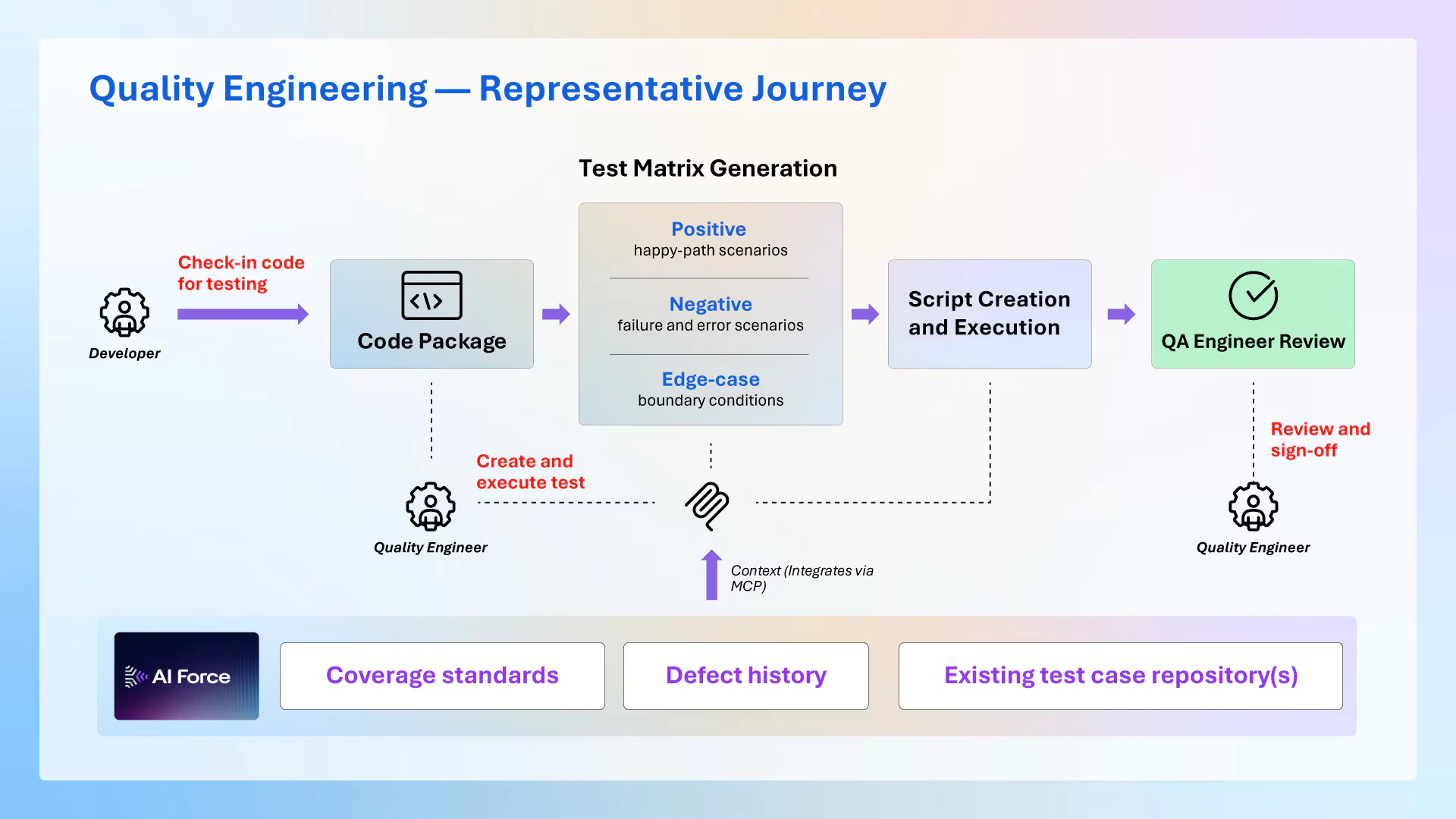
Code package: A developer checks in the updated code for testing.
Test matrix generation: The Quality Engineer has Kiro generate the test matrix, positive, negative and edge-case scenarios against the coverage standards, defect history and existing test assets HCLTech AI Force supplies.
Script creation and execution: Kiro writes the tests and runs them, with assertions informed by prior defect history.
QA engineer review (human Ggte): The Quality Engineer reviews coverage, validates the critical assertions and signs off before the branch is accepted.
Every cycle feeds new coverage patterns and defect insights back into HCLTech AI Force, so each test cycle starts from a stronger baseline than the last.
Application support and maintenance
Production incidents in complex estates usually require engineers to correlate telemetry across several systems before they can even find the cause. The Support playbook turns incident resolution into a guided, agent-assisted workflow. An incident raised in the ITSM tool starts the investigation, the AWS DevOps Agent diagnoses it, HCLTech AI Force supplies the governing context, compliance rules, operating procedures and past-incident knowledge and Kiro helps implement the fix, with an Operations Support Engineer validating and approving the change before it reaches production.
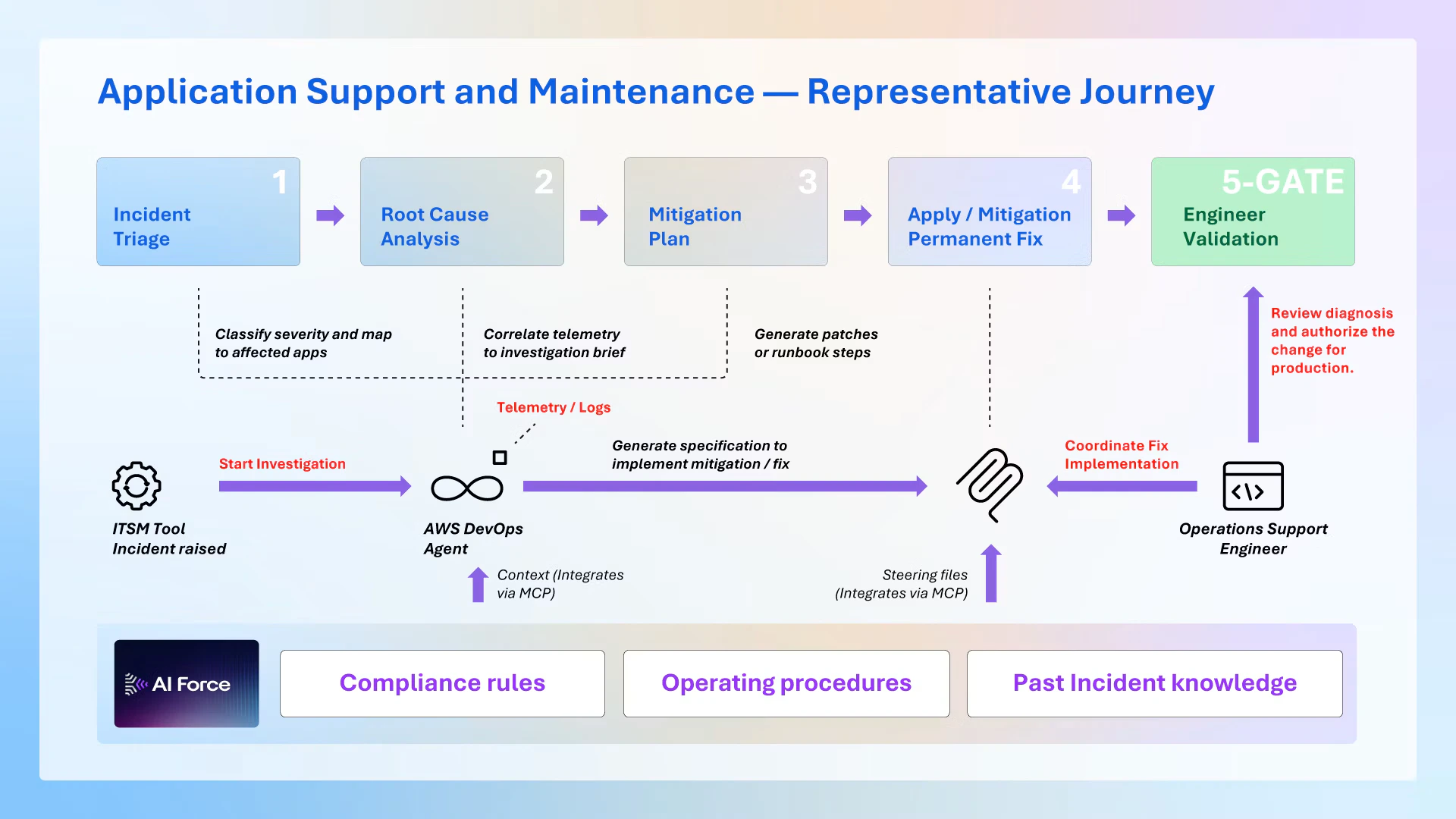
Incident triage: An incident raised in the ITSM tool is classified and mapped to the applications it affects.
Root-cause analysis: The AWS DevOps Agent correlates telemetry and logs into a structured investigation brief, narrowing the cause against the context HCLTech AI Force provides.
Mitigation plan: Code patches or runbook steps are proposed and checked against the enterprise compliance rules and operating procedures.
Apply the fix: Kiro helps the Operations support engineer turn the approved plan into the mitigation or permanent fix.
Engineer validation (human gate): The engineer reviews the diagnosis and the fix, then authorizes the production change.
Verified root causes and fixes are captured back into HCLTech AI Force, so each resolved incident makes the next similar one faster to diagnose.
Conclusion: From experimentation to scale
AI coding tools speed up individual tasks. Delivering AI's value across the full lifecycle, at enterprise scale, under governance is a different and harder challenge. That is what HCLTech's AI-DLC practice delivers: a governed operating model in which agents execute and engineers remain in command at every critical gate.
The path to scale is deliberate, not disruptive: start in the domain where delivery friction is highest, prove the outcome in a pilot with clear baselines and let measured results carry it across the portfolio. The organizations that move won't just ship faster; they'll build a delivery capability that compounds with every project.
Call to action
Ready to explore AI-DLC for your organization? HCLTech offers an AI-DLC Assessment to help you get started. Our experts review your application portfolio, identify the highest-impact entry point and define a clear adoption roadmap for your first pilot.
Contact HCLTech to schedule an AI-DLC Assessment or explore the HCLTech Enterprise AI-DLC offering on AWS Marketplace.
Related Content
- HCLTech AI Force - From AI capability to autonomous outcomes
- AI-Driven Development Life Cycle: Reimagining Software Engineering
Tags: AI-DLC, Agentic AI, Kiro, HCLTech AI Force, Application Modernization, Software Development

