


Picture this. You are a customer surfing beach wear apparel for your impending year-end vacation at Hawaii on your popular retailer app. Flurried by the options available, you prefer to type in to ChatGPT around preferable options. Your past purchases – the ‘digital DNA’ to be precise – helps throw up a few tempting choices. All along, you are ‘voice assisted’ to select your option. You are then prompted if you want to buy it, and post entering your payment credentials, you have your favorite apparel bought – and delivered - without you lifting a finger!
From automated to autonomous Commerce – Agents in Commerce
Welcome to the world of autonomous commerce. OpenAI’s Agentic Commerce protocol is taking a lead in this, and it is reshaping customer shopping journey like never before. ChatGPT has traditionally been associated with responses to queries. A good 700 MN users harp on ChatGPT every week to get answers to their myriad queries – ranging from business to weather to politics! Well – no more just that. With a feature around Instant Checkout, OpenAI is aiding the shopping journey to not just help in recommendations, but buying and the ensuing commerce value chain too.
The good part here is, merchants can keep using their existing systems to fulfil the order management process, payments, and fulfilment workstreams. The role of ChatGPT here is just like a digital shopping assistant for the user – acting as a conduit to pass information between user and merchant. While the monetization is primarily through merchants (they pay a small fee on completed purchases), it is free for users. The CX for the user/customer is thereby unchanged from how she experienced ChatGPT so far.
This is already integrated with Stripe for payments. Shopify merchants can use the feature too, which means that merchants get the end-to-end backup from search to social media – to now agent assisted shopping! The recent tie-up with PayPal will also scale this ecosystem further – in transforming Retail AI agents from advisory tools to transactional assistants.
Perplexity.ai is another leader in this space, in fact having a head start of a year over Open AI. In November of 2024, they launched ‘Buy with Pro’, that allowed search and commerce to happen via the same AI-powered agent.
The entire trend of Agents in e-commerce has gained momentum phenomenally over last year in particular, where Gen AI and non-AI conversion rates are approaching parity.
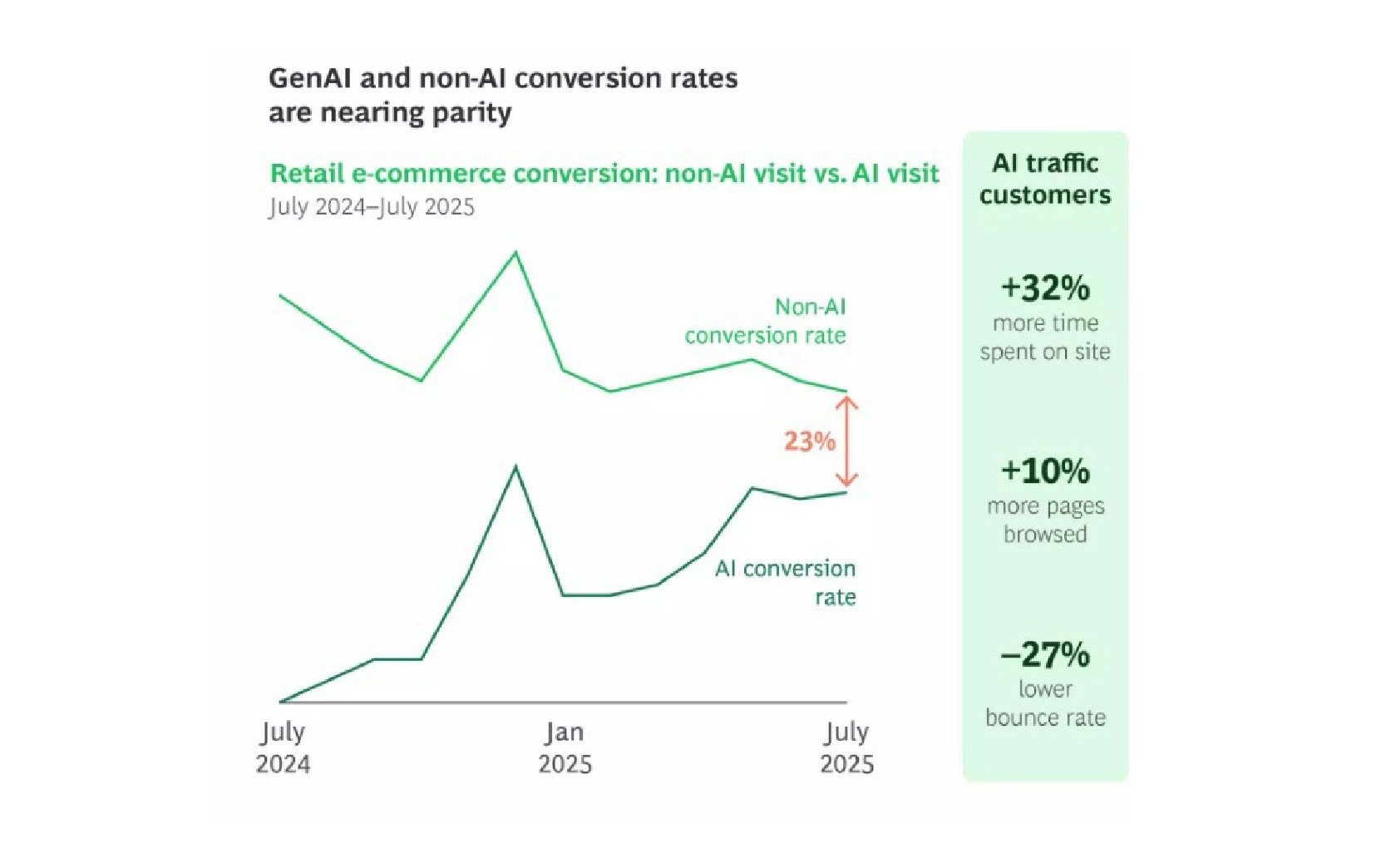
(Source: https://www.bcg.com/publications/2025/agentic-commerce-redefining-retail-how-to-respond)
What next for Agentic Commerce in Retail
The space of autonomous commerce is evolving to a state where as the next stop, agents can manage the entire purchase process on its own with minimal humans-in-the-loop. From there on, we could think of an agent-to-agent scenario, where 3rd party AI agents talk directly to brand agents to complete purchases, making the entire cycle fully autonomous. We can visualize that state as the ‘north star’ of agentic commerce in Retail.
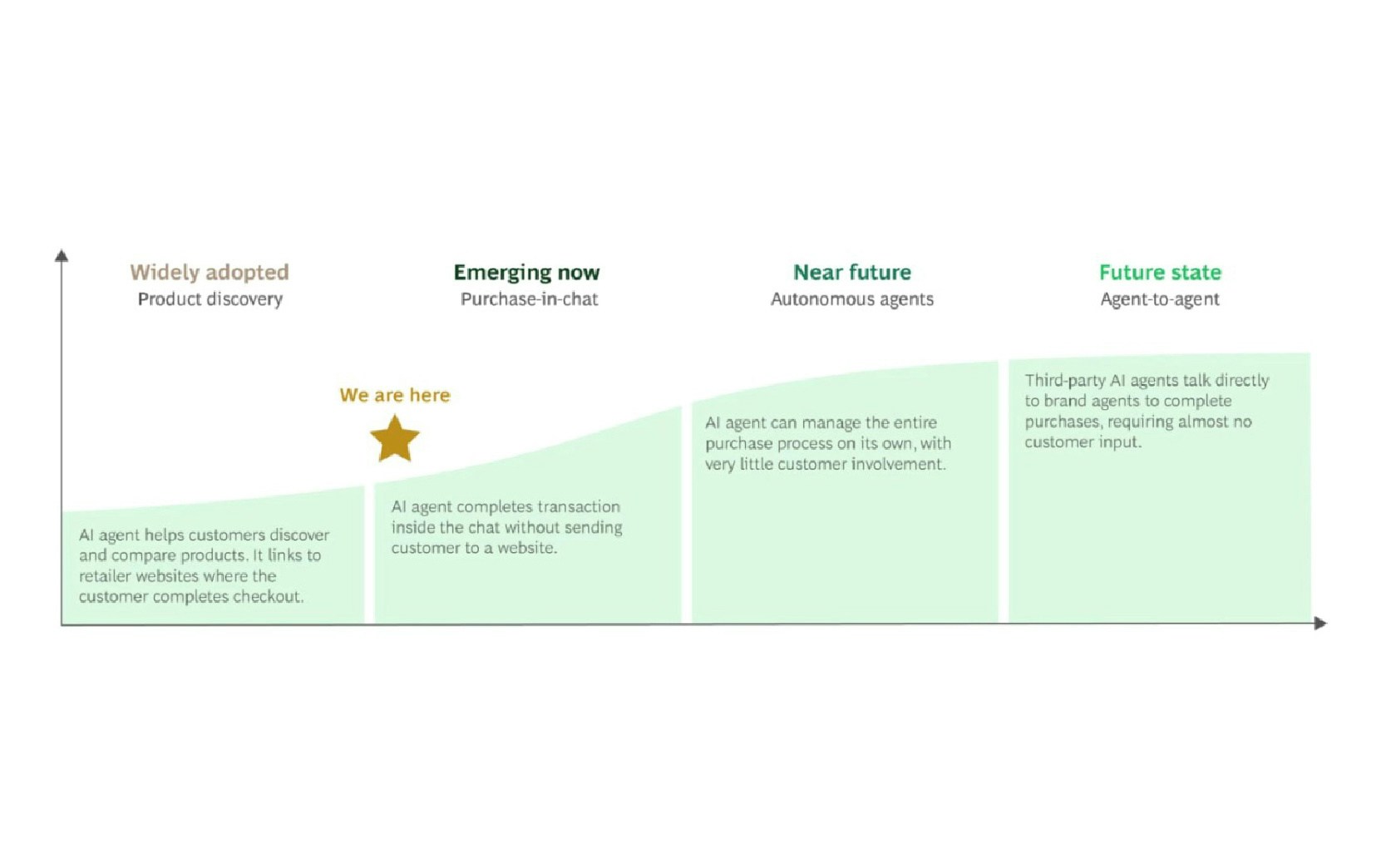
(Source: https://www.bcg.com/publications/2025/agentic-commerce-redefining-retail-how-to-respond)
Now for physical Retail
So much for digital retail assistants. With all the talk around digital, let us not forget that physical Retail still contributes ~ 70% of global retail sales. At the risk of leaving the habitual shoppers, who still ring in to the age-old concept of retail/in-store therapy behind, AI is making quantum advancements there too. Imagine you prefer to swing by your favorite retail store down the shopping arcade to serve the same purpose – grabbing beach wear for your upcoming vacation. The moment you step in, a store associate guides you to Aisle B that sports a vibrant assortment of your choice. While you are left wondering how she knew what you wanted, you pass through a store layout that seems to stack a much better collection from the last time you visited. Stroke of chance? Not quite – it is data science- backed visual merchandising and advanced planograming in action there! And some computer vision AI too.
Vision AI in Retail
One prominent tailwind to the AI revolution that industries are witnessing worldwide is the phenomenal advancement of Physical AI and associated infrastructure. Just like good and clean data is a pre-requisite for desired AI output, the hardware side plays out via enhanced compute power, low latency, ability to process gigantic volumes of data, all the while adhering to sustainability guidelines. Firms like NVIDIA and DELL are taking a lead here. Take Vision AI as an example. With increased camera prowess for in-store and warehouse setups, firms like RealSense are providing the hardware, that ingests feed to be utilized by platforms like NVIDIA Metropolis for greater insights into in-store customer behavior, eyeball movements, ‘holes in the shelf’ to track missing SKUs on aisles, and much more.
Use cases for Vision AI abound – both on front-end and operations. Smarter visual merchandising can lead to a reshuffle of SKU placement in stores, including the details around number of facings and depth across store layout, end-of-aisle placements – all of which impact the cost of stocking for CPGs within the stores. A more real-time planograming can happen as a result. This can also address a major problem for Retailers viz Shoplifting. Between 2023 and 2024, Retailers on average experienced 18% increase in shoplifting incidents.
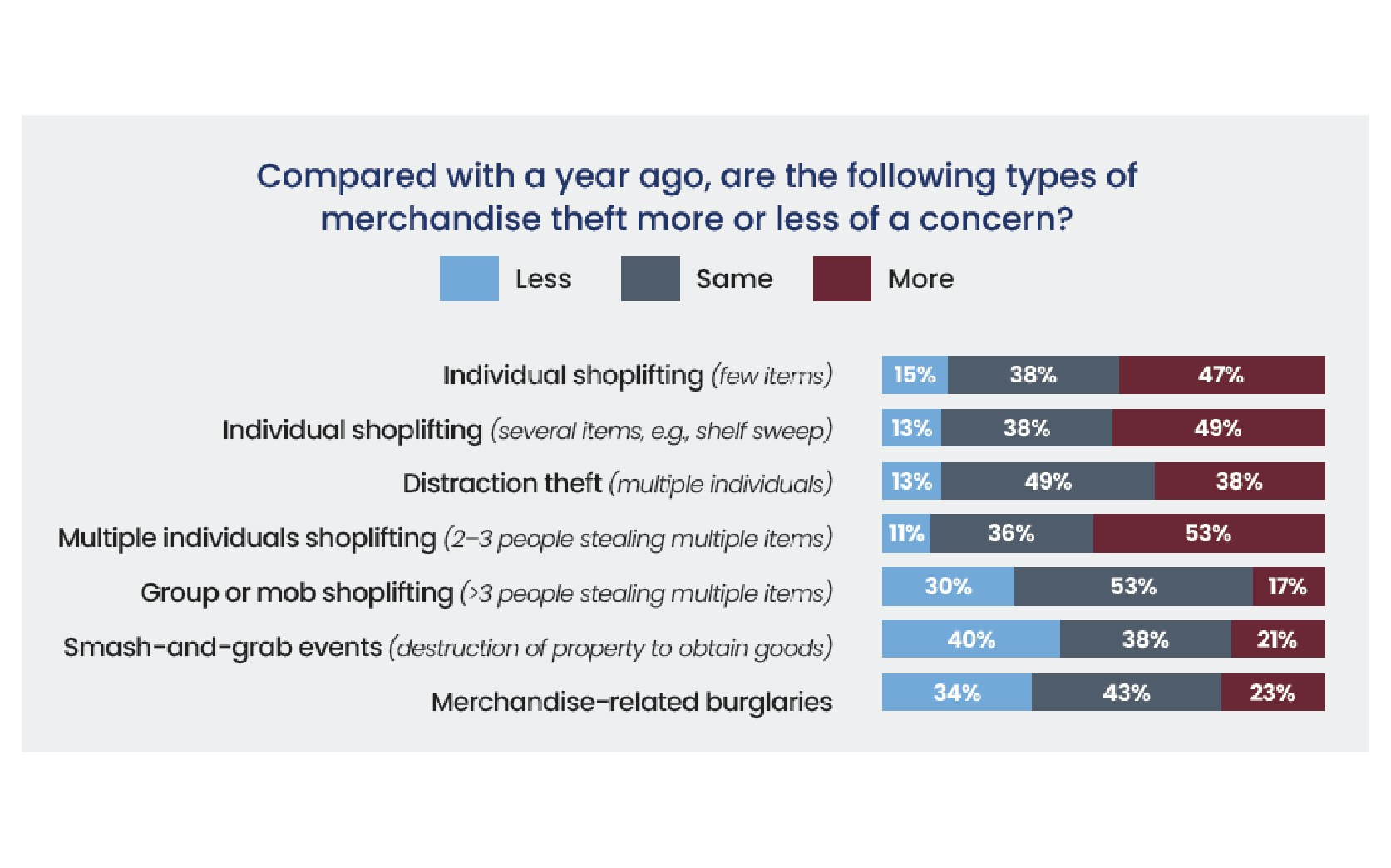
(Source: https://nrf.com/research/the-impact-of-retail-theft-violence-2025)
In case of NVIDIA Metropolis, the good part is, while it provides analytics around all the above for subsequent actions at the Retailers’ ends, the same infrastructure can be used for Use Cases like fully automated checkout systems, leading to faster customer checkout experience.
The operations side of the story gets equally enriched using computer vision AI. Advanced warehouses, CPG manufacturing shop floors use autonomous mobile robots, robotic arm manipulators, humanoids working along side humans. Managing the robotic fleet at scale is a challenge, that is well managed using platforms like Mega (NVIDIA Omniverse) - which syncs up digital twin technology with robots and video analytics AI. Improved operational efficiency, faster picking (and outbound) warehouse operations result. All of that translates to more accurate deliveries, and better customer experience – which is the holy grail of Retail 5.0.
Customer experience is the true ROI
Computer Vision AI opens up new use cases for Retail and CPG as AI models evolve, and cloud adoption enhances. In another 8 years, the market is projected to hit around USD 13 BN.
Computer Vision AI in Retail market (2023 – 33), USD BN
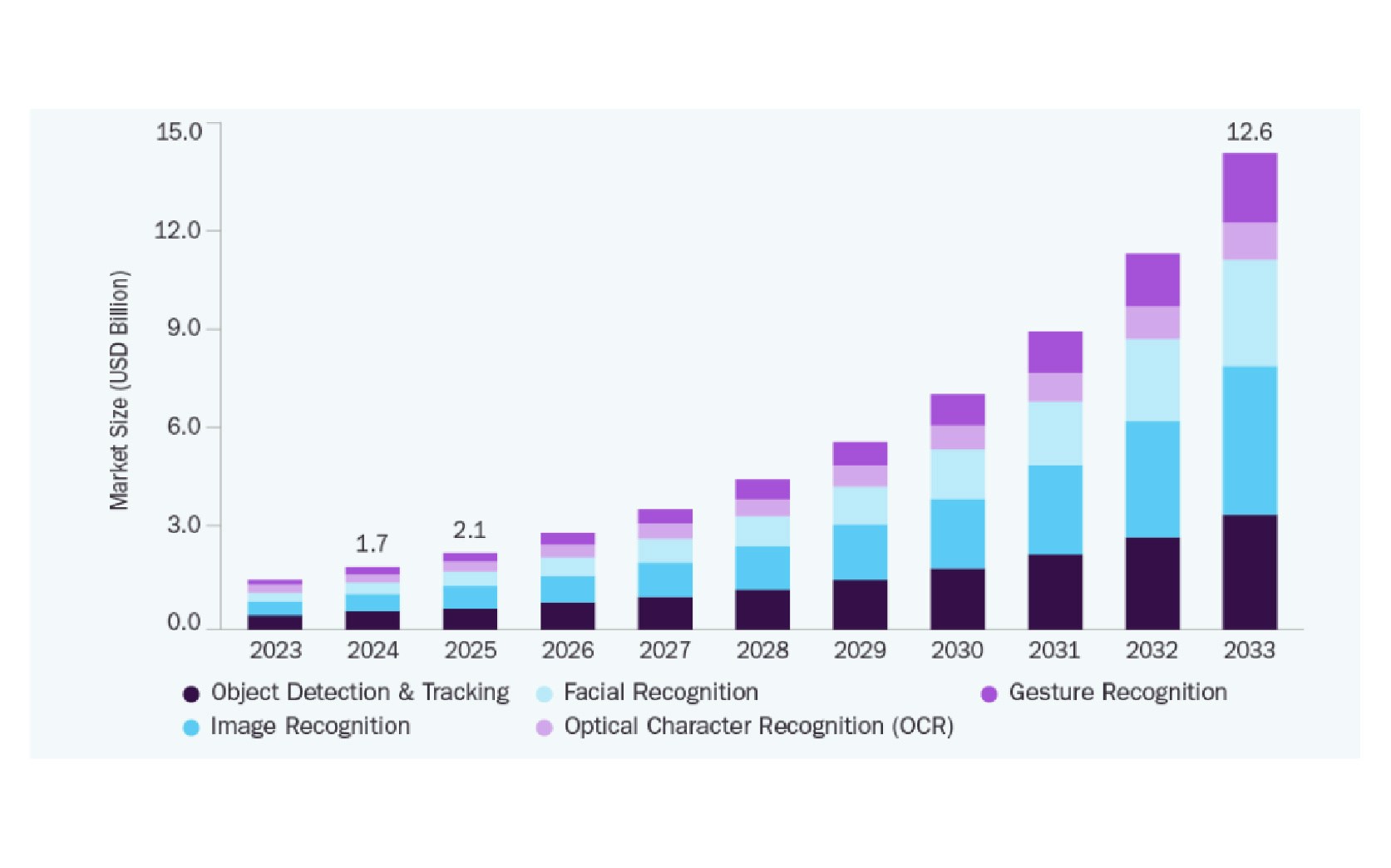
(Source: https://www.grandviewresearch.com/industry-analysis/computer-vision-ai-retail-market-report)
CPG Manufacturing provides another ripe case for Vision AI, where defects can be tracked within manufacturing and packaging, leading to reduction of downtimes and improved efficiency.
Be it front end CX that gets elevated using a seamless commerce cycle, or in-store purchase that gets a boost through Vision AI, pertinent use cases across customer shopping journey can be mined for the right AI intervention. This is aided by partner ecosystems, which already have a rich set of platforms and/or solutions sitting with them – in which case all it boils down to is leveraging the same through a set of APIs, and providing a wrapper of Retail and CPG on top.
A razor sharp focus on evolving customer needs is paramount at this stage. Solution providers like HCLTech, which bring in a deep understanding of Consumer sector value chain and a set of tailored solutions to address specific customer pain points, can be winners here.
For eventually, tech for the sake of tech isn’t of much value. It’s applicability is.
AI is not the hero. Customer is.


