


Every unresolved customer issue carries a cost: additional contacts, more agent effort, escalations and a customer whose confidence is harder to regain.
Modern contact centers excel at routing interactions, understanding intent and supporting customer engagement across channels. Yet enterprise value is realized only when customer issues are fully resolved and outcomes are confirmed.
A customer may receive accurate information and experience a seamless interaction, but if they still cannot access a service, complete a transaction, or achieve their intended outcome, the issue remains unresolved.
That distinction is becoming increasingly important as organizations invest in AI, automation and cloud contact center platforms. The question is no longer simply how efficiently interactions are managed. It is whether those interactions produce verifiable business outcomes.
HCLTech’s NextGen Contact Center as a Service (CCaaS) proposition addresses this challenge through a framework built around Prevent → Eliminate or Deflect → Human-Assisted Resolve → Autonomous Resolution. At the center of this framework is AssistIQ, which connects customer context, AI-powered guidance, governed actions and outcome verification into a connected resolution workflow.
The objective is straightforward: help customers achieve confirmed outcomes with less effort while enabling organizations to improve service quality, operational performance and business value.
What must be true before we can say an issue is resolved?
Customer interactions can be handled efficiently and still fail to resolve the underlying problem.
A helpful explanation may not correct a customer’s account. A completed automation may update one system while leaving another out of sync. A conversation may conclude successfully while the customer remains unable to complete the intended task.
For an access issue, resolution may require verifying that entitlement has been restored and the customer can successfully sign in. For a service request, it may mean confirming that a required change exists in the authoritative system and that the customer understands the next step.
This transforms resolution from an activity into a measurable business outcome supported by evidence, ownership and verification.
That principle forms the foundation of HCLTech’s service resolution framework.
The AssistIQ service resolution framework
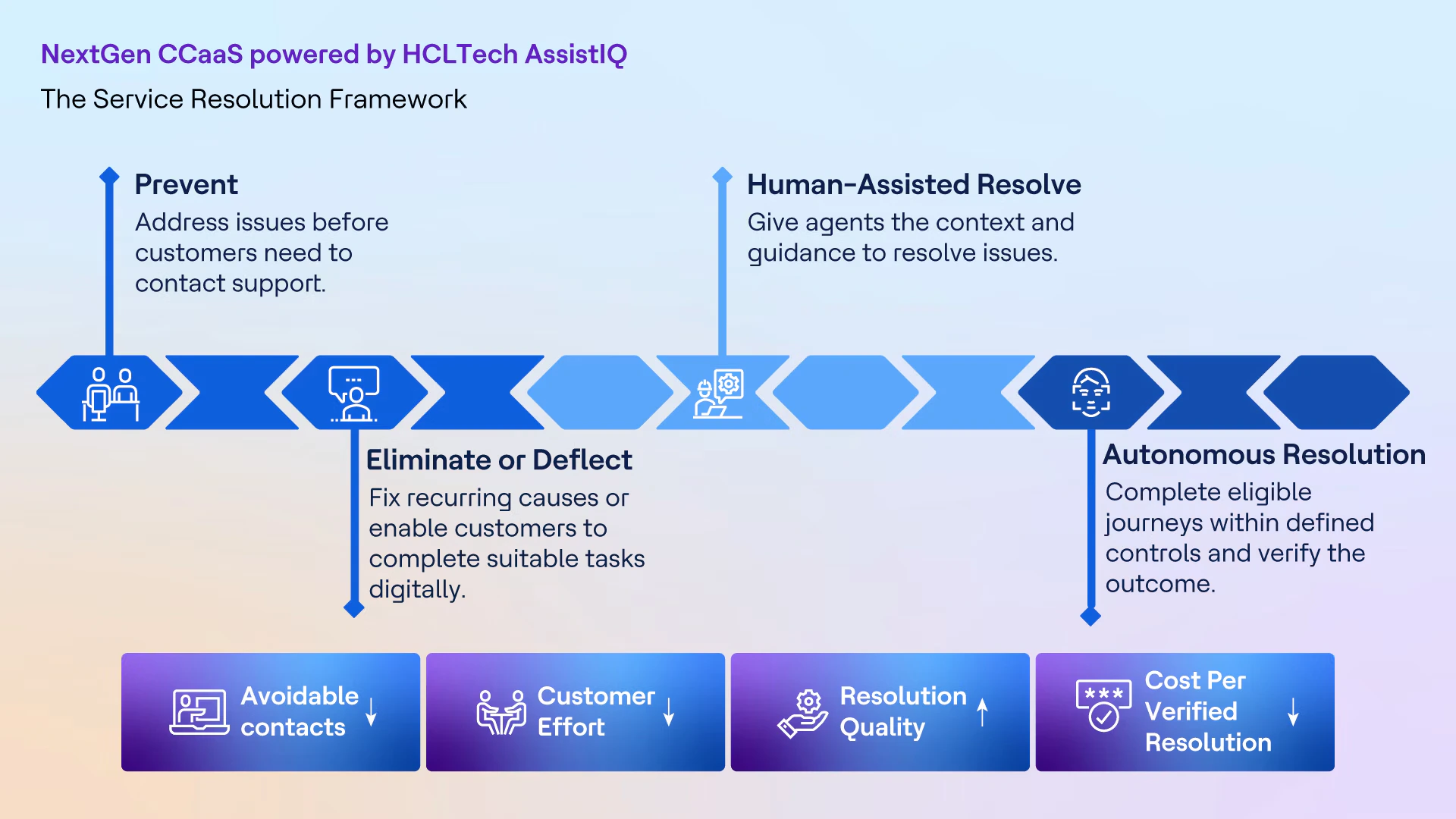
Prevent
The best service interaction is the one that never occurs.
AssistIQ helps organizations identify preventable causes of customer demand and supports proactive interventions before issues become support cases. With the appropriate data and integrations, organizations can connect service signals to corrective actions that reduce avoidable demand.
Success is measured through verified reductions in customer contacts rather than notifications alone.
Eliminate or deflect
Many contacts are symptoms of recurring process failures, knowledge gaps, or system issues.
AssistIQ uses resolution evidence and recurring-cause analysis to help identify corrective actions and assign ownership for remediation. Eliminating root causes reduces unnecessary service demand and improves experiences at scale.
Where service interactions remain necessary, customers can be guided through digital journeys supported by contextual knowledge, visual assistance and continuity across channels.
Success is measured through verified outcomes, not simply through channel transitions.
Human-assisted resolve
Many customer journeys still require human expertise, empathy and judgment.
AssistIQ equips agents with customer context, prior interactions, cited knowledge, next-best actions and controlled execution capabilities. Visual guidance and multilingual support help improve understanding while agents maintain ownership of customer outcomes.
The objective is not merely to reduce effort but to improve resolution quality, confirm outcomes and minimize repeat work.
Autonomous resolution
For eligible journeys, the goal is to complete resolution without requiring human agents to perform every step.
AssistIQ supports eligibility validation, policy controls, permissions management, approved actions and outcome verification. Autonomous resolution is applied where governance requirements and operational readiness have been established.
Complex or uncertain cases return seamlessly to human ownership with context preserved.
A continuous improvement loop
Evidence generated through assisted and autonomous resolution feeds back into prevention and demand elimination initiatives.
Recurring failures highlight opportunities for process improvement, while consistently successful journeys become candidates for controlled automation. This creates a continuous improvement cycle that helps organizations expand service capabilities while maintaining accountability and governance.
How AssistIQ brings the framework to life
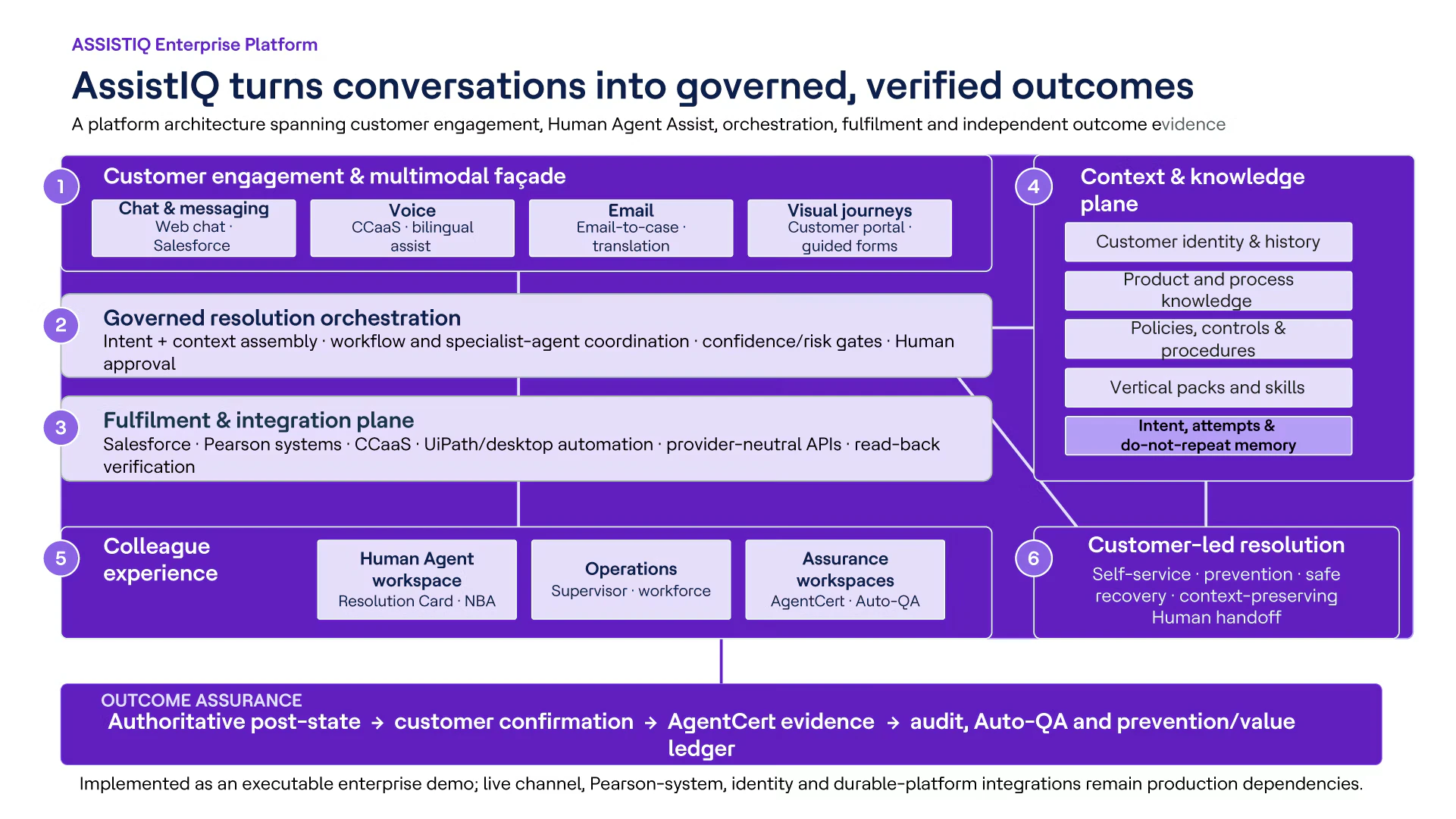
AssistIQ serves as the resolution layer within HCLTech’s NextGen CCaaS proposition, connecting customer conversations, enterprise knowledge, actions, approvals and outcome verification.
Unified customer context
AssistIQ brings together customer objectives, interaction history, previous attempts and recommended next steps in a shared workspace.
By reducing the effort required to reconstruct cases, organizations can improve continuity across channels and help agents focus on resolution rather than information gathering.
AI-guided resolution and governed execution
AssistIQ combines intent recognition, cited knowledge, next-best actions and domain-specific workflows to support resolution decisions.
Recommendations are supported by business rules, diagnostics and system validations that make guidance relevant to the service scenario. Risk-based controls, approval workflows and confidence thresholds help ensure recommendations are translated into accountable actions.
The result is a structured path from insight to execution while maintaining governance requirements.
Assisted digital experiences
Many customer journeys become easier when customers can see what to do rather than rely exclusively on verbal instructions.
AssistIQ supports guided visual experiences that help customers navigate key tasks while maintaining continuity with the original interaction. Agents remain aware of journey progress and can intervene when required.
The objective is to reduce customer effort, improve completion rates and minimize misunderstandings.
Multilingual customer support
AssistIQ combines bilingual conversation views, confidence-based review processes and human fallback paths to support communication across languages.
By preserving context and intent, organizations can extend language support while maintaining service quality and governance standards.
Verified outcomes and evidence
Resolution is complete only when the outcome has been confirmed.
AssistIQ’s completion model combines authoritative verification and customer confirmation before a case is considered resolved. Supporting evidence captures actions performed, approvals granted, controls applied and results achieved.
This creates transparency and helps organizations understand why outcomes succeeded or failed.
Why it matters to enterprise leaders
Chief financial officer
Reduced customer effort, fewer repeat contacts and higher resolution quality create opportunities to lower the cost of delivering successful customer outcomes while improving operational efficiency.
Chief operations officer
Success depends on consistent execution, clear ownership, manageable exceptions and reliable recovery mechanisms. Shared context, governed actions and verification workflows help improve operational consistency across service delivery.
Chief transformation officer
A defined resolution journey provides a manageable unit of change. Organizations can establish baselines, connect systems, validate controls and expand capabilities based on measurable outcomes rather than assumptions.
Chief customer experience officer
The key question is whether customers repeat themselves less, complete tasks more easily and avoid returning with unresolved issues. Outcome verification helps keep those objectives visible.
One metric deserves particular executive attention:
Cost per verified resolution
Traditional contact center metrics measure activity.
Cost per Verified Resolution measures outcomes.
The metric combines service costs with successfully resolved issues under a consistent verification standard, helping organizations connect customer success, operational performance and business value.
Measuring transformation outcomes
The business case for AI-powered CCaaS should connect capabilities to measurable improvements.
- Reduced customer repetition
- Improved agent effectiveness
- Higher resolution quality
- Greater automation accountability
- Better multilingual service delivery
- Lower avoidable demand
Performance should also be measured across each stage of the framework:
| Stage | Primary Measure |
|---|---|
| Prevent | Avoided demand |
| Eliminate | Sustained reduction in recurring causes |
| Deflect | Verified digital completion |
| Human-Assisted Resolve | Agent effectiveness and resolution quality |
| Autonomous Resolution | Verified completion and exception management |
Organizations should distinguish between avoided demand, reduced handling effort and realized financial savings to ensure benefits are measured accurately and not counted twice.
A credible pilot should establish baselines, eligible contact types, quality thresholds and comparison methods before reporting improvement.
Start with one journey and prove the complete loop
A practical starting point is a recurring service request with a clearly defined business outcome, accessible data and a manageable exception path.
Organizations should first determine whether the demand can be prevented or eliminated. Where interactions remain necessary, they can evaluate whether journeys are best completed digitally, through human-assisted resolution, or through autonomous execution.
The first objective is to validate recommendations, actions, verification mechanisms and recovery processes. Expansion should occur only after agreed operational and quality standards have been achieved.
This approach makes the NextGen CCaaS proposition tangible: a defined journey, a connected resolution workflow and measurable business value.
Building the future of customer service
The future of customer service will not be defined by how many interactions organizations automate.
It will be defined by how effectively they eliminate customer effort, accelerate resolution and deliver measurable business outcomes.
HCLTech’s NextGen CCaaS proposition, powered by AssistIQ, provides a practical framework for making that transition. By combining prevention, demand elimination, assisted resolution and governed autonomy, organizations can create service operations that are increasingly intelligent, connected, accountable and outcome-driven.
Where do your customers and agents repeatedly get stuck?
The answer often reveals the greatest opportunity for measurable customer, operational and financial value.

