The IBM report "Mainframes as mainstays of digital transformation" emphasizes the importance of leveraging GenAI technologies to enhance mainframe operations and highlights how organizations can utilize AI to improve efficiency, reduce costs and create new growth opportunities. Gartner estimates that over 100 million IBM® mainframe MIPS are installed worldwide, underscoring the significance of this technology.
The shortage of mainframe skills among new generations is a key factor driving mainframe modernization projects in organizations. The introduction of GenAI-infused tools to augment human capabilities in understanding undocumented code or complex issues can help reduce the skill gap.
Today, there is an end-to-end ecosystem to leverage AI and the mainframe, including:
- Hardware acceleration: Industry-first, on-chip hardware accelerator for processing extremely high throughput and low latency enterprise AI workloads.
- Software acceleration: IBM® and partners are continuously investing in runtimes, compilers and transformers that can seamlessly exploit AI hardware optimizations.
- Cloud native solutions: RedHat OpenShift helps modernize applications with toolchain support, enabling the delivery of fully operationalized micro-services on the mainframe.
- AI offerings: Build AI solutions on premier AI offerings with seamless exploitation of AI optimizations, as well as open-sourced data science and AI platforms fully supported and optimized on the mainframe.
- Modern data management: Break down data silos, support dynamic scaling and reduce integration costs. Build pipelines that work where the data is located, creating new possibilities for analytics, governance and Responsible AI.
This comprehensive ecosystem enables organizations to fully leverage the power of AI and Mainframe technologies to drive innovation and efficiency. In the following sections, we will explore three key aspects of integrating AI with mainframe technology: transforming mainframe application development with GenAI, enhancing mainframe support with AI-assisted tools and enabling AI workloads on mainframes.
Transform Mainframe Application Development with GenAI
Mainframe application modernization is a topic that every mainframe client is addressing at different levels, mainly driven by digital transformation. The principal challenge is to accelerate application modernization to better support business transformation initiatives. But how can AI help with mainframe application modernization? One option is to leverage watsonx Code Assistant for Z, a GenAI-assisted solution that can accelerate the mainframe application lifecycle and streamline modernization. This solution supports the end-to-end lifecycle with capabilities for application discovery and analysis, code explanation, automated code refactoring, code optimization advice, Cobol to Java transformation and code validation. Developers can automatically refactor selected elements of an application, optimize code to increase performance and transform code to Java using generative AI.
Below is a chart that provides a quick overview of the application lifecycle supported by the solution:
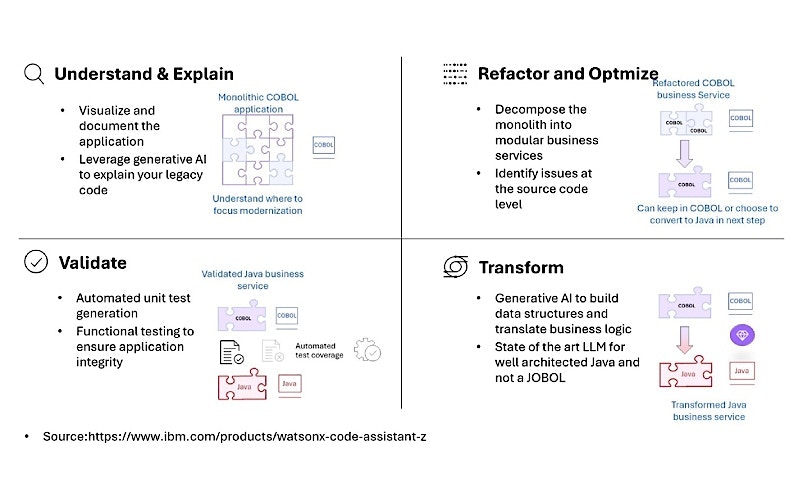
The impact of leveraging AI in mainframe application modernization is multifaceted, addressing several key areas:
- Reduce knowledge gap: Real-time code explanations help developers and system programmers understand the code better, accelerating development and modernization efforts
- Free up SMEs: By reducing dependence on senior experts, AI broadens the talent pool and alleviates knowledge bottlenecks through real-time code explanations
- Streamline documentation: AI can be used to understand applications with code explanations, reducing the need for manual documentation efforts
- Facilitate modernization strategy: AI provides deeper insights into programs, aiding in the identification of optimal modernization approaches
Transform Mainframe Support Assistant with GenAI
AI assistants can significantly transform how mainframe support teams engage with and optimize the execution of routine tasks. In real-world scenarios, newer professionals often struggle to find relevant information to understand and resolve problems, leading to a high dependency on senior mainframe teams.
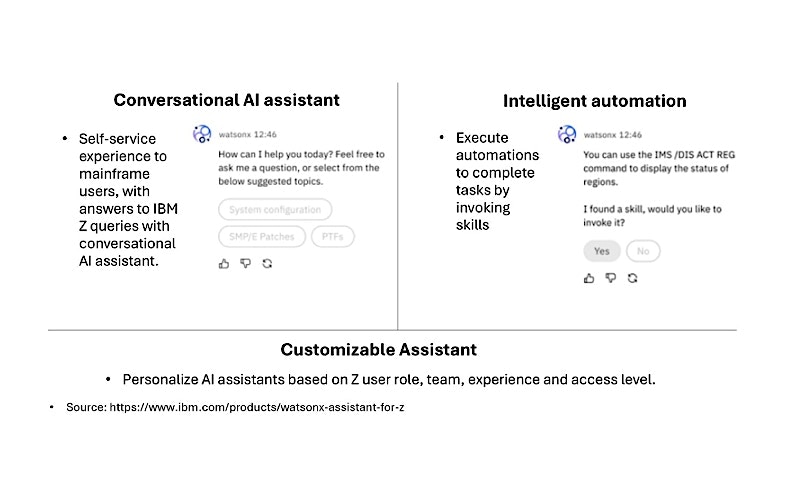
The value proposition of watsonx Assistant for Z lies in its ability to provide users with accurate, up-to-date answers to their IBM® Z queries and simplify the execution of both complex and repetitive tasks. By codifying the knowledge of Z experts into a trusted set of automation, which can be customized based on the team's access skills, persona and experience level and by ingesting proprietary documentation and knowledge bases, it offers a personalized experience.
Below is a chart to quickly overview the support lifecycle supported by the solution:
Enable AI Workloads on Mainframe
There are mission-critical and transactional AI use cases that require real-time processing at scale, handling multiple transactions per second. This involves high-performance data processing without offloading to external AI systems as well as sensitive data handling in an architecture that may require machine learning, deep learning and GenAI capabilities, sometimes working together in an ensemble architecture to achieve better business outcomes.
For these reasons, aspects such as real-time processing, low latency, high processing power, accelerated AI integration, data protection and addressing data gravity challenges are essential for leveraging the full potential of AI on mainframe systems, as described below:
- Low latency and high processing power: Optimized for low latency, high-speed transaction processing and real-time analytics, which are crucial for managing large-scale transactions efficiently. For instance, running AI solutions for fraud detection on each credit card transaction.
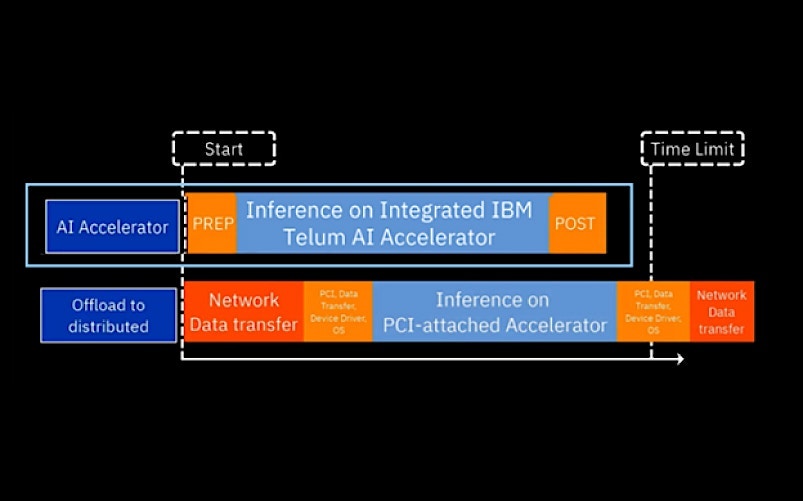
Accelerated AI integration: Enables near real-time analytics and decision-making directly on the processor. The image below illustrates the difference between using an AI Accelerator and offloading to a distributed system.
- Data protection and privacy: Essential for AI applications that require access to sensitive data, as failure to secure this information can have serious consequences.
- Data gravity: Allows data to be processed close to where it resides, helping organizations derive insights from large volumes of sensitive data without migrating it to other platforms, addressing data gravity challenges.
In a nutshell, the integration of GenAI with mainframe technology represents a transformative opportunity for organizations. By leveraging AI to enhance mainframe operations, businesses can improve efficiency, reduce costs and unlock new growth opportunities. The comprehensive ecosystem of hardware acceleration, software optimization, cloud native solutions, AI offerings and modern data management provides a robust foundation for this transformation. As we continue to explore the potential of AI in enabling workloads, modernizing application development and enhancing support, the future of mainframe and AI technology is interesting. Leveraging these advancements will not only address the current skill gap but also create new opportunities for innovation and efficiency improvements in mainframe operations.