


Welcome to Part 2 of our blog series on the SupplyChain Copilot. In Part 1, we have introduced this groundbreaking Gen AI-powered solution designed to revolutionize procurement processes. We discussed how it addresses chronic inefficiencies, integrates with existing systems and transforms the RFQ-to-fulfillment lifecycle.
Now, we'll dive deeper into the technical details that make the SupplyChain Copilot such a powerful framework. In this part, we'll explore the Agentic Workflow that drives its intelligent decision-making processes and underlying AWS native Agentic Architecture that forms the backbone of the solution.
Let's begin by understanding the execution context of the Agentic Workflow:
Agentic workflow:
The SupplyChain Copilot uses a multi-agent approach for a specific purpose. This design isn't about adding complexity, but rather about keeping responsibilities clear and manageable. Each step in the process produces a defined output that can be easily verified.
The system operates with 6 specialized agents, each handling distinct tasks and a supervisor agent oversees the entire process. This structure allows for a modular and efficient workflow while maintaining simplicity in each agent's role.
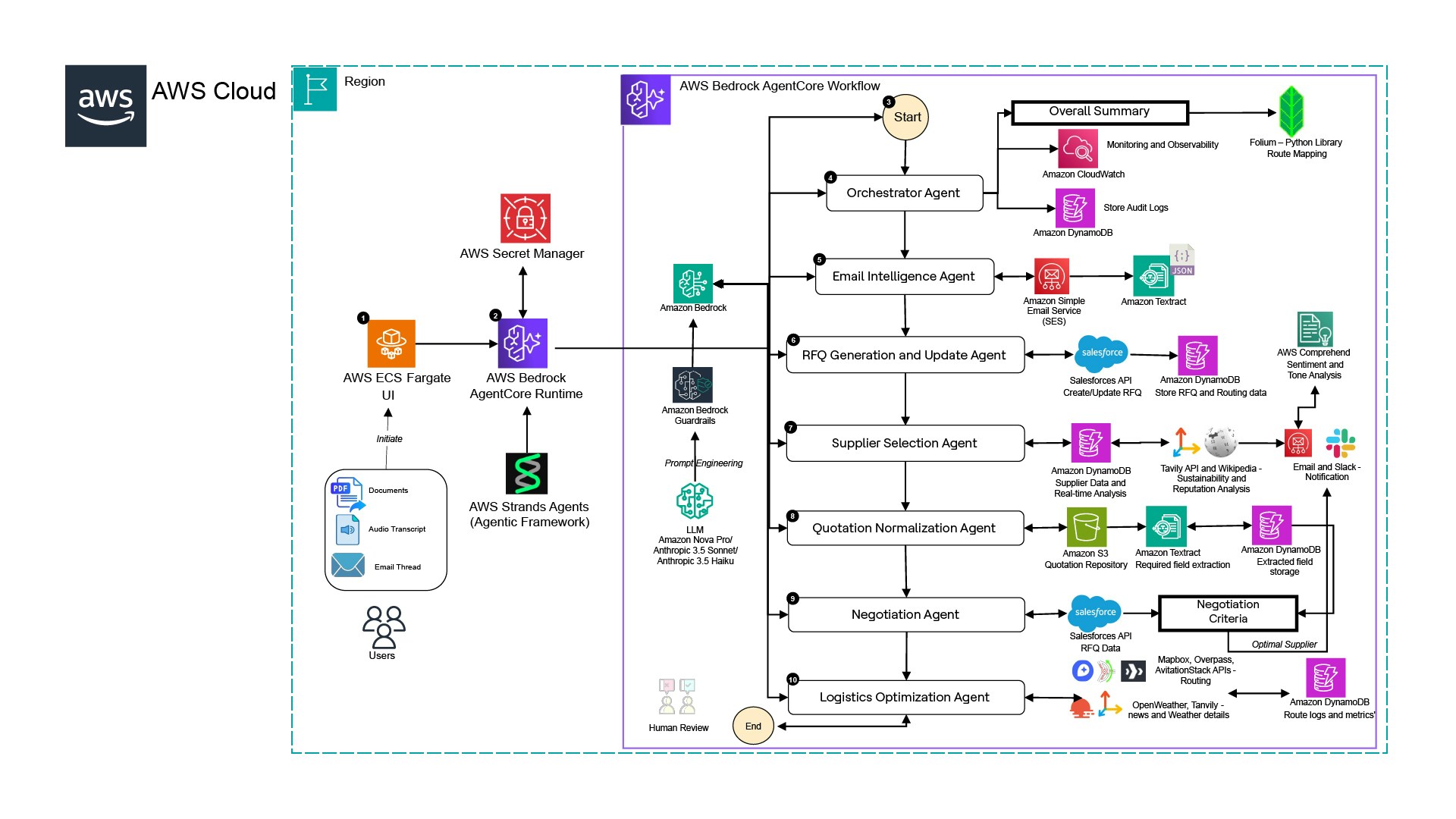
Figure 1: Agentic Workflow
A0. Email intelligence Agent (Reader)
Extracts RFQ data from email threads, attachments and voice transcripts using Amazon Textract and Comprehend AI services.
A1. RFQ Generation and update Agent (Recorder)
Validates and updates RFQ information in Salesforce and stores RFQ and audit data in Amazon DynamoDB.
A2. Supplier selection Agent (Evaluator)
Rates suppliers based on cost, delivery time and quality using internal and external data.
A3. Quotation normalization Agent (Analyzer)
Extracts insights from supplier provided quotations and stores in Amazon S3 and enables fair comparison.
A4. Negotiation Agent (Communicator)
Generates contextualized messages drafts for suppliers, checks the tone and notifies via channels like email and Slack.
A5. Logistics Agent (Planner)
Computes routes and route maps using Mapbox and Folium APIs. Uses AviationStack, OpenWeather and Overpass APIs for routing and disruption inputs. Logs route metrics to DynamoDB.
A6. Supervisor orchestrator Agent (Orchestrator)
Coordinates the workflow and compiles final reports. Deployed on Amazon Bedrock AgentCore Runtime environment, with full observability via CloudWatch.
The key feature here is the supervisor agent. It ties everything together, making sure the system works as a unified tool rather than separate pieces. It's responsible for controlling the workflow and putting together the final summaries.
Below table describes agent’s roles and responsibilities.
| Agent | Role | Description | Key Tools & Usage |
| A0 – Email Intelligence Agent | Reader | Extracts structured RFQ data from email threads, document attachments (PDF/handwritten) and voice transcripts | 1-Textract, Comprehend – Parse and extract entities 2-Gmail / SES – Fetch and process email chains 3-Claude 3.5 Haiku – Context-aware data extraction |
| A1 – RFQ Generation and Update Agent | Recorder | Validates and updates RFQ records in Salesforce and DynamoDB | 1-Salesforce API – RFQ and Account updates 2-DynamoDB – Store RFQ and audit data 3-Claude 3.5 Haiku – Field mapping and validation |
| A2 – Supplier Selection Agent | Evaluator | Scores suppliers by cost, lead time, and quality | 1-DynamoDB – Supplier data reference 2-Claude Haiku 3.5 – Multi-criteria evaluation 3-Tavily / Wikipedia – Reputation insights 4-SES / Slack – Outreach and notifications |
| A3 – Quotation Normalization Agent | Analyzer | Normalizes supplier quotes and benchmarks market data | 1-Textract, DynamoDB – Quote extraction and Storage 2-Claude 3.5 Sonnet – Normalize quote formats 3-S3 – Quote repository |
| A4 – Negotiation Agent | Communicator | Crafts counter-offers and manages supplier communications | 1- SES, Slack – Send negotiation updates 2- Comprehend – Sentiment and tone analysis 3- Claude Sonnet 3.5 Sonnet – Drafts optimized responses 4- Salesforce – RFQ data for negotiation |
| A5 – Logistics Optimization Agent | Planner | Determines optimal shipping route and mode | 1- Mapbox / Folium – Route visualization 2- AviationStack, OpenWeather, Overpass – Route and weather data 3- Claude 3.5 Sonnet – Cost, ETA, and CO₂ optimization 4- DynamoDB – Route logs and metrics |
| A6 – Supervisor / Orchestrator Agent | Orchestrator | Coordinates agent workflows and compiles final reports | 1- Amazon Nova Pro – Core orchestration and reasoning 2- AgentCore Runtime (ECS Fargate) – Workflow execution 3- CloudWatch – Monitoring and observability 4- DynamoDB, Slack – Audit and summary updates |
Technical architecture - AWS:
The core Agent’s execution engine is powered by Amazon Bedrock, which provides the foundation LLMs for our AI capabilities. We've built an AgentCore workflow on top of this. This workflow does two main things:
- It runs the supervisor agent, which oversees the entire process
- It triggers each of the specialist agents when they're needed
This setup allows for a smooth, coordinated flow of tasks from one agent to the next, ensuring that each step in the supply chain process is handled efficiently and in the right order.
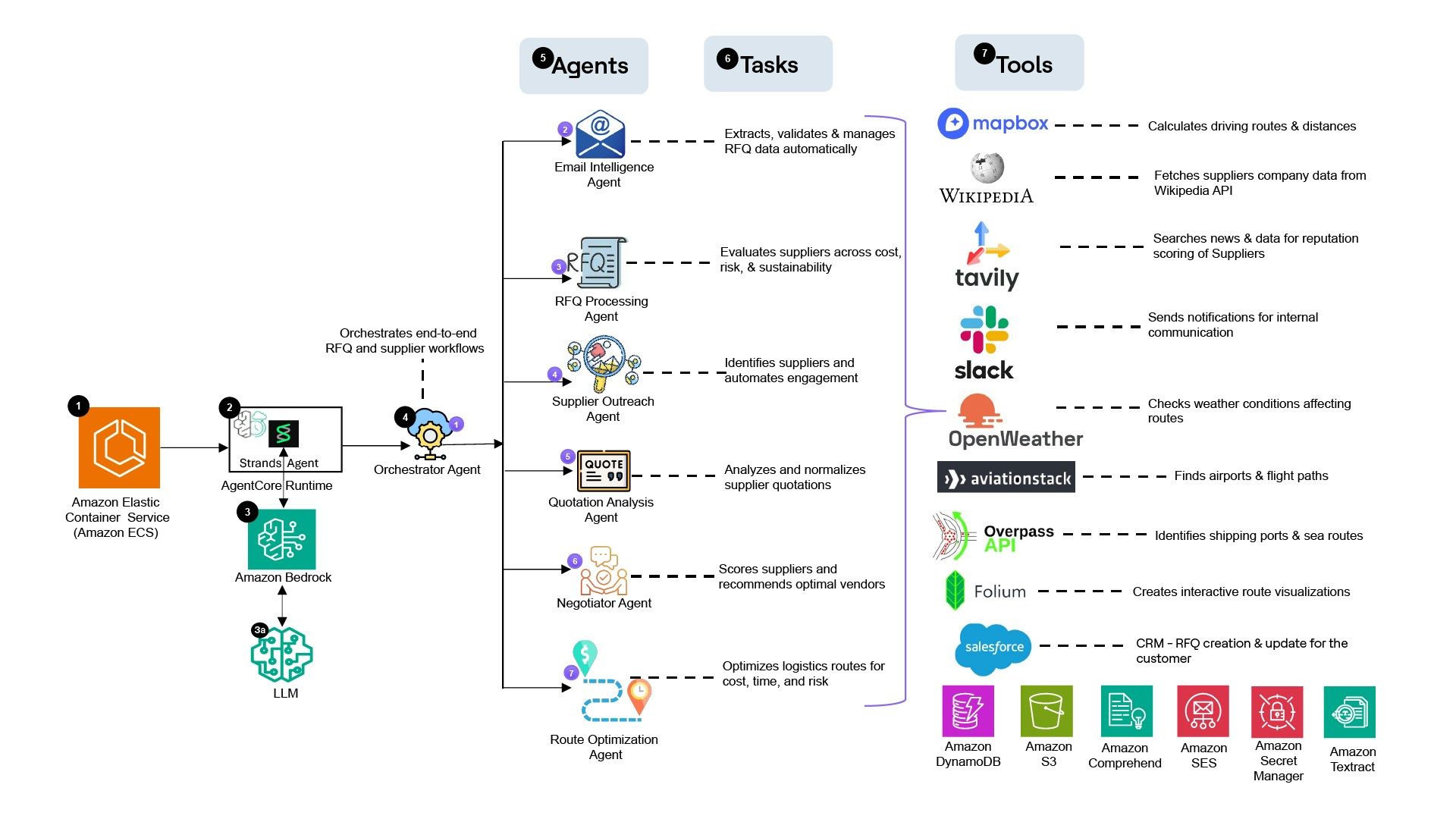
Figure 3: Technical Architecture
The SupplyChain Copilot's architecture is divided into several key layers. Here's what each layer does:
Amazon Bedrock AgentCore runtime and orchestration
- ECS Fargate runs the UI and the agent runtime
- Bedrock AgentCore Runtime manages the workflow and the agent chain
- Strands Agents provide the agent framework
Model layer and controls
- Amazon Bedrock hosts our AI models, including Amazon Nova Pro and Anthropic's Sonnet 3.5 and Haiku 3
- Amazon Bedrock Guardrails ensure the models behave as expected
Data extraction and understanding
- Amazon Textract handles document and quote extraction, especially PDFs and scans
- Amazon Comprehend supports tone and sentiment checks for supplier communications
Data storage and monitoring:
- Amazon DynamoDB stores RFQ information, routing data and audit logs
- Amazon S3 keeps quote files and extracted data
- Amazon CloudWatch monitors the system's performance
Communication tools
- Amazon SES supports supplier outreach and negotiation communication
- Slack is used for internal updates and notifications
External signals for routing and context
- For logistics planning, the system integrates routing and disruption inputs using Mapbox, Overpass, AviationStack and OpenWeather, with Folium used for route mapping
- For supplier context, the design calls out Tavily and Wikipedia as external sources for sustainability and supplier reputation checks
Tackling complex procurement: Who benefits most
The SupplyChain Copilot is ideal for industries where procurement is:
- High-volume
- Time-sensitive
- Initially disorganized
This includes, but isn't limited to:
- Manufacturing, Electronics, Automotive, Energy, Retail, Pharmaceuticals, Aerospace, Construction etc
What these industries have in common isn't the product they make, but how their procurement process looks. Typically, it involves:
- RFQs (Requests for Quotations) starting in email threads
- Suppliers responding in various formats
- Logistics risks appearing late in the process
- Decision-making rationale getting scattered across different channels
Our solution is designed to address these common challenges, bringing order and efficiency to the complex procurement processes.
Conclusion
Throughout Parts 1 and 2 of this blog series, we've explored the SupplyChain Copilot in depth. We've seen that what supply chain teams truly need isn't another fancy dashboard, but a solution that works smoothly from the very start. even when that start is a jumbled email thread.
This is where SupplyChain Copilot excels. As we've detailed in these posts, it's designed to handle the complexities of the procurement process. To recap, here's what it does:
- Turns scattered information into a clear, structured RFQ
- Keeps Salesforce records up to date
- Makes supplier quotes easy to compare
- Help draft negotiation messages
- Creates logistics plans that consider weather and news risks
- Ties everything together with a clear summary and audit trail
In Part 1, we introduced the concept and benefits of this solution. In Part 2, we delved into its technical architecture and workflow. Together, these posts demonstrate how SupplyChain Copilot doesn't just add another layer to your process - it makes the whole process work better, from start to finish.
We hope this blog series has provided valuable insights into how Agentic AI-driven solutions like SupplyChain Copilot can transform procurement processes, making them more efficient, accurate and manageable.


