Listen to article
Key takeaways
- Broadcast modernization is no longer only about launching new standards but about operating multiple standards and delivery models without multiplying cost
- For broadcasters, the biggest operational risk is not scale alone but managing scale through fragmented, manual workflows
- Centralized orchestration can shift operations from station-by-station control to fleet-wide visibility, automation and service delivery
- Broadcast as a Service is emerging as a practical model for affiliates and local stations that do not want to replicate infrastructure everywhere
- The long-term opportunity is broader than broadcast alone, pointing toward unified edge platforms that can support free-to-air, streaming, monetization and new audience experiences
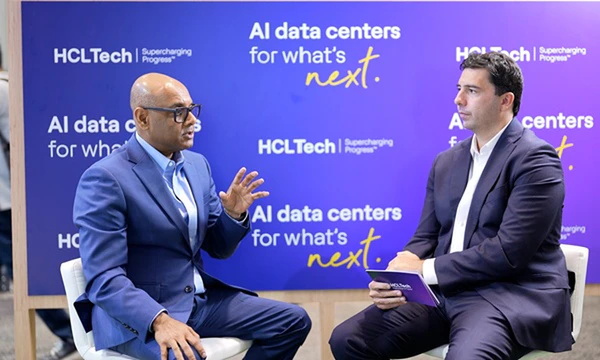
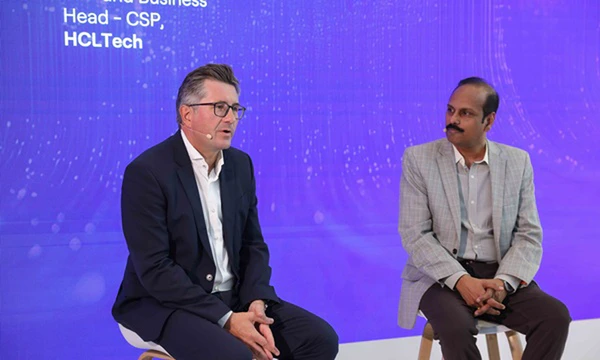
At NAB 2026, HCLTech used a theater session with Globo to make a point that goes beyond any single market or broadcast standard. As broadcasters expand into new technologies while continuing to support legacy services, the real challenge is no longer just technical rollout. It is operational scale. Hosted around the theme of broadcast core centralization and automation, the session featured Atheer Sabti, Global Principal Solutions Architect at HCLTech, and Jonas Ribeiro, Head of Infrastructure and Telecom Products at Globo, who set out a vision for how broadcasters can move from fragmented, station-led operations to more centralized, orchestrated and elastic models.
That matters because the industry is now living in a dual world. Broadcasters are being asked to launch new standards and new services without abandoning the old ones. In practice, that means operating more infrastructure, more workflows and more complexity at the same time, often without the luxury of growing cost in line with service ambition.
Why broadcasters are rethinking the operating model
The problem is straightforward. Broadcasters are trying to digitize and modernize the front end, while much of the middle and back end is still held together by manual effort, repeated engineering work and people stitching broken processes together. That can work at limited scale. It becomes much harder when broadcasters need to operate across multiple standards, multiple stations and multiple delivery environments at once.
In the US, that challenge shows up through the coexistence of ATSC 1.0 and ATSC 3.0, including simulcast obligations that can leave broadcasters operating both environments for years. In Brazil, the same issue appears in a different form, with ISDB-T still in operation while the new TV 3.0 era begins to take shape. The technology is not the only issue here. The bigger problem is what happens to operational cost, monitoring, reliability, SLA performance and engineering workload when the number of services and configurations begins to expand much faster than the old operating model was designed to handle.
That is why the session focused on centralization not as a technical preference, but as an operational necessity.
Globo’s case for a broadcast core
Globo offered a particularly relevant example because of the scale and complexity of its environment. As one of Brazil’s largest media companies, it operates across free-to-air television, streaming and pay TV, supported by more than 123 affiliates and reaching almost the entire population. As Ribeiro explained, the shift to Brazil’s new DTV+ model creates a chance not just to deploy a new standard, but to rethink how broadcasting itself is operated.
The vision he described is built around a central broadcast core that brings national feeds, encoding, packaging and delivery into a more elastic architecture. Rather than asking every affiliate to maintain full-time local playout, encoding and infrastructure even when much of the day is spent simply carrying the national feed, the model uses a hybrid architecture. Core capabilities are centralized, while more local, customized or time-specific functions are activated at the edge only when needed.
“We thought in a broad way that we’re going to have our national feed and create this concept of the Broadcast-as-a-Service” — Jonas Ribeiro
That changes the economics materially. Instead of running 24/7 infrastructure everywhere, the broadcaster can turn on playout, graphics or local processing only in the windows where local programming or local advertising requires it.
The aim is “more elasticity, more scalability, optimization of the resources and our operation,” said Ribeiro.
From station operations to fleet operations
That shift only works if orchestration becomes a first-class capability.
Trying to run this kind of model without automation and orchestration would be “a nightmare,” said Sabti.
The complexity is too high, especially when multiplied across large station footprints and mixed delivery requirements.
The operating model HCLTech and Globo described is built around a centralized orchestration layer that connects planning, playout automation, ad management, infrastructure activation, telemetry, visibility and billing. This allows broadcasters to move from individual device configuration and manual intervention toward template-based, profile-driven operations.
“We move from a station-by-station operation to a fleet station operation” — Atheer Sabti
Instead of logging into each device or each site, engineering and operations teams can define intents, map them to workflows and provision or deprovision services centrally.
That is the deeper operating-model shift. Broadcasters stop thinking in terms of site-by-site control and start managing a fleet. Visibility improves. Rollout becomes faster. Reliability is easier to engineer. Cost per station becomes easier to understand. And crucially, new service models become possible.
Broadcast servitization becomes more plausible
One of the more interesting ideas in the session was the emergence of broadcast servitization.
Sabti suggested that in Globo’s model, the broadcaster can increasingly become “the broadcaster of the broadcasters,” creating a shared service model for affiliates that no longer need to replicate the same capital investment and operational burden independently.
That changes the role of central infrastructure. It no longer exists only to support the parent broadcaster’s own network. It can also become a platform through which affiliates consume playout, encoding, stitching, graphics and other broadcast capabilities on demand. In practice, that means better cost control for local operators and a new monetization and service opportunity for the core provider.
This is a significant reframing. It suggests that the future broadcast core may function less like a static engineering hub and more like a programmable service layer.
The edge becomes strategic
The session also pointed toward a wider future architecture. Ribeiro described how Globo is thinking not only about the main core and local edge nodes for DTV+, but about a broader “global edge” concept that could unify free-to-air TV, streaming, CDN capabilities, monetization and AI-enabled services closer to the user.
That is an important signal. The logic of centralization is not about forcing everything into one place. It is about placing capabilities in the right place. Shared and common services live in the core. Localized or time-sensitive services can be activated at the edge. Public cloud can support disaster recovery and overflow capacity. The value comes from orchestration across all of it.
For broadcasters, that architecture does more than reduce cost. It creates the foundation for new audience experiences as well.
Ribeiro highlighted examples spanning immersive audio, synchronized broadband experiences, sports statistics, replay workflows and t-commerce, all built around the idea that broadcast and broadband are no longer separate universes. They are becoming one coordinated environment.
A practical path forward
Neither HCLTech nor Globo framed this as a one-step transformation. The recommendation was more pragmatic: improve visibility first, standardize workflows as much as possible, reduce unnecessary variation across stations and then build incrementally over time.
That matters because the industry doesn’t have the luxury of resetting from zero. Legacy standards are not disappearing overnight. New services are arriving quickly. Engineering teams are already under pressure. The broadcasters that succeed are unlikely to be the ones that simply add more point solutions on top of that complexity. They will be the ones that create a more centralized, orchestrated operating model capable of absorbing it.
That is the real significance of the NAB session. Broadcast modernization is no longer just about moving to the next standard. It is about designing an operational core that can support many standards, many services and many business models without breaking under the weight of manual effort.