AI is no longer just a promise for the future of life sciences and healthcare. It is already changing how new therapies are discovered, how clinicians work, how medical devices generate intelligence and how payers improve operational efficiency.
But there is a hard truth: Many organizations are still stuck in the pilot stage.
They have promising AI experiments, but not enough production-grade AI. They have models, but not always the platform, governance, security, economics and operating model needed to scale. In a highly regulated, data-rich and compute-intensive industry, this gap can slow down innovation and dilute business value.
That is why the next phase of AI requires an AI Factory to enable scalable, Responsible AI deployment across healthcare and life sciences.
An AI Factory is not just a collection of GPUs or a technical environment. It is an enterprise capability to build, deploy, manage and scale AI in a repeatable and responsible way. It connects data, compute, models, platforms, applications, security, governance and operations into one integrated foundation.
For life sciences and healthcare, this matters deeply.
Pharmaceutical companies can use AI to accelerate target identification, molecular modeling, clinical trial optimization, quality control and pharmacovigilance. Healthcare providers can improve clinical documentation, patient intake, lab interpretation, remote monitoring and virtual patient engagement. MedTech companies can create smarter devices, AI-enabled imaging systems and connected care platforms. Payers can automate prior authorization, claims intelligence, regulatory monitoring, reporting and reimbursement analytics.
The opportunity is clear and with AI Factory, your organization can confidently scale AI initiatives to deliver measurable business value.
This is where HCLTech AI Factory, advanced by AMD, offers unique value by enabling faster, more efficient AI deployment tailored for healthcare needs.
HCLTech brings the enterprise transformation capabilities required to industrialize AI: advisory, data engineering, AI platforms, infrastructure services, application integration, security, Responsible AI, MLOps, LLMOps and managed operations. AMD brings an open, high-performance AI technology stack designed for demanding AI and HPC workloads.
At the core of this stack, AMD Instinct GPUs support large-scale training, inference, genomics, medical imaging, scientific computing and generative AI workloads. AMD EPYC CPUs provide the enterprise backbone for data pipelines, virtualization, inference serving and platform operations. AMD ROCm enables an open software ecosystem that gives enterprises more flexibility, portability and control.
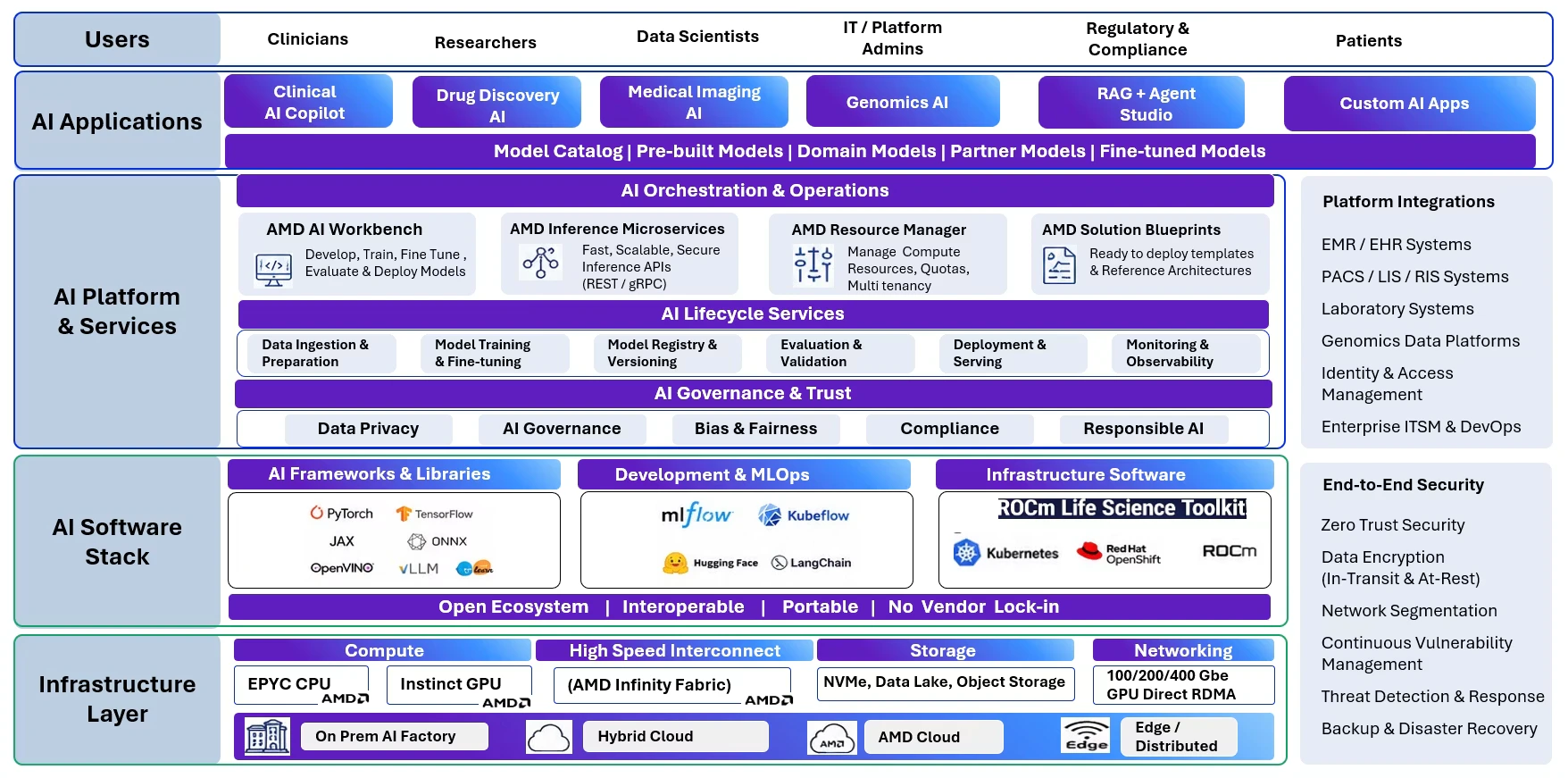
This open approach is strategically important. As AI adoption grows, leaders want performance but also choice. They want to optimize cost without compromising scalability. They want to support cloud, on-prem, hybrid, sovereign and edge deployment models. They want to reduce vendor-concentration risk while building an AI platform that can evolve with the business.
From a business perspective, the real value of an AI Factory is measured by its outcomes.
- Can researchers shorten discovery cycles?
- Can clinical teams reduce administrative burden?
- Can payers improve review speed and compliance readiness?
- Can MedTech companies bring intelligent products to market faster?
- Can enterprises lower the cost of AI adoption while improving utilization and control?
These are the questions that matter.
The HCLTech and AMD approach helps answer them by combining full-stack infrastructure, open software, domain-aligned solutions and managed services into a scalable model. Instead of building every AI use case from scratch, enterprises can reuse patterns, platforms, governance, accelerators and operational playbooks.
That means faster time-to-insight, lower total cost of ownership, improved developer productivity, stronger governance and a clearer path from proof of concept to production.
The adoption journey should be practical. Start with high-value use cases. Assess data readiness, infrastructure gaps, regulatory needs and expected ROI. Run targeted proofs of concept in lab, cloud or on-prem environments. Benchmark performance and cost. Then scale the workloads that create measurable business value.
For organizations with existing GPU investments, a structured ROCm adoption and migration strategy can help identify where AMD can deliver the best return on investment. The goal is not migration for its own sake. The goal is a more flexible, open and economically sustainable AI platform.
The number of pilots will not determine the future of AI in healthcare. It will be defined by the ability to operate trusted AI at scale.
With HCLTech AI Factory and AMD’s open AI stack, life sciences and healthcare enterprises can move from experimentation to execution responsibly and securely, with a clear focus on business outcomes.
The future of healthcare AI is not just intelligent.
It is industrialized.
To learn more about how HCLTech is helping enterprises modernize infrastructure and accelerate AI adoption with AMD, visit: https://www.hcltech.com/amd.